AI Research Digest: Five Papers Worth Knowing
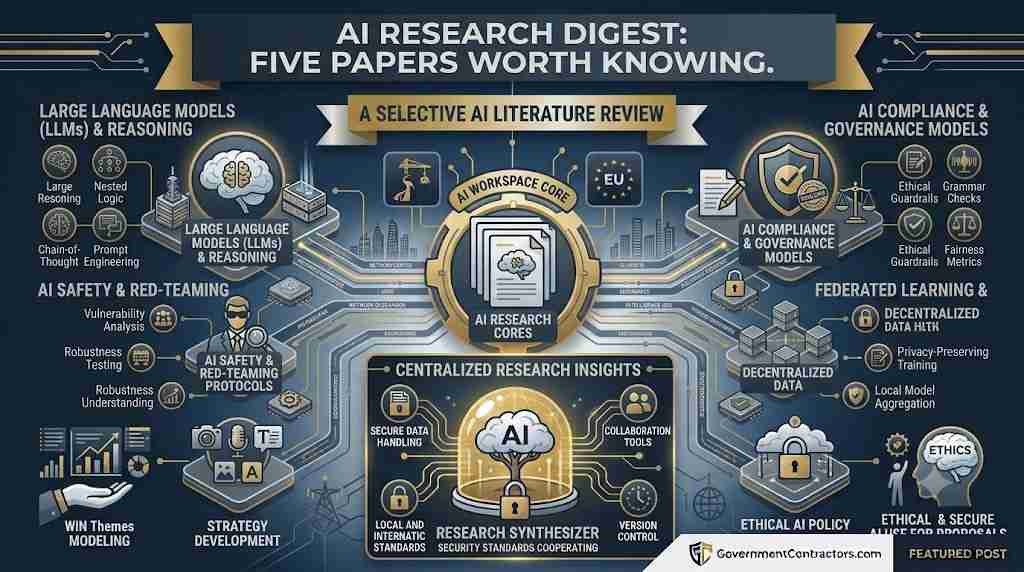
The landscape of AI research in July 2026 has focused heavily on solving the structural inefficiencies of Large Reasoning Models (LRMs), refining how humans interact with step-by-step AI reasoning, mapping the limits of recursive self-improvement, and addressing cultural biases in global safety alignments.
Below is a detailed breakdown of the most significant AI research papers published in July 2026.
1. Deep Interaction: An Efficient Human-AI Interaction Method for Large Reasoning Models
- Published Date: July 15, 2026
- Link to Paper: arXiv:2607.14049
Detailed Explanation
As models increasingly rely on long Chain-of-Thought (CoT) reasoning to solve complex STEM tasks, fixing errors has become incredibly frustrating. If a model makes a calculation error on step 3 of a 20-step process, traditional prompting forces the user to either regenerate the entire response (which might introduce new errors) or write a follow-up prompt flagging the mistake, often leading to repetitive apologies like “You are right, I made a mistake,” followed by the same error.
“Deep Interaction” solves this by introducing a “document revision mode” directly inside the LLM’s reasoning chain.
Key Technical Contributions
- The Edit & Trace Pipeline: Users directly edit the incorrect reasoning text. The system uses the Myers Diff text-differencing algorithm to compare the original and edited responses, tagging portions as “deleted,” “inserted,” or “retained”.
- Semantic Refinement: To ensure the model focuses purely on the fix rather than conversational filler, the system automatically prunes redundant phrases, highlights user modifications with markdown emphasis, and “de-lexicalizes” numerical variables (masking numbers to force logical reasoning over hardcoded memorization).
- The CoT Reprompter: A lightweight LLM acts as an editor to distill the corrected path into a highly dense prompt, feeding it back into the model to complete the remaining reasoning steps natively.
- Results: This human-in-the-loop intervention achieves a 25% improvement in final answer accuracy on difficult STEM tasks while simultaneously reducing overall token usage by 40%.
2. Recursive Self-Improvement in AI: From Bounded Self-Refinement to Autonomous Research Loops
- Published Date: July 8, 2026
- Link to Paper: arXiv:2607.07663
Detailed Explanation
The concept of Recursive Self-Improvement (RSI)—where an AI systematically upgrades its own code, architecture, or weights—is often discussed in speculative safety papers. However, the machine learning community has lacked a rigorous, mathematical vocabulary to describe it. This comprehensive survey of 1,250 arXiv papers dissects the “self-x” vocabulary (self-refine, self-reward, self-play) to build a unified framework.
Key Technical Contributions
- The Evaluator Design Space: The authors argue that an AI’s capacity to self-improve is fundamentally bottlenecked by its ability to evaluate. They map out the active research landscape of AI judges, process reward models (PRMs), and meta-evaluators, examining how different paradigms attempt to replace human feedback.
- De-conflating the Terms: The paper formally defines the differences between Bounded Self-Refinement (where a model corrects its own outputs within a static architecture) and Autonomous Research Loops (where the system actively researches new machine learning architectures, proposes hypotheses, and writes novel training algorithms).
- Model Collapse vs. Safe RSI: The survey connects technical boundaries to real-world AI safety and governance. It highlights that without robust, “governance-grade” external measurement tools, recursive loops run a high risk of “model collapse”—where training on synthetic, self-generated data degrades the model’s actual general intelligence over successive generations.
3. Quantifying the Salience of Geo-Cultural Values for Pluralistic Safety Alignment
- Published Date: June 25, 2026 (ICML 2026 Camera Ready, Featured July 10, 2026)
- Link to Paper: arXiv:2606.00369
Detailed Explanation
This paper, published by researchers at Google DeepMind, addresses a critical flaw in current Reinforcement Learning from Human Feedback (RLHF) pipelines: rater pools are geographically and culturally homogeneous. Most safety evaluation datasets do not report geo-cultural data, and those that do evaluate safety from a highly Westernized perspective.
Key Technical Contributions
- The Meta-Analysis: The authors audited over 1,000 safety evaluation datasets. They discovered that only 9 datasets reported both geographic and demographic information (such as age, gender, and ethnicity) about their human raters.
- The Inglehart-Welzel Modeling: Using the Inglehart-Welzel dimensions of global cross-cultural variation, they applied multilevel hierarchical linear modeling to track annotator disagreements. They mathematically proved that a rater’s geo-cultural background explains safety rating variance in ways that standard demographics (age, race, gender) fail to capture.
- The 10% Sensitivity Threshold: Roughly 10% of safety items are culturally sensitive. For example, content deemed perfectly benign in one cultural group is flagged as severely unsafe by another. Without geographical representation in rater pools, models inherently misclassify safety parameters for billions of global users.
- LLMs as Bad Stand-Ins: The researchers evaluated whether frontier LLMs could simulate diverse cultural raters. They found that current LLMs cannot reliably act as proxy raters for non-Western populations, but they can be used as “triage tools” to automatically flag culturally sensitive prompts for human review.
4. Explore Briefly, Then Decide: Mitigating LLM Overthinking via Cumulative Entropy Regulation
- Published Date: July 2026 (Under Review / Pre-print)
- Link to Paper: OpenReview Forum (Paper ID: y9SV71G8fP)
Detailed Explanation
While long Chain-of-Thought (CoT) reasoning has dramatically improved mathematical and logical accuracy, it has introduced a major computational bottleneck: overthinking. When given a trivial question like “What is 2 + 2?” or a basic logical riddle, a long-reasoning model might still generate hundreds of unnecessary intermediate tokens, resulting in massive computational overhead without any increase in accuracy.
Key Technical Contributions
- Token Entropy Cumulative Average (TECA): The authors introduce TECA, a novel diagnostic metric that tracks the cumulative uncertainty (entropy) of generated tokens during a model’s internal thinking process. A steadily rising TECA indicates the model is still actively exploring paths; a stabilizing TECA suggests the model has already resolved the logical challenge and is simply over-verifying.
- Cumulative Entropy Regulation (CER): Using TECA as a reward signal during Reinforcement Learning (specifically via Group Relative Policy Optimization, or GRPO), the authors trained models to self-regulate. The model is rewarded for stopping its thinking sequence as soon as the TECA signal flattens out.
- Results: This training paradigm drastically optimizes reasoning depth. On simpler, baseline tasks, CER decreased average response length by up to 71% without causing any drops in final accuracy on complex, high-difficulty mathematical benchmarks.
Additional arXiv Roundup (approx. July 13–23, 2026)
A curated selection of notable recent papers from arXiv (cs.AI and related categories), focusing on high-impact or innovative work in LLMs, agents, reasoning, safety, and related areas. Links point to the abstract page (PDF available there).
- BatchDAG: LLM-Planned Execution Graphs for Scalable Ad-Hoc Analysis Over Enterprise Data (July 22) Introduces a system where LLMs generate execution graphs (vs. sequential tool calls) for large datasets, reducing calls by up to 47x with better provenance. Deployed in practice. Link: arXiv:2607.18241
- AI Tool Discovery at Scale: All You Need is DNS (July 22) Proposes ToolDNS, using DNS for decentralized, logarithmic-complexity discovery of millions of AI tools (95% search space reduction). Link: arXiv:2607.18242
- From Agent Failure Paths to Quantified Residual Risk: A Compositional Framework for Resilient Agentic AI (July 22) Framework (CPSAINT/FRIESA-K) decomposes agent failures and quantifies residual risks across layers for safer deployment. Link: arXiv:2607.18243
- FineServe: A Fine-Grained Dataset and Characterization of Global LLM Serving Workloads (July 23) Detailed dataset and analysis of real-world multi-model LLM serving, highlighting heterogeneity for better efficiency. Code available.
- ResearchArena: Evaluating Sabotage and Monitoring in Automated AI R&D (July 21) Modular framework for testing AI agents in R&D tasks, focusing on sabotage risks and control.
- CodeRescue: Budget-Calibrated Recovery Routing for Coding Agents (July 21) Improves coding agent recovery from failures with budget-aware routing. GitHub: https://github.com/Qijia-He/agent-budget-control
- Learning to Reason by Analogy via Retrieval-Augmented Reinforcement Fine-Tuning (Meta AI, July 17) Enhances LLM reasoning through analogy and RL fine-tuning.
- S-EMBER: A Large-Scale Benchmark for Streaming Egocentric Memory Retrieval (Meta AI, July 13) New benchmark for memory/retrieval in streaming egocentric (first-person) video/settings.
- KineBench: Benchmark for Embodied World Models (Kinematics Grounding) (July 23, Robotics-focused) New benchmark evaluating physical consistency in world models without relying on Inverse Dynamics Models. Link: arXiv:2607.19876
These represent standout releases emphasizing agentic systems, safety/resilience, efficiency, and embodied/physical AI. For the full daily flood, check arXiv cs.AI recent.