5 Federal IT Trends for August 2026: AI Procurement Rules, a Shifting FedRAMP Bar, $75.7B in Civilian IT, CIO Turnover, and Skills-Based Hiring
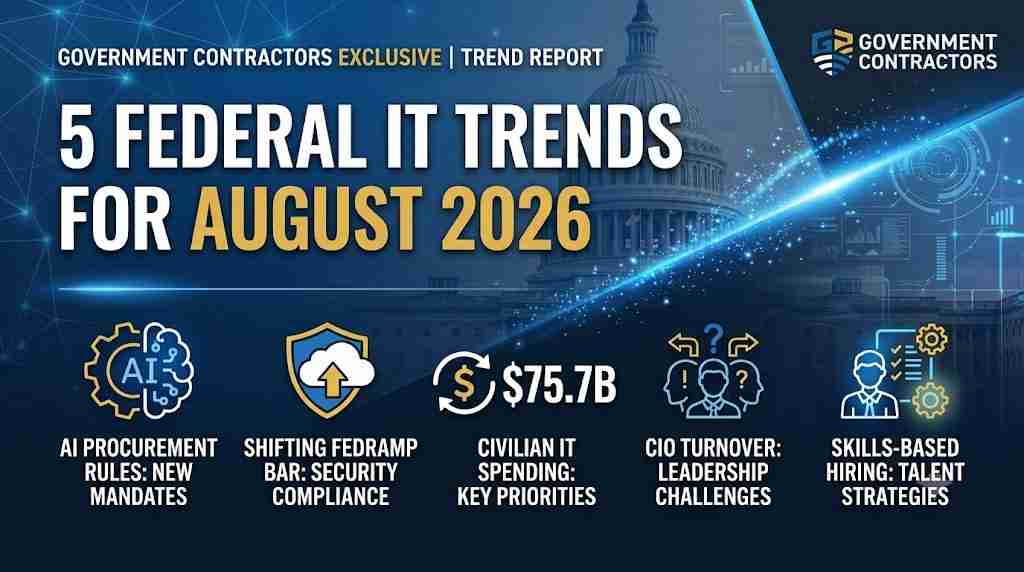
Five shifts are reshaping federal technology this month: contested GSA rules for buying AI, alongside the first bid protest alleging an agency used AI to score an award; a FedRAMP bar moving from certification toward patch speed; a record $75.7 billion FY27 civilian IT request landing amid heavy CIO turnover; billion-dollar customer experience awards; and skills-based hiring replacing degree requirements.
1. AI has moved from a tool agencies buy to a rule that governs how they buy
What happened: GSA’s draft acquisition rule for large language models drew sharply split industry comment — Palantir asked GSA to withdraw the rule outright, while most contractor associations asked for revision rather than withdrawal. In parallel, a contractor filed a protest alleging the Army improperly used AI in making a $450 million award, and an industry attorney predicted more protests on the same theory. GSA signed an agentic AI OneGov agreement with CORAS, and OpenAI’s GPT-5.6 models went live for government use through the FedRAMP-authorized ChatGPT Enterprise offering.
Why it matters: Two separate compliance questions just became live at once — how contractors use AI to produce proposals, and how agencies use AI to evaluate them. The protest theory is hard to prove unless agencies report AI use as high-impact, which makes AI use disclosure a coming point of contention.
Where it lands: Capture and proposal teams need an internal position on AI use disclosure before a customer asks. Market intelligence teams should track the GSA rule’s final form as a leading indicator for FAR-level language.
2. The cloud authorization bar is moving in two directions at once
What happened: A VA memo revealed the department will not require existing FedRAMP certification as a precondition for cloud contract awards. In the same window, the FedRAMP director publicly warned vendors slow to patch that they should stay out of government following the Hugging Face breach — and was subsequently placed on administrative leave over unrelated comments about veterans’ hiring preference.
Why it matters: The de facto security test is shifting from a certification artifact toward demonstrated patch velocity and operational responsiveness. That is a different sales conversation and a different proof burden.
Where it lands: If your differentiator was “we are FedRAMP authorized,” it is thinning. Mean-time-to-patch, SBOM discipline, and incident communication practices are becoming the substantive proof points.
3. Modernization funding and CIO authority are both unsettled heading into FY27
What happened: Federal CIO Greg Barbaccia is leaving government and returning to Palantir. HHS IT chief Clark Minor is on his way out. NIH named Maureen Falvella permanent CIO. The Senate stopgap would extend the Technology Modernization Fund’s deadline for financing new projects through December 11, a longer runway than the House version. The administration requested a record $75.7 billion for civilian agency IT in FY27, roughly $7.7 billion above expected FY26 spending, with 12 of the 23 large civilian agencies slated for increases. GAO separately found DOGE’s savings tally included figures that could not be substantiated.
Why it matters: Money is growing while the people who direct it are turning over. That combination reliably produces both delay and opportunity — new leaders re-open decisions their predecessors closed.
Where it lands: Refresh your account maps. A CIO change is a ninety-day window in which incumbency counts for less than it did the month before.
4. Customer experience and digital service delivery keep drawing real dollars
What happened: VA awarded Salesforce a $1.6 billion contract covering veteran care and services. GSA outlined a digital roadmap aimed at improving agency-delivered services and teased further Login.gov user experience work ahead of the platform’s ten-year mark next April. A tech-focused taxpayer services bill cleared Senate Finance. DHS plans to expand AI use in FOIA processing. USPS is exploring AI in hiring while publicly reassuring staff about replacement.
Why it matters: CX is no longer a soft category. It is showing up as billion-dollar platform awards, statutory mandates, and identity infrastructure investment.
Where it lands: Position CX work against measurable service outcomes — completion rates, call deflection, time-to-benefit — not design language.
5. Federal hiring rules are being rewritten around skills instead of credentials
What happened: The Senate Homeland Security and Governmental Affairs Committee advanced a bill to eliminate education requirements for federal contracting jobs. OPM told agencies to put technology recruiting at the center of staffing plans and set a governmentwide target that at least a third of external hires be early-career workers.
Why it matters: The acquisition workforce that will review your proposals is being rebuilt with different entry criteria and a younger profile. Separately, skills-based hiring norms in government tend to migrate into how contractors are asked to staff.
Where it lands: Staffing and training service lines have a clear hook here. So does any firm that can document skills-based qualification for key personnel rather than degree-based.