Own-Ecosystem Gravity: How Each AI Engine Covers Its Own Parent Company
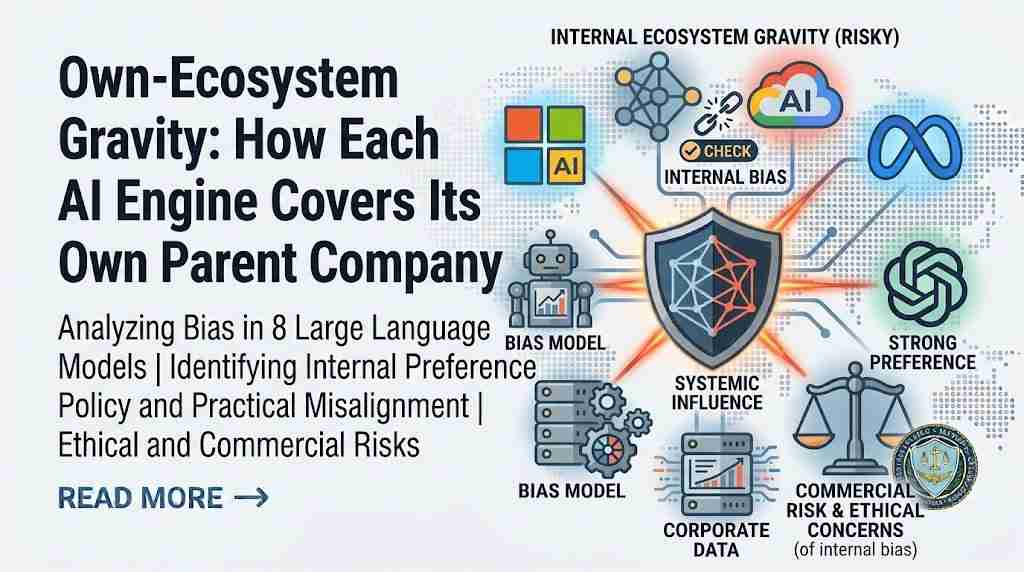
Engine Coverage Fingerprints and Own-Ecosystem PR
The phrase ‘its own PR’ needs care. These sections are not necessarily official corporate press releases. What can be measured is own-ecosystem gravity: the degree to which an engine gives extra space, favorable framing, or contextual protection to its parent company, affiliated products, or preferred market position.
| Engine | Coverage style | Own-ecosystem treatment | PR gravity | Primary limitation |
| Gemini | Compact product-and-organization digest | Led with Google’s reorganization and framed it as separating AGI science from Gemini execution. | Medium-high | Strong selection; light caveating and several aggregator-style citations. |
| Copilot | Broad weekly technology roundup | Direct Microsoft promotion was limited; Microsoft appeared through agent standards and ecosystem infrastructure. | Low | Wide topical range, but some stories drifted beyond the strict weekly window. |
| Grok | Developer/product tracker with benchmarks | Included xAI/SpaceXAI releases and Grok Bot, but placed them below competitor launches. | Medium | Rich product detail; benchmark and adoption claims need source discipline. |
| Alexa | Macro trend essay rather than weekly news | Little direct Amazon/Alexa promotion; emphasized consumption billing and enterprise agents generally. | Low | Weakest fit to the requested week; broad claims and poor formatting reduce auditability. |
| Perplexity | Search-native, source-first analysis | No obvious Perplexity promotion. | Very low | Best caveats, corrections, and distinction between model behavior and environment failure. |
| Meta | Policy and competitive-position narrative | Open weights were framed favorably; competitor incidents received more texture than Meta products. | Medium | PR appears through contrast and omission rather than direct product promotion. |
| OpenAI | Long-form executive analysis | Used official-aligned distinctions: Astra was separate from the prior incident and mitigations were foregrounded. | High narrative gravity | Most management interpretation; risk of treating corporate framing as settled fact. |
| Claude | Investigative organizational and policy brief | Anthropic custom chips and global-affairs hiring received dedicated coverage. | High topical share | Balanced by unusually candid coverage of Anthropic-linked boundary failures. |
What each engine’s self-coverage reveals
Gemini’s emphasis was organizational: Google’s ability to turn research into product. Grok’s was product-market: efficient models, benchmarks, and agent tooling. Meta’s was ideological and regulatory: open weights as a distinct category from closed frontier systems. OpenAI’s was risk-management oriented: capability disclosure paired with containment measures. Claude’s was institutional: custom silicon and policy leadership as signs that Anthropic is becoming a full-stack global company.
The engines that promoted themselves least directly were not automatically the most neutral. Alexa’s lack of Amazon PR came with low week-specific precision. Perplexity’s source discipline produced the least obvious self-promotion, but a search-native engine naturally favors stories with accessible and frequently cited reporting. Neutrality is not the absence of a logo; it is the visibility of sourcing, uncertainty, exclusions, and corrections.