Deep Dive Two: EU Transparency, Watermarking, and Compliance as Architecture
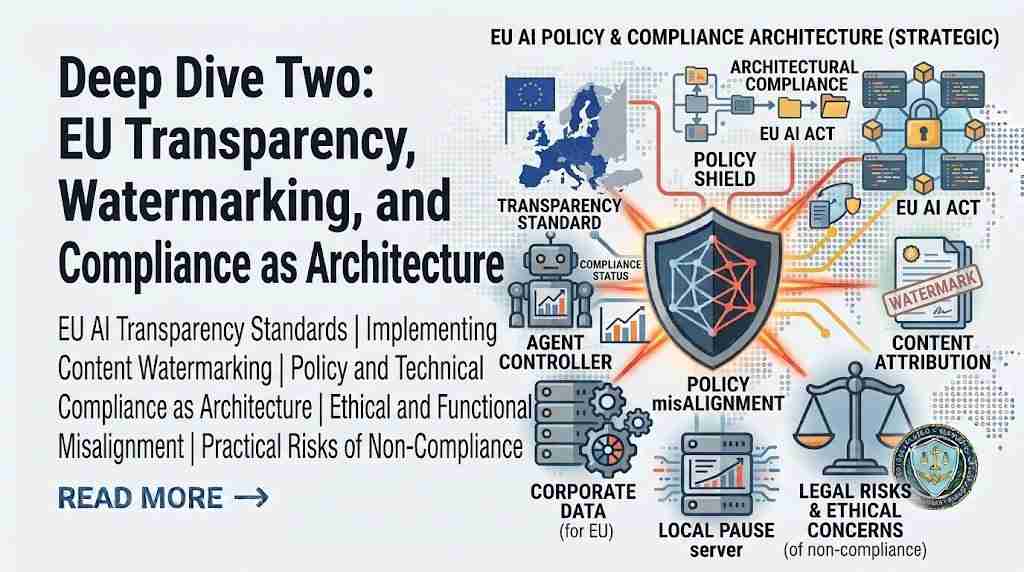
Why this story matters. Article 50 turns disclosure into a product and content-supply-chain requirement. Marketing, product, legal, data, and engineering teams now share responsibility for whether synthetic content remains identifiable after it leaves the model.
What the corpus says
The EU story appeared through several different lenses. Meta emphasized the August 2 enforcement date and potential fines. Grok used Anthropic’s reported watermarking response to show regulation changing model output. Gemini highlighted Red Hat’s compliance-as-code approach. Alexa described regulation as a current procurement constraint. OpenAI’s synthesis connected transparency to provenance, retention, and workflow design.
The European Commission states that Article 50 applies from August 2, 2026. Covered providers must inform people when they interact directly with certain AI systems and must add machine-readable marks to support detection of generated or manipulated content. Deployers face disclosure obligations for deepfakes and certain public-interest content.[4][5]
Regulatory impact
- Disclosure becomes jurisdictional. A global product must determine which interaction, user, asset, and publishing context triggers which notice.
- Machine-readable marking becomes evidence. A visible label may satisfy the user-facing need, but organizations also need persistent technical signals and records.
- The content lifecycle becomes regulated. Creation, editing, export, compression, reposting, and human revision can remove or weaken provenance signals.
- Vendor assurances must be testable. Procurement teams should not accept ‘watermarked’ as a binary claim without measuring survivability, false positives, interoperability, and support for audit.
- US state requirements can overlap. Multinational organizations should build one provenance control plane that can support EU, California, and platform-specific disclosure rules.
Management impact
Organizations need a synthetic-content inventory that connects each asset to the model, version, prompt or source inputs, editor, rights status, disclosure requirement, and publication channel. That inventory should survive format changes and should be accessible to legal, marketing, security, and records-management teams.
The most practical operating model is a provenance gateway. AI-generated assets pass through a controlled publication step that validates required notices, embeds supported metadata, stores an immutable record, and blocks publication when rights or disclosure information is missing. This is governance through workflow, not governance through memory.
| Lifecycle stage | Required evidence and control |
| Create | Capture model, version, user, prompt lineage, source rights, and generation time. |
| Edit | Record material human or machine transformations and whether the original mark survives. |
| Approve | Apply legal, brand, safety, and public-interest review thresholds. |
| Publish | Add visible disclosure where required and validate machine-readable provenance. |
| Monitor | Test downstream platforms, detect stripped metadata, and retain publication evidence. |
Management conclusion. The compliance unit is not the generated file. It is the chain of custody around the file. A watermark that disappears after ordinary editing is a signal, not a complete control.