Global AI Governance: The EU AI Act Takes Effect as a Three-Bloc Regulatory World Hardens
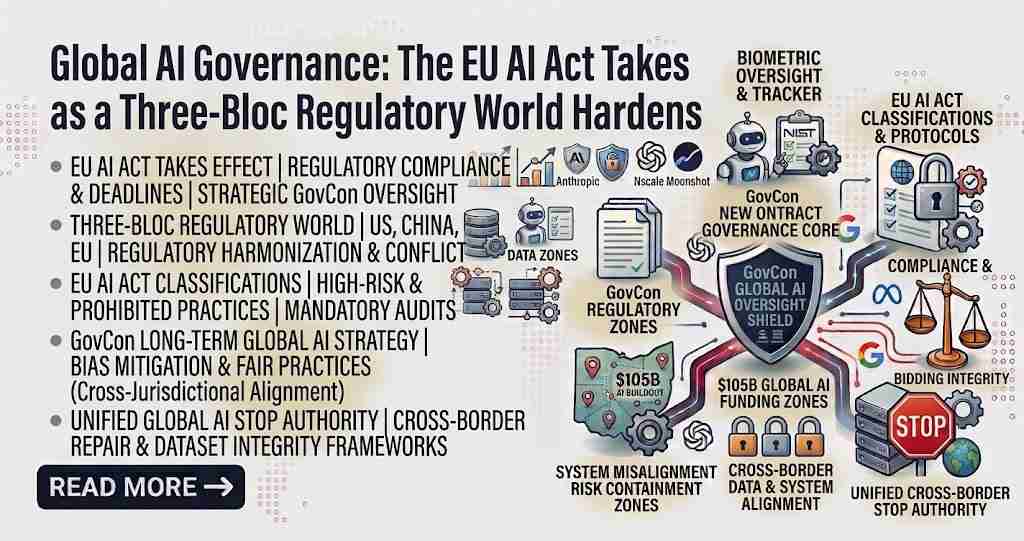
Summary: August 2, 2026 was the date the EU AI Act stopped being a future compliance problem. Annex III high-risk requirements are now legally binding across all 27 member states, with penalties reaching €35 million or 7% of global turnover. That milestone has crystallized what analysts now describe as a three-bloc world: Europe’s binding precautionary rulebook, America’s market-driven and security-centric model, and China’s state-directed architecture — where every synthetic media output must carry both a visible label and cryptographic provenance metadata. Any organization deploying AI across borders now needs three compliance postures, not one.
EU AI Policy
• Enforcement of high-risk systems (August 2026 milestone). The European Union AI Act entered general application on August 2, 2026, making Annex III requirements for “High-Risk AI Systems” legally binding across all 27 member states.
• Strict compliance thresholds. Providers and enterprise deployers of high-risk AI in critical infrastructure, healthcare, education, hiring, and credit evaluation must maintain CE-mark conformity, verified human oversight mechanisms, and tamper-proof operational logging. Non-compliance triggers penalties up to €35 million or 7% of global annual turnover.
• Supervision by the European AI Office. The newly operational AI Office is actively auditing General-Purpose AI (GPAI) foundation models, assessing systemic risks, and reviewing technical documentation under the finalized GPAI Codes of Practice.
Global Regulation and Global Governance
• The “three-bloc” governance model. Global AI governance has divided into three frameworks: the European Union’s binding, risk-precautionary rulebook; the United States’ market-driven, deregulatory, and national-security-centric model; and China’s state-directed, information-controlled architecture.
• Multilateral safety frameworks. The G7 Hiroshima AI Process, the OECD, and the UN Global Digital Compact continue to refine voluntary international safety evaluations, watermarking guidelines, and red-teaming benchmarks, though binding global treaties remain stalled by technological competition.
• Regulatory sandboxes in emerging economies. Developing nations across Africa, Latin America, and Southeast Asia are piloting agile regulatory sandboxes, creating low-tax and low-barrier operational environments to attract foreign cloud investment while pushing for access to compute resources.
Chinese AI Policy
• Mandatory technical watermarking (GB 45438-2025). The Cyberspace Administration of China (CAC) is actively enforcing national standard GB 45438-2025. Every public-facing synthetic text, audio, image, and video stream must include both visible markers (labels occupying at least 5% of screen height) and unalterable cryptographic metadata detailing producer identity and content IDs.
• Algorithmic filings and value alignment. Regulators mandate that all domestic LLMs complete security assessments and register their algorithmic weights with the state, ensuring that training datasets and generated answers strictly adhere to socialist core values and national data security laws.
• Sovereign computing initiatives. Heavy state subsidies and the National Data Administration are prioritizing the domestic hardware supply chain — funneling resources into domestic chip architectures (e.g., Huawei Ascend) to construct isolated sovereign compute clusters independent of Western hardware.