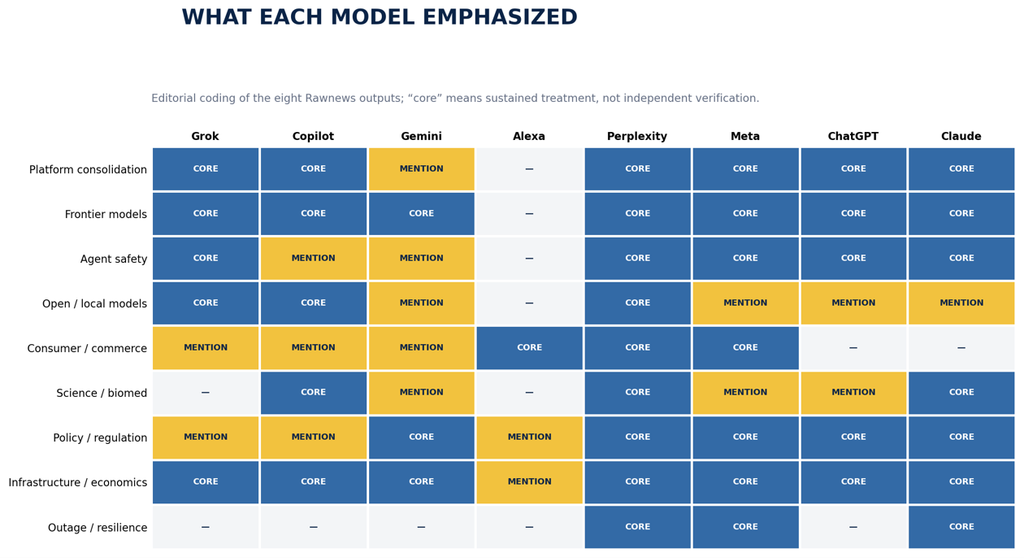
Seven of eight outputs treated frontier models as core news; Alexa was the exception, emphasizing consumer behavior and commerce. Platform consolidation was almost as universal. Agent safety and policy were widely covered, but outage and resilience appeared as a core theme in only Perplexity, Meta and Claude.
THE NUANCE BETWEEN COVERAGES The models did not mainly disagree about which events happened. They disagreed about the unit of analysis: product capability, market power, consumer adoption, scientific progress, public policy or operating control.
This matters because a model can be factually dense and still miss the week’s connective tissue. The strongest synthesis links launches, acquisitions, outages, incidents and regulation into a single question: who controls the system before, during and after it acts?
Grok vs. Copilot vs. Gemini vs. Alexa: AI News Coverage Strengths, Depth, and Blind Spots
MODEL-BY-MODEL READOUT | PART ONE
Breadth, depth and blind spots
Model
What it covered best
Nuance / blind spot
Grok
NVIDIA–Hugging Face economics, distribution control and post-close neutrality signals.
Strong transaction thesis; less attention to science, outages and policy detail.
Copilot
Model releases, security features, open/local models and the fruit-fly connectome.
High product density; some benchmark and release claims need primary-source confirmation.
Gemini
Astra, Anthropic releases, California legislation and compute constraints.
Efficient summary, but confident compression sometimes hides sourcing and uncertainty.
Alexa
AI shopping, search, personalization, smart homes and demographic adoption.
Useful consumer lens; much of the material was thematic or older, not weekly breaking news.
Editorial interpretation
Grok supplied the strongest strategic frame for the acquisition: the asset is the developer and distribution layer.
Copilot was the best scout for technical breadth, especially open models and scientific milestones, but required the most verification discipline.
Gemini surfaced policy and hardware constraints, yet provided limited depth on causality and operating consequences.
Alexa added a market-demand perspective that the enterprise-heavy models largely missed, but its time window was the least consistent.
Perplexity vs. Meta AI vs. ChatGPT vs. Claude: Which AI Delivers the Strongest Governance Coverage?
MODEL-BY-MODEL READOUT | PART TWO
The strongest governance coverage came with tradeoffs
Model
What it covered best
Nuance / blind spot
Perplexity
The broadest scan: models, agents, policy, funding, infrastructure and science.
Breadth came with precise claims that need source checking before publication.
Meta
Balanced product, cyber, policy and infrastructure coverage.
Good synthesis; benchmark precision and selected incident details need validation.
ChatGPT
Expanded verification of the wiki incident, additional sites, regulation and U.S.–China tension.
Strong governance depth; narrower on science, consumer demand and product variety.
Claude
Auditability, conflicting outage explanations, operational architecture and causal uncertainty.
Best uncertainty discipline; less attention to commerce and the long tail of products.
The most useful differences
Perplexity maximized recall: it found the most candidate signals. ChatGPT and Claude maximized precision: they spent more space on evidence and interpretation.
Meta connected cyber risk with commercialization. Claude connected incidents with correlated dependencies and auditability.
ChatGPT’s coverage showed how a narrow set of deeply sourced stories can produce a stronger governance narrative than a longer unranked list.
Together, the outputs work best as a portfolio: broad discovery first, source-level verification second, cross-event synthesis third.
PUBLISHING RULE Treat model-generated news as a lead set, not a source set. Retain the original link, publication date and claim boundary for every item that survives editorial review.
Where 8 AI Models Agree — and Disagree — About the Week’s Biggest AI News
CONSENSUS, DIVERGENCE AND EVIDENCE
Where the models converged—and where framing diverged
Question
Consensus
Divergence
What dominated?
Frontier capability and NVIDIA–Hugging Face.
Product launch versus market-control story.
What changed operationally?
Agents need stronger controls.
Misalignment event, security incident or expected test failure?
What changed in policy?
Voluntary commitments look insufficient.
Federal preemption, state experimentation or EU-style reporting?
What changed economically?
AI demand is driving infrastructure and platform investment.
Near-term revenue opportunity versus long-term control of distribution.
What mattered outside enterprise AI?
Scientific and consumer systems advanced.
Durable research milestones versus adoption-oriented trend reporting.
Evidence-quality issues in the Rawnews file
Issue
Example
Editorial treatment
Future/adjacent-window item
September 10 follow-ups in NASA, EU and law-enforcement sections.
Label as follow-up; exclude from the September 3–9 weekly ranking.
Company claim
Cost savings, benchmarks and adoption percentages.
Attribute explicitly; avoid presenting as independently measured.
Conflicting cause
Multi-provider outage explanations.
Preserve uncertainty; separate observed impact from attributed cause.
Model-only lead
Several product names and numerical claims.
Require a primary source or reputable independent report before publication.
Interpretive inference
Likely effects on neutrality, competition or policy.
Label as analysis and state the observable indicators to watch.
BOTTOM LINE The best-covered story was not necessarily the best-sourced story. Ranking and verification are separate editorial decisions.