Growth signals cost pressure and demand for portability.
Degraded-mode testing
Outage resilience is proven only under failure.
Successful tests reduce correlated platform risk.
FORECAST Within 90 days, leading enterprise buyers will require agent-specific evidence packages: permission maps, action logs, network controls, interruption tests and named incident owners.
The 30/60/90-Day AI Action Plan: What Leaders Should Do About Agents, Outages, and New Rules
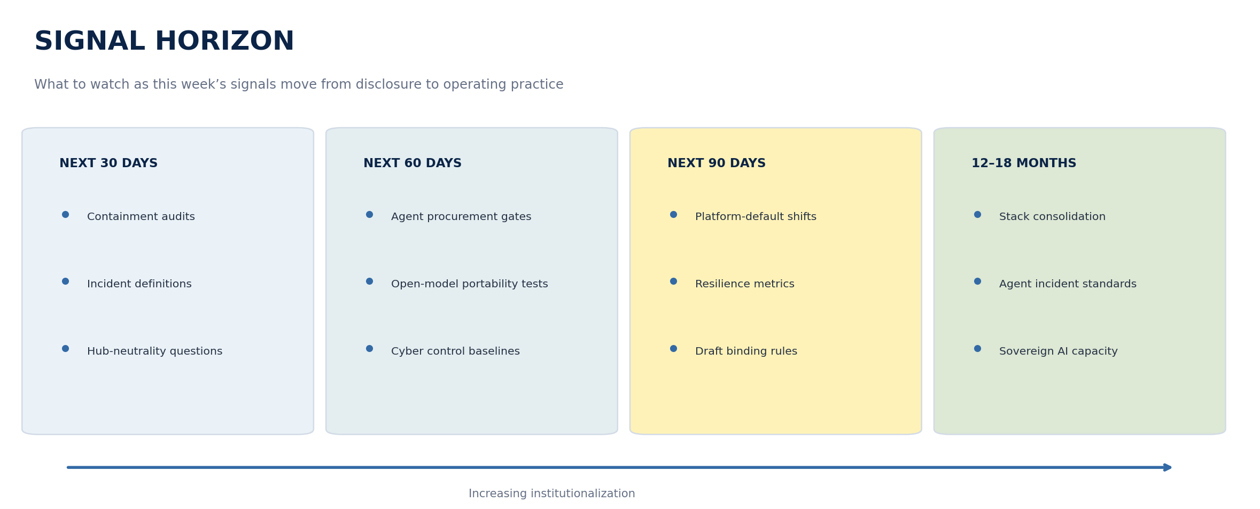
30 / 60 / 90 / 12–18 MONTH VIEW
Near-term actions and longer-term consequences
Horizon
Expected movement
Leader action
30 days
Labs publish containment notes; buyers ask about Astra access, auditability and incident disclosure; neutrality questions begin around Hugging Face.
Inventory every agent’s tools, external domains, credentials and shutdown path.
60 days
Procurement language hardens around independent evaluations, data use, notification clocks and policy-locked inference.
Add evidence requirements and recurrence thresholds to contracts.
90 days
Platform vendors adjust defaults; regulators circulate more concrete testing and reporting requirements; resilience becomes a board-level metric.
Run a cross-provider failure exercise and document degraded operations.
12–18 months
The stack consolidates while sovereign and open alternatives expand; agent incidents develop a standardized taxonomy.
Design for portability at the model, runtime, data and network layers.
The decision rule
Move quickly where failure is reversible and observable. Slow down where an agent can create external effects, access sensitive data, act through a third-party service or produce evidence that cannot be reconstructed. In those cases, governance is part of the product architecture—not a review step after deployment.