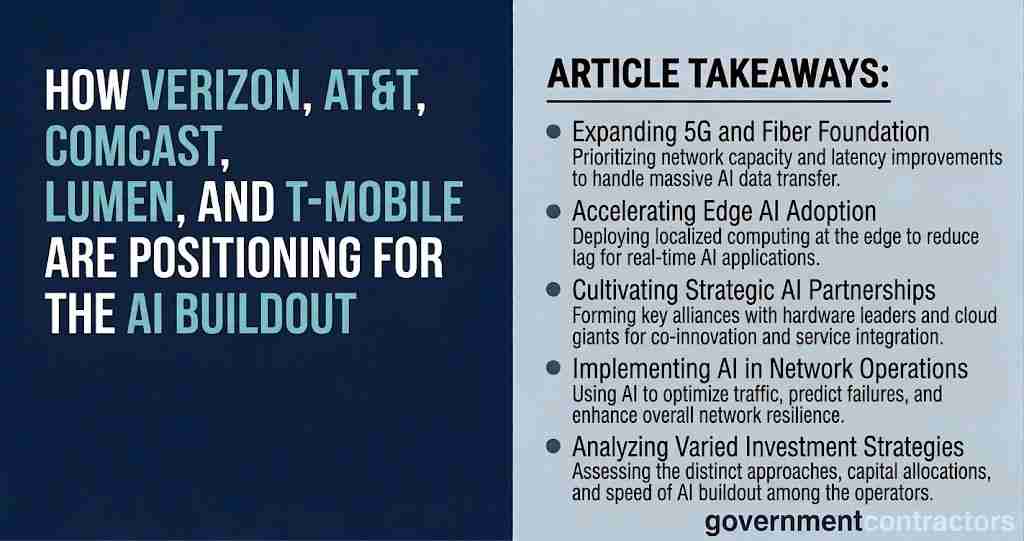
How Verizon, AT&T, Comcast, Lumen, and T-Mobile Are Positioning for the AI Buildout
INDUSTRY AND INSTITUTION WATCH | PART TWO
Telecom operator watch
| Header | News / signal of interest |
|---|---|
| Verizon | Signed a multibillion-dollar Corning agreement for more than 80 million miles of high-density fiber through 2032, positioning for broadband and AI data-center traffic. |
| Comcast | Warned of broadband subscriber pressure. Its AI story is therefore operational: network reliability, service automation, retention and monetization of a distributed edge footprint. |
| AT&T | Reported open models at roughly 40% of AI consumption, potentially rising to 60%, with large savings on suitable workloads; a cable-theft outage underscored physical-security risk. |
| Lumen | No standalone weekly AI launch. Competitive relevance centered on whether its existing backbone can deliver inter-data-center capacity faster than rivals can build. |
| T-Mobile | No major weekly AI product release. Capital-allocation pressure around Deutsche Telekom could shape investment in 5G-edge inference, automation and fixed wireless. |
What separates the operator strategies
- Verizon is leaning into new physical capacity and hyperscaler transport.
- AT&T is demonstrating internal model-economics and open-model portability.
- Comcast’s near-term AI case must show retention and operating leverage.
- Lumen’s advantage depends on activation speed and trusted interconnect.
- T-Mobile’s advantage remains proximity to a large 5G customer base, if capital follows the opportunity.