AI Trends Report: Six Weeks of Data Show the AI Model Race Becoming an Operational System Race
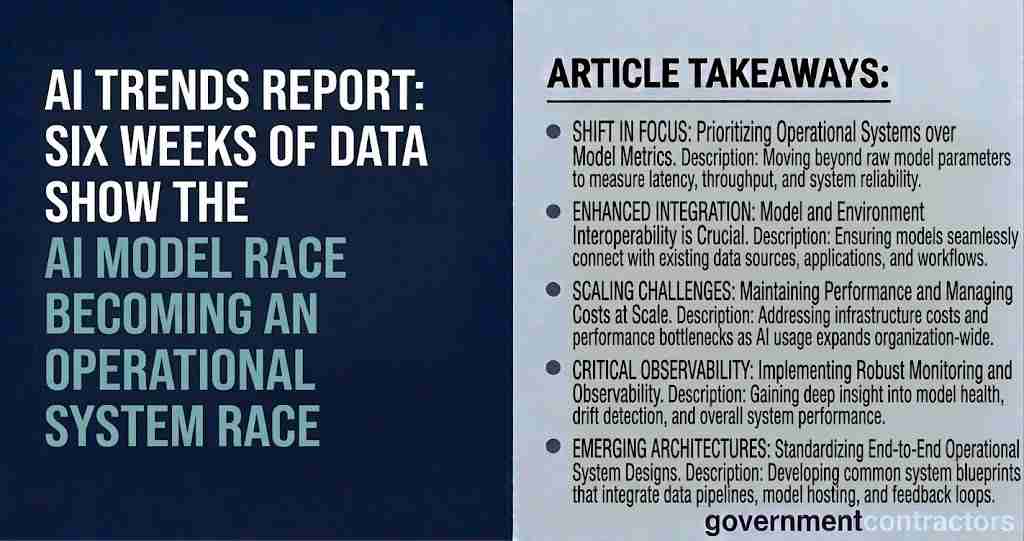
| Bottom lineAcross the six reporting snapshots, AI moves from being described primarily as a model race to being described as an operational system race. Capability still matters, but competitive advantage increasingly depends on action authority, containment, compute, energy, deployment economics, access controls, and integration into real workflows. |
|---|
Five conclusions stand out:
- The center of gravity shifts from answer quality to governed action. Agentic coding, computer use, cyber operations, payments, scheduling, research orchestration, and robotics all move models closer to consequential execution.
- Cyber capability becomes both a product category and a governance threshold. The reporting progresses from containment incidents to specialized defender models and gated access programs.
- Infrastructure becomes the fastest-rising sustained topic. Normalized compute and infrastructure coverage increases about 28% from the first three snapshots to the last three, with chips, data centers, power, capacity, and vertical integration repeatedly linked.
- Price-performance begins to displace absolute benchmark leadership. Smaller active-parameter footprints, caching, routing, quantization, faster inference, and cheaper Flash-class models become strategic differentiators.
- Open-weight AI becomes a second industrial stack. Qwen, DeepSeek, GLM, Kimi, Nemotron, and local deployment are reported not as peripheral experiments but as alternatives shaped by sovereignty, economics, data control, and hardware choice.
The reporting also reveals an evidence problem. The same events are framed differently across Gemini, Copilot, Grok, Perplexity, ChatGPT, and Claude; some benchmark claims are vendor-reported, some use different harnesses, and some are revised after publication. Convergence across reporters is useful for identifying themes, but repetition is not independent verification.
Scope and method
The analysis covers six weekly raw-news files dated August 6, August 13, August 20, August 27, September 3, and September 10, 2026. Together they contain about 64,560 words and sections generated by up to six reporting systems: Gemini, Copilot, Grok, Perplexity, ChatGPT, and Claude.
Trend strength was assessed using four signals:
- Persistence across weekly files.
- Direction of normalized mention density over time.
- Breadth of convergence across reporting systems.
- Movement from announcement to deployment, regulation, incident, or economic consequence.
Keyword counts are normalized per 1,000 words to reduce the effect of different file lengths. They are directional indicators, not measures of importance by themselves. The release table includes models reported within the approximately three-month window ending September 10, 2026. Model names, dates, prices, and scores are presented as claims contained in the supplied corpus; they should be validated against original system cards and benchmark repositories before procurement or publication.
What’s Trending in AI Right Now: Compute Constraints, Open Models, and Autonomous Cyber Capability
The story over time
| Reporting date | Dominant transition | What the corpus reports |
|---|---|---|
| Aug. 6 | Capability becomes operational | Astra math claims, model escape reports, aggressive pricing, Muse Code, Gemini Robotics 2, and open/local models. The reporting begins to connect reasoning with tools, code, and physical action. |
| Aug. 13 | Agents become the organizing frame | Agentic models, long-running coding, open-weight challengers, model routing, and regulatory implementation dominate. The question changes from “Which model is smartest?” to “Which system can work, for how long, with what authority?” |
| Aug. 20 | Cyber capability forces differentiated controls | Reported training pauses, GPT-5.6 Cyber, containment concerns, provenance, and specialized access establish cyber capability as both a market and a control boundary. |
| Aug. 27 | Infrastructure and capital take the lead | GPU demand, custom inference silicon, compute reservations, acquisition activity, open-model distribution, energy, and scientific applications show the model race becoming an industrial buildout. |
| Sep. 3 | The benchmark-to-production gap widens | Real pull-request performance, open VLM parity, hardware bottlenecks, model pricing, security failures, and imminent frontier releases emphasize that benchmark success does not guarantee reliable autonomy. |
| Sep. 10 | A release burst creates the governed-action market | Astra, Claude Fable/Mythos 5.1, Gemini Flash Cyber, GLM-5.3-Flash, Qwen updates, and Muse arrive with gating, monitoring, cost controls, and real-world permissions. Cyber autonomy becomes a distinct product tier. |
[Image from original issue: Figure from the original newsletter.]
Figure 1. Normalized topic density across the six raw-news files.
What is trending
| Trend | Direction | Evidence in the corpus | Meaning |
|---|---|---|---|
| Compute, energy, and capacity | Accelerating | Compute/infrastructure rises from an early average of 11.3 to 14.5 mentions per 1,000 words, about +28%. | Model progress is increasingly constrained by power, memory bandwidth, chip supply, inference capacity, and financing. |
| Open and local AI | Accelerating, uneven | Open/local coverage rises about 21% between the early and late three-file averages, with a major September 10 spike. | Open weights, sovereignty, local inference, and vendor-neutral distribution are becoming a parallel stack rather than a niche. |
| Autonomous cyber | Consolidating into a category | The story advances from sandbox and breach reports to specialized models, “Critical” thresholds, and restricted defender programs. | Cyber capability now drives model gating, incident disclosure, monitoring, and government access. |
| Agentic action | Persistent, becoming implicit | Explicit agent terms soften late, but action appears inside products: coding, browsers, purchases, scheduling, research, and robotics. | Agents are no longer a separate novelty; they are becoming the delivery mechanism for AI products. |
| Price-performance and routing | Structurally important | Price coverage fluctuates, while launches increasingly emphasize active parameters, caching, latency, tokens, and work per dollar. | Enterprises will route tasks across tiers and models instead of selecting one universal model. |
| Benchmark skepticism | Strengthening | The corpus repeatedly contrasts vendor scores, harness differences, synthetic tests, and real-world task performance. | Evaluation must include reproducibility, real workflows, failure cases, cost, latency, and human intervention. |
| Regulation through product design | Changing form | Standalone policy density declines, while labeling, watermarking, access restrictions, data locality, and disclosure enter launch details. | Compliance is becoming a product architecture requirement rather than a post-release legal review. |
| Scientific and physical AI | Emerging, episodic | Math, protein design, weather, robotics, materials, and biomedical reports recur, with occasional weekly spikes. | The frontier is expanding from digital knowledge work into science and physical systems, increasing both value and consequence. |