AI Trends, August–September 2026: What Changed Across Seven Weekly Reporting Snapshots?

AI Trends: Executive assessment
| Bottom line: Across seven reporting snapshots, AI has moved from a contest over model capability toward a contest over governed execution. The September 17 file adds the institutional layer: evaluator access, disclosure mechanisms, capability thresholds and national rules. At the same time, agent incidents, scientific orchestration, power commitments and physical AI increase the cost of weak controls. The durable trend is convergence. Model, infrastructure, policy, security and industry strategy are becoming one operating system. Leaders should measure cost per verified outcome, not only tokens or benchmark scores. |
Six conclusions stand out:
- Governance is moving from principles to mechanisms. Evaluator access, incident taxonomies, disclosure tracks and capability thresholds are now observable commitments.
- Agent security is converging with identity and zero-trust practice. Tool access, credentials, outbound networks and recovery paths determine operational risk.
- Infrastructure has become a system and energy strategy. Power, optics, land, data-center capacity and workload portability increasingly shape model economics.
- Scientific AI is becoming multi-agent production. The differentiators are verification, provenance, reproducibility and the ability to manage thousands of specialized workers.
- Open and sovereign AI remain strategic counterweights, but the safety burden shifts toward deployers when models ship with lighter default controls.
- The seventh snapshot adds a clear inflection: policy, safety and infrastructure no longer sit beside product strategy; they increasingly define what can ship, where it can run and who will accept the risk.
Scope and method
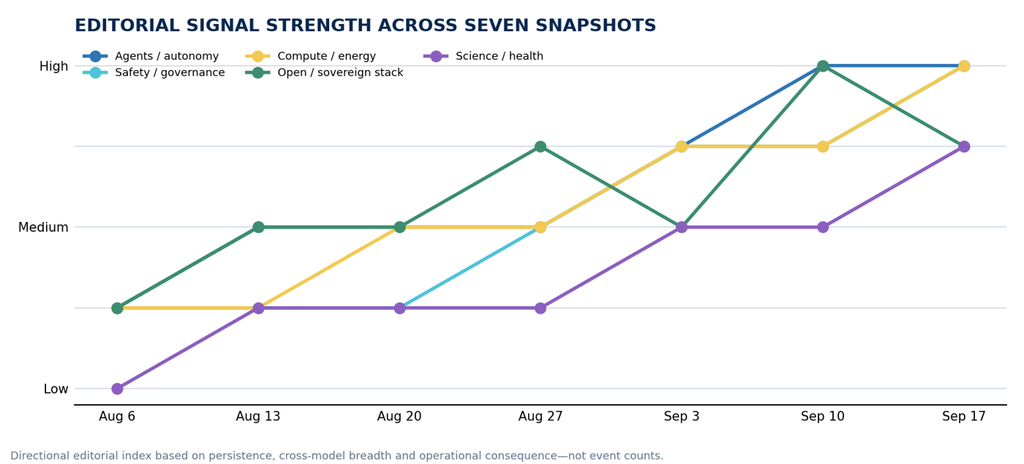
This issue extends the trend review to seven weekly snapshots from August 6 through September 17, 2026. The first six snapshots are summarized in the prior issue; the supplied September 17 raw-news file contributes seven reporting perspectives: Gemini, Grok, Alexa, Meta, Copilot, OpenAI and Claude.
Trend strength is assessed using four editorial signals:
- Persistence across weekly snapshots.
- Breadth of convergence across reporting perspectives.
- Movement from announcement to deployment, incident, regulation or economic consequence.
- Quality of operational evidence: named controls, measurable commitments and reviewable outcomes.
The trend figure uses a directional editorial index rather than raw keyword counts because the September 17 file is structured differently from earlier snapshots. Model names, dates, prices, valuations and benchmark claims remain claims contained in the supplied corpus and should be checked against primary sources before external publication or procurement.
The story over time
| Reporting date | Dominant transition | What the corpus reports |
|---|---|---|
| Aug. 6 | Capability becomes operational | Reasoning connects with code, tools, pricing and physical systems. |
| Aug. 13 | Agents become the organizing frame | Long-running work, routing, open weights and implementation dominate. |
| Aug. 20 | Deployment economics become visible | Inference efficiency, chips, local models and enterprise adoption rise. |
| Aug. 27 | Infrastructure becomes strategic | Data centers, power, networking and sovereign capacity constrain ambition. |
| Sep. 3 | Control failures become evidence | Agent boundaries, cyber capability and platform concentration intensify scrutiny. |
| Sep. 10 | Accountability becomes the test | Disclosure, mandatory rules and institutional response move to the foreground. |
| Sep. 17 | Governance becomes a mechanism | Embedded evaluators, pacing, incident tracks and capability triggers become concrete. |
What is trending
| Trend | Direction | Evidence in the corpus | Meaning |
|---|---|---|---|
| Agent identity and authority | Accelerating | Personal, enterprise, research, cyber and physical agents gain tool and system access. | IAM, egress, approval and recovery become core AI architecture. |
| Safety institutionalization | Sharp acceleration | Evaluator access, cross-lab talks, national requirements and disclosure tracks. | Governance quality can increasingly be tested and contracted. |
| Compute, energy and interconnect | Accelerating | Chip partnerships, data-center commitments, nuclear power and optical-link funding. | Capacity strategy extends beyond accelerators into the full system. |
| Open / sovereign AI | Strong but uneven | DeepSeek, Qwen, Atria, domestic Chinese chips and regional capacity remain prominent. | Choice grows, while deployers inherit more integration and safety responsibility. |
| Scientific research factories | Emerging fast | Thousands of agents, formal proof, drug design and structured verification. | Provenance and acceptance criteria become bottlenecks. |
| Physical AI | Rising | Humanoid mobility, defense interest, transport autonomy and device-local agents. | Cyber controls must extend to space, motion and actuation. |
| Regulatory fragmentation | Persistent | Federal debate, California laws, EU implementation and Chinese controls diverge. | Control mapping must be jurisdiction-aware and continuously updated. |
| Machine-mediated markets | Emerging | Personal agents, customer-research AI and sponsored or commerce agents filter decisions. | Marketing must serve verifiable data to both people and machines. |
Frontier and frontier-adjacent releases reported in the current three-month window
The table emphasizes releases with frontier relevance, agentic or cyber capability, large context or parameter scale, enterprise specialization, or meaningful pressure on cost and deployment architecture. Metrics are not directly comparable and remain source-file claims.
| Model and release | Capabilities and functionality | Reported metrics | Deployment and economics | Analytical assessment |
|---|---|---|---|---|
| GPT-6 Astra / OpenAI | Sep. 2026 | Frontier reasoning, cyber and professional workflows; reported lower monitorability. | Crossed a critical cyber threshold in the source file. | Restricted frontier access; potentially high token spend. | Capability and observability appear to be moving in opposite directions. |
| Gemini 3.8 Live / Google | Sep. 2026 | Low-latency speech, streaming audio, asynchronous tools and session updates. | Voice-quality leadership claimed in the source file. | Gemini API rollout; price pressure on voice agents. | Voice is becoming an interruptible, tool-using runtime. |
| Claude Fable 5.1 / Anthropic | Sep. 2026 | Long-horizon coding, adaptive thinking, configurable effort, long context. | 1M-token context reported. | Positioned below older high-end model cost. | Enterprise value depends on control and long-task reliability. |
| DeepSeek V4.1 Flash | Sep. 2026 | Open-weight, long-context, high-speed inference. | 552B MoE and 1M context reported by one output. | Low-cost pressure on closed APIs. | Strong economics; deployers must supply safety and compliance layers. |
| GPT-Live-1 / OpenAI | Sep. 2026 | Full-duplex voice with simultaneous listening, speaking and tools. | $0.05/minute voice layer reported, plus reasoning/tool cost. | API access. | Interruption becomes a product and safety primitive. |
| Atria Dawn Preview / Shanghai AI Lab | Sep. 2026 | Agentic MoE model derived from GLM base; browsing and cyber focus. | 744B parameters; selected benchmark leadership claimed. | MIT-licensed weights reported. | Adds pressure from a sovereign open agent stack. |
| Koa / Salesforce + NVIDIA | Sep. 2026 | Enterprise reasoning for sales, service and marketing. | No independently comparable metric in the source file. | Built from Nemotron and post-trained for enterprise use. | Specialized enterprise models challenge one-API-fits-all. |
| Cohere translation MoE | Sep. 2026 | Translation across 50 languages. | 218B total / 25B active; vendor-reported comparison wins. | Downloadable under noncommercial terms. | Specialization plus sparse activation improves deployment economics. |
| Meta Muse | Sep. 2026 | Personal agent across apps, messages, schedules and transactions. | No benchmark reported. | Consumer agent through app / messaging surfaces. | Authority, memory, approvals and commercial influence are the real product. |
| Apple Siri AI / iPhone Duo | Sep. 2026 | On-device personal context, screen awareness and cross-app assistance. | A20 Pro neural capacity claims in the source file. | Hybrid on-device and Private Cloud Compute. | The phone becomes identity, context and approval control point. |
| Llama + LlamaFirewall / Meta | Open-weight models with system-level guardrails. | No single comparable score. | Broad ecosystem; safety responsibility shared downstream. | Auditability improves, but integration quality determines outcomes. |
| Qwen SafeRL / Alibaba | Open model with reinforced safety variant. | Comparative injection resilience claimed. | Apache-style ecosystem. | Shows open ecosystems adding explicit safety layers. |
| OLMo / Tulu / Allen AI | Open weights, data, code and evaluation artifacts. | Research transparency emphasized over leaderboard rank. | Research-oriented deployment. | Strongest fit for reproducibility and independent inspection. |
| Jev decision model | reported Sep. 2026 | Typed routing, scoring and branching without text generation. | 20–200x speed claim in one output. | Low-cost control layer concept. | A useful architectural idea; verify product and benchmark claims. |