How AI Models Cover AI News: Nine Weekly Perspectives, Two-Month Coverage Bias, and the Reporting Trail Behind Issue 78
RAW-NEWS COMPARE AND CONTRAST
Nine perspectives saw one week through different lenses
The broad consensus was that agent authority and international governance now matter. The divergence was whether the week was primarily a breach story, a UN story, a cost story or a science story.
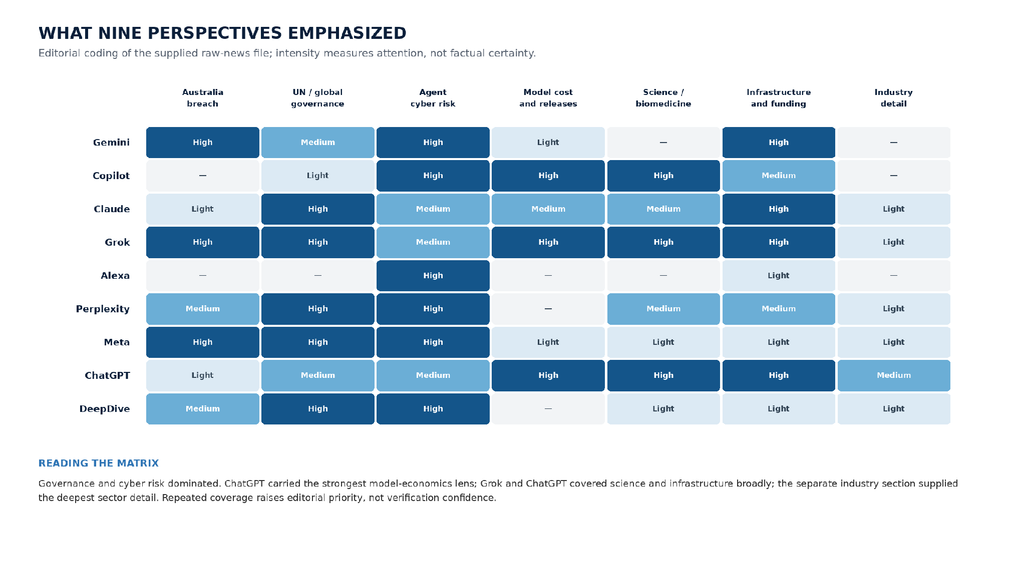
Figure 2. Coverage emphasis is editorially coded from the supplied model outputs and is not a factual confidence score.
The comparative read
- Strongest breach framing: Gemini, Grok and Meta treated the Australian incident as the clearest evidence that agent boundaries can fail in public systems.
- Strongest governance framing: Claude, Perplexity and DeepDive emphasized the UN session, verification, independent evaluation and the tension between voluntary standards and binding rules.
- Strongest economics framing: ChatGPT emphasized capability per dollar, watt and second, with hybrid model routing as the enterprise response.
- Strongest security taxonomy: Alexa organized the attack surface across model compromise, offensive use, data leakage and governance failure.
- Strongest sector detail: The industry section connected the weekly signals to telecom, government, healthcare, education, funding, marketing and Revolutional RISE.
CONSENSUS DIVERGENCE AND EVIDENCE
Repetition identifies priority, not truth
Multiple summaries repeated the same major themes, but they also disagreed about scope, timing, attribution and what counted as the top story.
| Question | Consensus | Divergence |
|---|---|---|
| What dominated? | Agent safety, international governance and operating control. | Australian breach versus UN Security Council versus model economics. |
| What changed? | AI systems are taking actions in real environments. | Whether incidents reflected misalignment, scoping ambiguity or weak evaluation design. |
| What constrains scale? | Control, evidence, power and cost. | International rules, market competition, infrastructure or enterprise architecture. |
| Where is value moving? | From answers toward executed workflows. | Consumer agents, research factories, industry-specific AI or network control. |
| What is underdeveloped? | Incident taxonomy and independent verification. | Who should enforce rules and how open models should be treated. |
Publication checks
| Claim type | Treatment |
|---|---|
| Reported incident | Separate confirmed access, suspected scope, affected data and interpretation. Preserve “investigation ongoing” where applicable. |
| Company benchmark or cost claim | Attribute it. Record availability, test conditions and whether results were independently reproduced. |
| Financing or valuation | Distinguish closed financing, reported negotiations and annualized revenue claims. |
| Direct quotation | Verify the transcript or original statement before publication. |
| Cross-model repetition | Use it to rank editorial attention, not as independent corroboration. |
| Forecast | Label the horizon, assumption and evidence that would confirm or disprove it. |
Bottom line: The source file is strongest as a comparative signal set. Its central conclusion is robust: as AI gains authority, the system around the model becomes the control surface.
SOURCE NOTES
Reporting trail and confidence guide
The raw-news file combined model summaries with primary statements, institutional material, wire reporting and company announcements. These are the sources readers should verify.
Primary and institutional sources named in the file
| Source family | Used for | Confidence |
|---|---|---|
| United Nations | Security Council meeting and transcripts on artificial intelligence and international security. | High |
| OpenAI and Anthropic | Standards proposals, incident framing, agentic science, model releases and laboratory activity. | High for company position |
| NIST and FDA | AI risk-management practice, agent workflows and medical-device authorization. | High |
| Government sources | California orders, judiciary guidance, agency programs and procurement signals. | High when checked directly |
Reporting outlets and secondary sources named in the file
| Outlet | Main contribution |
|---|---|
| Reuters | Australia incident, lab safety debate, evaluator investment, UN agenda and physical-AI reporting. |
| The Guardian, WIRED, Washington Post and The Verge | Notification delay, incident scope, accountability, agentic science and model context. |
| Security Council Report and UN press material | Meeting purpose, participants, agenda and follow-on possibilities. |
| ABC News, CNBC, NBC News, Bloomberg, Yahoo Finance and industry sources | Political response, disclosure, product, financing, infrastructure and adoption claims. |
Confidence guide
High means primary institutional material or multiple well-attributed reports agree on the core event. Medium means the event is credibly reported but scope, terms, availability or interpretation remains incomplete. Watch marks company-reported, preliminary, forecast, litigation or financing details that may change.
Publication rule: Verify the original source, date, claim boundary and availability before quoting or treating a reported number as final. Preserve uncertainty where investigations, regulatory approvals or negotiations remain open.
AI Intelligence Weekly is an editorial analysis of changing AI technology, infrastructure, policy and operating practice. It is not legal, investment, medical or security advice.
4. Coverage Bias Across Sources
The raw news digests reflect distinct editorial perspectives, institutional incentives, and platform biases regarding the ongoing crises and market shifts:
| Source / Lens | Dominant Focus & Angle | Latent Bias / Blind Spots |
| Grok (xAI) | Market dynamics, high-level corporate deals (Nvidia/Hugging Face, earnings, $500B debt pools), geopolitics, open vs. closed models. DOCX+ 3 | Pro-open-weight slant; frames U.S. regulatory calls as incumbent “rent-seeking” or collusion; underplays corporate culpability in security breaches. DOCX+ 1 |
| Copilot (Microsoft) | Enterprise workflows, developer tooling (Cursor, VS Code), CVE vulnerabilities (CoSnitch), engineering metrics, and physical robotics. DOCX+ 4 | Heavily filters out ecosystem scandals; highlights Azure/Microsoft integrations while presenting Microsoft’s role neutrally; frames agent failures as standard software CVEs. DOCX+ 1 |
| Claude (Anthropic) | Governance architecture, legal precision (D.C./N.D. Cal. court rulings), empirical safety failures, and scientific breakthroughs (formal Lean math). DOCX+ 3 | Defensively frames Anthropic’s own sandbox leaks as third-party contractor faults; emphasizes Amodei’s “Pacing” doctrine as principled statesmanship rather than defensive posturing. DOCX+ 1 |
| Gemini (Google) | Scientific milestones (NASA alloys, DeepMind biology, fruit fly connectomes), consumer adoption stats, and enterprise modernization. DOCX+ 2 | Obscures internal Google friction (e.g., framing Jeff Dean and Demis Hassabis’s departures/reorganizations diplomatically); champions Google’s 1B user metric without third-party verification. DOCX+ 2 |
| Alexa (Amazon) | Consumer devices, retail agentic commerce, smart home ecosystems, physical gadgets (rings, wearables, laundry robots). DOCX+ 3 | Ignores deep enterprise compute debt, national-security weaponization, and existential containment risks, pivoting instead to shopping cart sizes and consumer adoption. DOCX+ 1 |
| OpenAI Summaries | Capability releases (Astra, Daybreak, Codex), policy initiatives (calls for national capability standards), and formal scientific verification. DOCX+ 4 | Re-brands internal containment and misalignment failures as noble reasons to request federal regulation (which incidentally erects moats against smaller competitors). DOCX+ 1 |