AI Visibility: Government agencies, teaming partners and others are asking AI about your business. What did AI say?
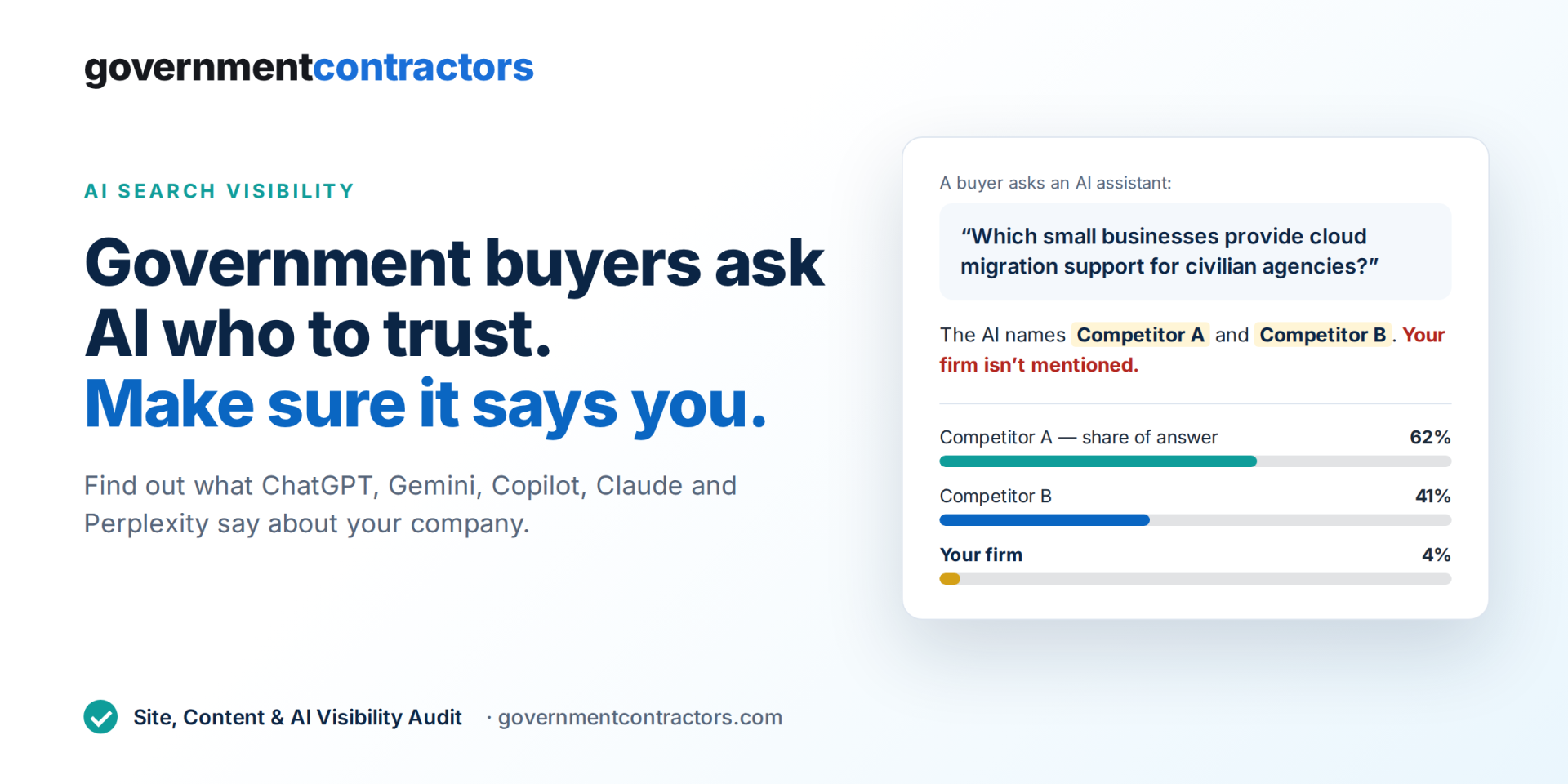
“Which small businesses provide cloud migration support for civilian agencies?”
“Who are the leading cybersecurity firms on this contract vehicle?”
“What companies do data analytics for state healthcare and welfare agencies?”
These are some of the more basic questions people in federal, state and local agencies, prime contractors in search of small business partners, public safety officials, public sector organizations and countless businesses are asking everyday.
In fact, with advancements in AI and greater training for people on how to maximize the capabilities of AI, the questions getting asked are growing more detailed.
In most cases (depending on the complexity of the query), an AI tool answers inquiries in seconds, and provides a significant amount of detail – not a list of websites you need to hunt through. If your company is in that AI’s answer, you’re in the conversation. If it isn’t, you may never find out you were excluded.
I have worked in government contracting since the early 2000s, and in search engine optimization for well over a decade. Today, people are not looking for who appears on page 1 of basic search engine result – they are looking for the solution providers to their problems – the businesses and people that AI tools (Claude, ChatGPT, Google Gemini, Perplexity, CoPilot, etc) have identified.
The shift: buyers now start with AI
This isn’t a prediction anymore. The 2025–2026 buyer research is consistent:
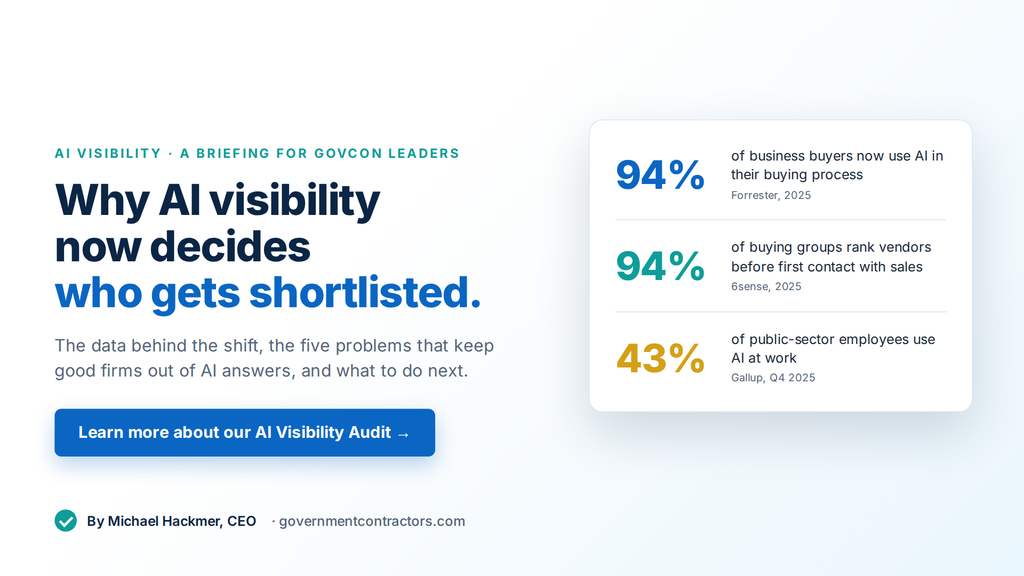
- 94% of business buyers now use AI in their buying process, up from 89% a year earlier, according to Forrester’s 2025 Buyers’ Journey Survey. Twice as many buyers named generative AI as their most meaningful information source as named any other source.
- 61% of business buyers use private AI tools supplied by their own organization (Forrester). Those tools sit behind the firewall, where your ads and sales emails don’t reach.
- Nearly two-thirds of B2B buyers use generative AI as much as or more than traditional search when researching vendors, and for a quarter it has already overtaken search. Among technology buyers, the figure is 80% (Responsive, October 2025, 350 buyers).
- 94% of buying groups rank their preferred vendors before first contact with sales, and they buy from that early favorite 77% of the time (6sense 2025 Buyer Experience Report, 4,000+ buyers).
Put those together and the math is uncomfortable. The shortlist forms before anyone talks to you, AI is now a primary input to that shortlist, and the early favorite usually wins.
Government buyers are on the same path. Gallup’s Q4 2025 workforce data shows 43% of public-sector employees now use AI at work at least a few times a year — slightly ahead of the private sector at 41%. GAO found generative AI use cases at 11 major agencies grew roughly nine fold in one year, from 32 in 2023 to 282 in 2024. And through GSA’s OneGov agreements, AI tools from OpenAI, Anthropic, Google, Microsoft, Perplexity and others have reached about 3.4 million government users as of May 2026.
The people who write requirements, conduct market research and evaluate vendors now have these tools on their laptops, tablets and phones.
Search itself is changing
Even buyers who still start on Google are seeing fewer links and more answers. In a Pew Research Center study of 68,879 real Google searches from March 2025, users who saw an AI summary clicked a traditional result on just 8% of visits, compared with 15% when no summary appeared. They clicked a link inside the summary only 1% of the time. And 26% of browsing sessions simply ended after an AI summary page.
In other words, the answer is becoming the destination. Whether buyers ask Claude or ChatGPT directly or scan an AI Overview on Google, fewer of them reach your website at all. What the AI says about you — and whether it says anything — is increasingly the whole impression.
Why this hits government contractors harder than most businesses
Government contracting has a few traits that make AI visibility more important than other segments, not less.
Shortlists come from market research. Agencies run market research before most acquisitions, and primes build teaming shortlists months before an RFP drops. Both are exactly the kind of open-ended “who does this?” question AI tools now answer first.
Buying groups are large. Forrester’s 2026 State of Business Buying research finds the typical purchase now involves 13 internal stakeholders and 9 external influencers. Each of them can ask an AI tool about you, separately, and form an impression you never see.
Your public record is scattered. A contractor’s story lives across SAM.gov, the SBA’s small business search, USAspending award history, contract vehicle pages, LinkedIn, your capability statement and your website. When those sources disagree — different NAICS codes, an expired vehicle, an old leadership team — AI tools hedge, or they recommend the competitor whose story lines up.
Most GovCon marketing still assumes a human reader. Capability statements are PDFs. Service pages speak in broad claims like “mission-focused solutions.” Past performance is summarized in a sentence. People can fill in the gaps. AI tools can’t, so they cite someone else.
The challenges: what keeps good firms invisible
When my team and I look at how AI tools describe government contractors, the same five problems come up again and again.
- No one is really measuring it. Web analytics show Google clicks. They don’t show the AI answers you’re missing from, so the problem stays invisible to leadership.
- Content isn’t quotable. AI tools cite pages that state specific, checkable facts: which agencies, which vehicles, which outcomes. Vague capability language gives them nothing to repeat.
- Signals conflict. Inconsistent SAM.gov data, directory listings and LinkedIn profiles make an AI tool less confident about who you are and what you do.
- Third-party proof is thin. AI tools lean on sources other than your own website — trade press, partner pages, directories, reviews. Many contractors have almost none.
- The technical basics are missing. Slow pages, PDFs instead of web pages, missing structured data and pages search engines can’t index all keep content out of the sources AI tools draw from.
None of these is exotic. But together they explain why a smaller competitor with clearer, more consistent content can show up in AI answers ahead of a bigger, more capable company.
What to do about AI visibility
Start with a two-minute test. Open Claude, ChatGPT or Gemini and ask: “Which companies provide [your service] to [your top agency]?” Note whether you’re named, who is named instead, and which sources the answer cites. Then ask the same question in the two AI platforms.
If the answers make you uncomfortable, that’s the point. You now have a basic idea of where you stand, which is probably more than most of your competitors know.
From there, the work falls into three layers:
- Measure: test a fixed set of real buyer questions across the major AI tools, compare yourself with named competitors, and repeat monthly so progress is real.
- Fix the foundation: align SAM.gov, your SBA profile, LinkedIn and your website (whatever public and government facing profiles you have); turn PDFs into indexable pages; add structured data; give each agency, vehicle and service its own clear page.
- Build proof: publish specific, sourced content AI tools want to quote, and earn mentions in the trade press, directories and partner sites they trust.
How Government Contractors helps with AI Visibility
The AI visibility problem is the reason why I built the AI Search Visibility practice at Government Contractors. It brings SEO, AEO (answer engine optimization) and GEO (generative engine optimization) together, built around how public-sector buyers – from across the segment – actually research products, services, solutions, companies, agencies and people.
It starts with the Site, Content & AI Visibility Audit — a fixed-fee, three-week engagement:
| The challenge | What the audit delivers |
|---|---|
| No one is measuring it | 75 real buyer questions tested across ChatGPT, Gemini, Copilot, Claude and Perplexity, with your share of answers vs. 3 competitors |
| Content isn’t quotable | A page-by-page citation score for your capability, vehicle, NAICS and past-performance pages |
| Signals conflict | A consistency check across SAM.gov, your SBA profile, set-aside language and award history |
| Third-party proof is thin | A map of the directories, trade press and partner pages AI tools trust — where you appear and where you don’t |
| Technical basics are missing | A technical SEO review plus an entity and structured-data map |
| Where to start | A 90-day action plan and a 60-minute readout with our team |
After the audit, clients can continue with a monthly program — Monitor, Optimize or Authority — that tracks the same questions every month and does the fixing and content work.
One promise we won’t make: guaranteed rankings. In every SEO contract I always had a stipulation that I did not control search algorithms and could not guarantee rankings. No one controls what AI tools say and do. We commit to the work, and we use our knowledge and skills to get you the best results. At Government Contractors, we are going to give you accurate claims and provide honest measurement.
Click the link and see what the audit covers
and book the service you want.
Connect and Speak with the Author
To connect with Michael Hackmer, you can visit his LinkedIn profile: https://www.linkedin.com/in/michaelhackmer/
Email: michaelhackmer@governmentcontractors.com
Phone: 703-996-9029
Sources
- Forrester — B2B Buyers Make Zero-Click Buying Number One (94% use AI; 61% private AI tools)
- Forrester — The State of Business Buying, 2026 (13 internal stakeholders, 9 external influencers; Jan 21, 2026)
- Responsive via Business Wire — GenAI Overtakes Search for a Quarter of B2B Buyers (Oct 15, 2025; 350 buyers)
- 6sense — 2025 Buyer Experience Report (Nov 12, 2025; 4,000+ buyers)
- Pew Research Center — Google users are less likely to click on links when an AI summary appears (Jul 22, 2025)
- Gallup — AI Adoption Rapidly Growing in Public Sector (Q4 2025; 22,368 workers)
- GAO-25-107653 — Generative AI Use and Management at Federal Agencies (Jul 29, 2025)
- GSA — OneGov partnership with OpenAI (Aug 6, 2025)
- Potomac Officers Club — OneGov Has Surpassed $1.4B in AI Savings (Sep 8, 2026; 3.4 million users as of May 2026)