The 10 Government Stories That Shaped the GovCon Market in Q3 2026
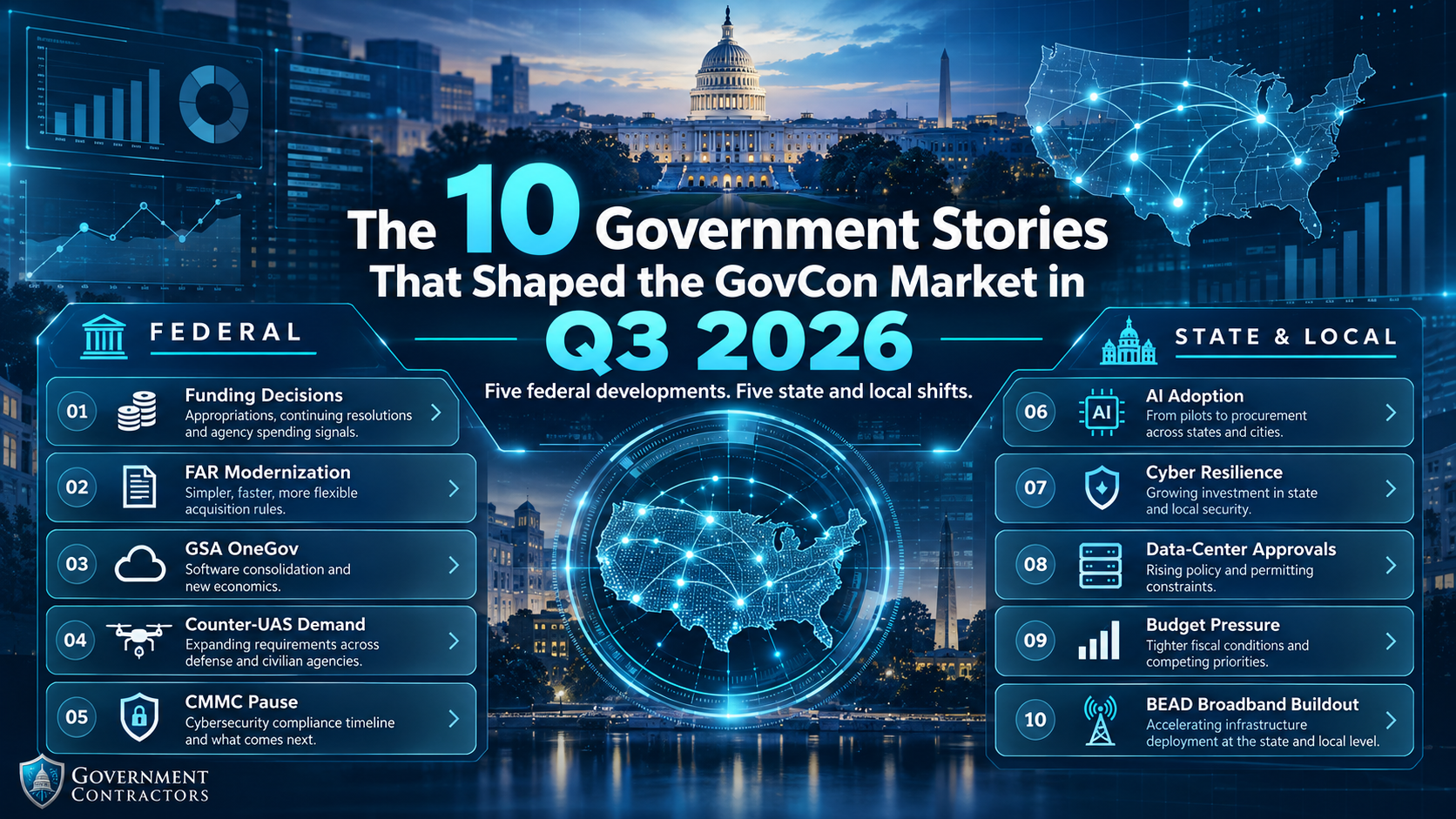
Five federal developments. Five state and local shifts. What happened—and what contractors should do next.
KEY TAKEAWAYS
- Follow funded work, not just announcements: appropriations, IDIQ ceilings, approved plans and actual task orders represent different levels of certainty.
- Federal acquisition and software-purchasing changes are reshaping contract terms and service economics, not eliminating established prime, reseller or teaming models.
- Cybersecurity and AI governance remain central: CMMC timing changed, while existing security obligations and state-specific oversight still require attention.
- At the state and local level, budgets, data-center approvals, cyber resilience and broadband buildout determine when legitimate demand becomes purchasable work.
- Reallocate business-development and capture capacity around verified funding, buyer access, compliance readiness and practical delivery milestones.
For the July–September 2026 period, Government Contractors reviewed a targeted selection of 46 dated reports from public-sector and defense news outlets. These ten recurring topics were chosen for business relevance and repeated coverage, not through a complete count of every article published. The central question for contractors is how to translate the signals into funded pursuits, sound pricing and realistic delivery decisions.
FEDERAL
Funding, acquisition policy, software economics, defense modernization and cybersecurity requirements set the conditions for federal pursuits.
01 FY2027 spending decisions create a gap between demand and funded work
The story. Through July and August, debate over the FY2027 defense authorization and appropriations bills left major program assumptions unsettled. A stopgap spending measure passed in September kept federal operations funded into December while lawmakers continued full-year negotiations. Industry reporting highlighted the practical consequences: executives at Anduril said planned production work under the Air Force Collaborative Combat Aircraft effort depended on FY2027 funding decisions. Authorization, appropriations, agency budget plans and signed task orders remained different things. [1, 2]
Why it matters. A prospective customer can have a genuine mission need without the authority or available funds to place an order on the advertised schedule. Under a continuing resolution, some new starts and production ramps can face limitations. Contractors relying on optimistic award dates risk overcommitting capture teams, hiring ahead of revenue or treating proposed spending as cash flow. [3, 4]
What contractors should do. Build a funding-confidence field into every major opportunity. Confirm the applicable appropriation and program line, acquisition milestones, existing obligations and the contracting officer’s expected order date. Stage hiring and bid spending against these checkpoints; distinguish “planned,” “authorized,” “funded” and “obligated” in pipeline reviews.
02 FAR modernization changes the rules contractors must read closely
The story. The Revolutionary FAR Overhaul continued moving through July–September as officials and industry examined revisions to federal acquisition policy, including commercial buying, negotiations, contract types and contracting-officer discretion. July coverage described the policy direction, August legal analysis explored proposed provisions, and September reports examined additional rewrites. The crucial limitation: proposals, agency deviations and final binding rules did not all have the same legal status. [5, 6]
Why it matters. Contractors may encounter different market-research expectations, competition procedures, commercial-item interpretations or risk allocations from one solicitation to another. Misreading a proposal as a universally effective rule could produce an inaccurate bid or an overlooked contract obligation. Small businesses have an additional reason to track possible interactions with set-aside and subcontracting requirements. [7, 8]
What contractors should do. Have contracts, capture and legal staff compare current solicitation language against existing templates. Track final rules and agency deviations, refresh compliance matrices and escalate unusual contract-type, indemnity, pricing or performance provisions before bid approval. Base decisions on the clauses incorporated into the actual solicitation—not a headline about reform.
03 GSA OneGov puts software pricing and implementation economics under scrutiny
The story. GSA advanced manufacturer-centered OneGov agreements during the quarter, focusing attention on government-wide pricing for software and AI services. The initiative prompted questions about how agencies acquire licenses, what happens when introductory discounts expire and where resellers or systems integrators contribute value. CACI leadership described one shift as a change in the order of the transaction: technology producers may anchor licensing while established partners perform implementation and related services. [9, 10]
Why it matters. For some technology contractors, license pass-through revenue could decline or become less attractive while integration, migration, cybersecurity, data management, training and managed services remain necessary. Less low-margin resale revenue can improve a reported margin percentage without necessarily increasing total gross profit. Agencies also need to evaluate renewal terms and the overall delivered cost—not merely the initial discount. [11, 12]
What contractors should do. Break every major solution into manufacturer licensing and separately priced services. Revisit teaming terms with OEMs, document implementation outcomes, model the price after promotional periods and secure visibility into renewals. Give account teams a clear explanation of what customers gain from your work beyond product procurement.
04 Counter-drone demand expands—but contract ceilings still are not orders
The story. The quarter brought several defense and homeland-security counter-unmanned-aircraft announcements. July and August reporting covered new task orders, an effort to build a digital counter-UAS marketplace and multiple-award contracts. In late September, the Army issued ten counter-drone IDIQ awards with a combined ceiling of about $4.15 billion. Contemporary reporting said only about $50 million was obligated at award, illustrating the difference between vehicle capacity and funded demand. [13, 14]
Why it matters. Sensors, electronic warfare, software, autonomy, integration and specialized component suppliers can see credible opportunities as agencies look for deployable systems. Yet a company may obtain vehicle eligibility without winning a task order. Rapidly changing technical standards and mission needs also reward teams able to demonstrate interoperability, field performance and production readiness. [15, 16]
What contractors should do. Map each procurement to its actual ordering authority, prime awardees and customer mission. Track obligated dollars and task orders separately from headline ceilings; validate technical interfaces, evaluation criteria and test evidence. Prioritize partners with a realistic customer path and the ability to field and support the solution. [17]
05 The CMMC Phase 2 pause changes timing, not the duty to protect data
The story. In July, Pentagon leaders suspended planned Phase 2 implementation of the Cybersecurity Maturity Model Certification program and launched a broader review, with particular concern about the assessment burden on smaller defense suppliers. August and September coverage followed the debate and the department’s regulatory actions. The postponement affected forthcoming third-party assessment requirements; it did not erase existing obligations to protect federal contract information and controlled unclassified information. [18, 19]
Why it matters. Defense suppliers faced a difficult planning problem: how much to invest immediately in external assessment preparations while details were under review. But they still had to maintain applicable security controls, customer commitments and contract compliance. A premature decision to halt cybersecurity remediation could create both delivery risk and future readiness problems. [20, 21]
What contractors should do. Check current solicitation and subcontract flow-down clauses before assuming an assessment is or is not required. Continue documenting relevant NIST SP 800-171 controls, incident-response procedures and remediation plans. Monitor formal DoD instructions and revise the timing of outside assessments as requirements become clear. [22]
STATE & LOCAL
Technology investment, infrastructure constraints and fiscal capacity vary sharply by jurisdiction. Contractors should evaluate state and local agencies individually rather than assume a national trend creates uniform demand.
06 State AI adoption moves from experimentation toward governed procurement
The story. July–September reporting showed state agencies increasing their attention to AI platforms, cybersecurity oversight and enterprise adoption. Oklahoma’s BEACON-related initiative illustrated an effort to organize AI capabilities for government use. California coverage described AI cybersecurity leadership at agencies, while Oregon and state CIO discussions showed how rules, model oversight and operational governance were evolving alongside adoption. [23, 24]
Why it matters. For GovTech vendors, the opportunity is broader than selling a chatbot. States may need data preparation, workflow integration, evaluations, staff training, security controls and ongoing monitoring. However, requirements differ across jurisdictions; a solution approved in one state may not satisfy another state’s procurement, privacy or AI-governance expectations. [25, 26]
What contractors should do. Build a state-by-state account map of AI policies, procurement rules and approval authorities. Lead with specific measurable use cases and clear explanations of data access, human oversight, model evaluation, record retention and auditability. Prepare procurement-ready documentation instead of relying on a generic AI product pitch. [27]
07 State and local cyber resilience becomes an operational procurement priority
The story. The quarter included reports of a coordinated cyberattack affecting water utilities in Minnesota communities, a Pennsylvania increase in cybersecurity and digital-services funding, concerns about critical-infrastructure gaps, and Georgia’s adoption of GovRAMP for state cloud-service vetting. These were distinct incidents and policies, but together they demonstrated the range of resilience and assurance issues confronting state and local buyers. [28, 29]
Why it matters. Utilities, transit agencies, counties and state departments depend on aging operational technology and cloud systems, often with lean security staff. Contractors offering monitoring, segmentation, incident recovery, modernization or assessed cloud services may find mission-driven needs. Winning those projects nevertheless depends on local budget authority, procurement access and proof of a practical deployment plan. [30, 31]
What contractors should do. Identify agencies with documented threats, funded improvement plans or new cloud-assurance requirements. Show relevant certifications, recovery procedures, OT capabilities, staffing capacity and measurable risk reduction. For cloud offerings, check whether a particular state requires GovRAMP or other authorization evidence.
08 Data-center development faces new state and local approval constraints
The story. As AI infrastructure projects expanded, governments debated their effects on electricity costs, water use, land use and nearby communities. In July, New York imposed a one-year pause on permitting new hyperscale data centers. August reporting followed the spread of local moratoria and tracking efforts, while September articles described additional scrutiny in Virginia and proposals in Chicago. A proposed restriction and an enacted restriction are not equivalent, and each jurisdiction has its own scope. [32, 33]
Why it matters. Construction, engineering, energy, networking and IT suppliers can invest considerable pursuit time in announced campuses that later stall at zoning, grid interconnection or permitting. The mission and demand may be real, but award timing depends on site readiness and local acceptance. The exposure is especially material for firms whose contracts depend on facility energization or phased construction. [34, 35]
What contractors should do. Check each prospective site’s permitting status, utility interconnection, water availability, local standards and community agreements. Require documentary project milestones before assigning senior teams or ordering long-lead equipment. Diversify the pipeline across approved, under-construction and early-concept projects. [36]
09 State and local budget pressure complicates modernization purchases
The story. Across the quarter, coverage examined fragile budget assumptions, uneven revenue growth, potential shifts in SNAP administration costs and uncertainty surrounding federal grants. Technology modernization remained important, but officials had to weigh near-term affordability, staffing obligations and local funding capacity. The reporting did not describe a single nationwide budget emergency; it highlighted different pressures facing different jurisdictions. [37, 38]
Why it matters. An attractive modernization proposal can be delayed, narrowed or restructured if a state or locality lacks the required match, appropriations or grant certainty. Contractors may face longer sales cycles, smaller initial scopes or changes to procurement schedules even when the agency supports the underlying mission. Solutions that quantify fiscal savings or legally mandated outcomes may be easier for buyers to defend. [39, 40]
What contractors should do. For each targeted account, confirm enacted budgets, grant award status, match requirements and who has authority to spend. Offer phased scopes with explicit cost and outcome measures. Maintain a pipeline category for compelling but unfunded opportunities rather than forecasting them as imminent awards. [41]
10 BEAD moves closer to construction while project-level execution risk remains
The story. The $42.45 billion Broadband Equity, Access and Deployment program moved through revised location assessments and plan reviews during July and August. By late August, the National Telecommunications and Information Administration had approved final proposals from all 56 participating states and territories. September reporting examined remaining mapping questions, guidance on unspent funds and the shift toward delivering actual networks. [42, 43]
Why it matters. Broadband construction, fiber engineering, network equipment, permitting, program management and other services can benefit as projects leave the planning stage. But federal approval of a state plan is not the same as a confirmed award for each local subgrantee. Serviceable-location lists, match requirements, site permissions and performance milestones can still alter project economics or timing. [44, 45]
What contractors should do. Track the states’ executed subgrantee awards and enforceable build schedules, not only federal announcements. Validate address-level service data, technology selection, construction permits, labor availability, backhaul costs and required matching funds. Pursue work packages tied to identifiable, approved locations and delivery milestones. [46]
The decision contractors should make now
• Audit the top pursuits for evidence of appropriated or awarded funding, accessible vehicles and real buying authority; move weakly qualified opportunities out of the near-term forecast.
• Review the economics and compliance of current proposals: delivery margins, OEM partnerships, updated FAR clauses, security requirements and state-specific procurement rules.
• Revisit workforce allocation. Assign senior capture, technical and relationship-building capacity to opportunities with demonstrable mission need, credible customer access and near-term execution potential.
The opportunity is not simply to follow ten headlines. It is to distinguish funded demand from market noise and direct attention to the accounts where a contractor can win, deliver and sustain value.
Sources and further reading
All 46 article references in the Q3 research workbook are listed below and grouped by the corresponding topics. Dates are publication dates recorded in the workbook; links lead to the originating publications. Opinion and legal-analysis sources provide context rather than binding government requirements.
F01 FY2027 spending decisions create a gap between demand and funded work
[1] Breaking Defense · Jul 22, 2026. House passes 2027 NDAA while measure remains stalled in Senate. Read source
[2] Breaking Defense · Aug 27, 2026. The fight over the FY27 defense budget is on. Read source
[3] Government Executive · Sep 1, 2026. House passes stopgap spending bill. Read source
[4] Breaking Defense · Sep 15, 2026. Anduril says CCA production work depends on FY27 appropriations. Read source
F02 FAR modernization changes the rules contractors must read closely
[5] Nextgov/FCW · Jul 23, 2026. Acquisition overhaul is providing discretion for tech adoption. Read source
[6] SmallGovCon · Aug 21, 2026. Reviewing RFO proposed rules Parts 5, 24, 29 and 52. (Legal analysis) Read source
[7] Washington Technology · Sep 18, 2026. FAR Overhaul targets commercial buying and negotiations. Read source
[8] Washington Technology · Sep 21, 2026. FAR overhaul expands flexibility on contract type. Read source
F03 GSA OneGov puts software pricing and implementation economics under scrutiny
[9] Nextgov/FCW · Jul 16, 2026. GSA eyeing OneGov savings beyond software and tech. Read source
[10] Nextgov/FCW · Aug 11, 2026. How OneGov is changing CACI’s contractor role. Read source
[11] Nextgov/FCW · Aug 13, 2026. OneGov savings balloon as AI contracting evolves. Read source
[12] Washington Technology · Sep 2, 2026. Industry offers playbook for OneGov deal expirations. Read source
F04 Counter-drone demand expands—but contract ceilings still are not orders
[13] Breaking Defense · Jul 30, 2026. JIATF-401 awards CACI $500M for non-kinetic counter-UAS. Read source
[14] DefenseScoop · Aug 4, 2026. Counter-drone hub taps Kaizen for online marketplace. Read source
[15] Washington Technology · Aug 3, 2026. 12 firms win DHS counter-unmanned aircraft vehicle positions. Read source
[16] Breaking Defense · Sep 29, 2026. Army announces multiple counter-drone IDIQ awards. Read source
[17] Washington Technology · Sep 30, 2026. Army awards counter-drone contracts worth more than $4B. Read source
F05 The CMMC Phase 2 pause changes timing, not the duty to protect data
[18] DefenseScoop · Jul 13, 2026. DoD halts forthcoming CMMC Phase 2 requirements. Read source
[19] DefenseScoop · Jul 17, 2026. Pentagon CMMC review task force begins work. Read source
[20] DefenseScoop · Aug 20, 2026. Pausing CMMC cannot mean pausing accountability. (Opinion) Read source
[21] Nextgov/FCW · Sep 9, 2026. CMMC Phase 2 suspension locked in with binding regulation. Read source
[22] Federal News Network · Sep 14, 2026. Cyber AB’s Matthew Travis on CMMC reform. (Interview) Read source
S01 State AI adoption moves from experimentation toward governed procurement
[23] StateScoop · Jul 24, 2026. Oklahoma debuts BEACON enterprise AI platform for agencies. Read source
[24] StateScoop · Aug 14, 2026. California directs agencies to add AI cybersecurity officers. Read source
[25] StateScoop · Sep 14, 2026. State CIOs address AI infrastructure and governance. (Panel / reporting) Read source
[26] Government Technology · Sep 24, 2026. Digital States 2026: AI moves from experiment to infrastructure. (Survey analysis) Read source
[27] Government Technology · Sep 25, 2026. Oregon executive order sets frontier AI procurement safeguards. Read source
S02 State and local cyber resilience becomes an operational procurement priority
[28] StateScoop · Jul 28, 2026. Coordinated cyberattack disrupts Minnesota water utilities. Read source
[29] StateScoop · Aug 13, 2026. Pennsylvania increases cybersecurity and digital-services budgets. Read source
[30] StateScoop · Sep 10, 2026. State CIOs highlight cyber gaps in critical infrastructure. (Research coverage) Read source
[31] Government Technology · Sep 11, 2026. Georgia adopts GovRAMP for state cloud services. Read source
S03 Data-center development faces new state and local approval constraints
[32] Government Technology · Jul 14, 2026. New York announces statewide hyperscale data-center moratorium. Read source
[33] Government Technology · Aug 19, 2026. NLC launches tracker for local data-center actions. Read source
[34] Governing · Aug 20, 2026. Data centers spreading—and so are moratoria. Read source
[35] Government Technology · Sep 18, 2026. Virginia moves toward data-center oversight and energy accountability. Read source
[36] Government Technology · Sep 23, 2026. Chicago mayor proposes yearlong data-center moratorium. Read source
S04 State and local budget pressure complicates modernization purchases
[37] Governing · Jul 28, 2026. A fiscal year built on assumptions already under stress. (Opinion) Read source
[38] Governing · Aug 6, 2026. State tax revenues stabilize while budget pressures continue. (Research analysis) Read source
[39] Governing · Aug 25, 2026. Federal SNAP cuts could affect local property tax bills. Read source
[40] Government Technology · Sep 16, 2026. NASCIO study identifies state modernization trade-offs. (Research coverage) Read source
[41] Governing · Sep 28, 2026. Federal grant uncertainty’s challenges for local governments. (Opinion) Read source
S05 BEAD moves closer to construction while project-level execution risk remains
[42] StateScoop · Jul 16, 2026. States review satellite BEAD eligibility after new mapping data. Read source
[43] StateScoop · Aug 26, 2026. NTIA approves final BEAD proposal from all states and territories. Read source
[44] StateScoop · Sep 2, 2026. GAO identifies BEAD mapping and sustainability challenges. (Research coverage) Read source
[45] StateScoop · Sep 4, 2026. NTIA clarifies leftover BEAD funding for true-up round. Read source
[46] Governing · Sep 8, 2026. Federal broadband program moves toward actual construction. Read source