10 Weekly AI Prompts for Government Contracting Professionals
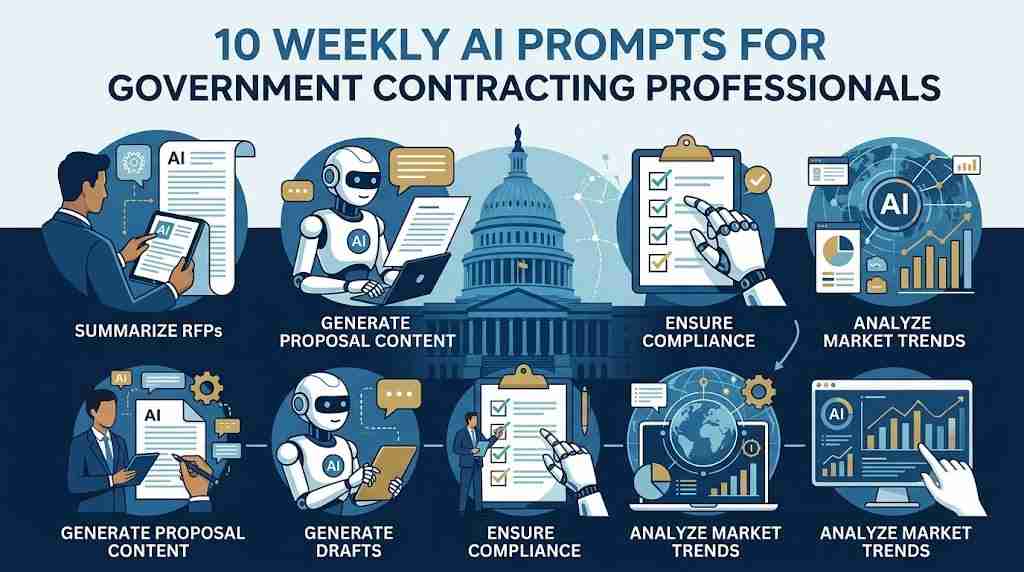
A 360° view into the GovCon and public sector market — designed to enhance your knowledge, grow your network, and increase your visibility in the office and on social media. Works for any role: executive, sales, marketing, capture, contracts, legal, HR, delivery.
How to use this resource: Run each prompt once a week in your AI tool of choice (Claude, ChatGPT, Gemini, Copilot). Total time: 60–90 minutes per week if batched, or 10–15 minutes a day. Customize the [BRACKETED] fields to your role, agencies, and market. Examples shown below are done in Claude using Fable 5 and Opus 5, which may not be necessary for you to get the same results.
1. The Weekly News Scan — “What’s Hot in GovCon”
The Prompt
“Using the outlets in my GovCon media list (You will need to create a spreadsheet of GovCon Media sources and other media that you want to use for this query), scan the past 7 days of federal and public sector news. Give me: (1) the 5 biggest stories affecting government contractors, (2) a 2-sentence ‘why it matters’ for each, (3) one story most people are missing, and (4) one talking point I can raise in a meeting this week. My focus areas are [AGENCIES / MARKETS, e.g., DoD, DHS, civilian IT, SLED].”
Steps to Execute
- Open your AI tool with web search enabled (or paste in headlines from your top 5–10 outlets).
- Paste the prompt with the media spreadsheet link and your focus areas filled in.
- Skim the output; click through to verify the 2–3 stories you plan to repeat out loud.
- Save the “talking point” to a running notes doc and use it in your next standup, pipeline review, or client call.
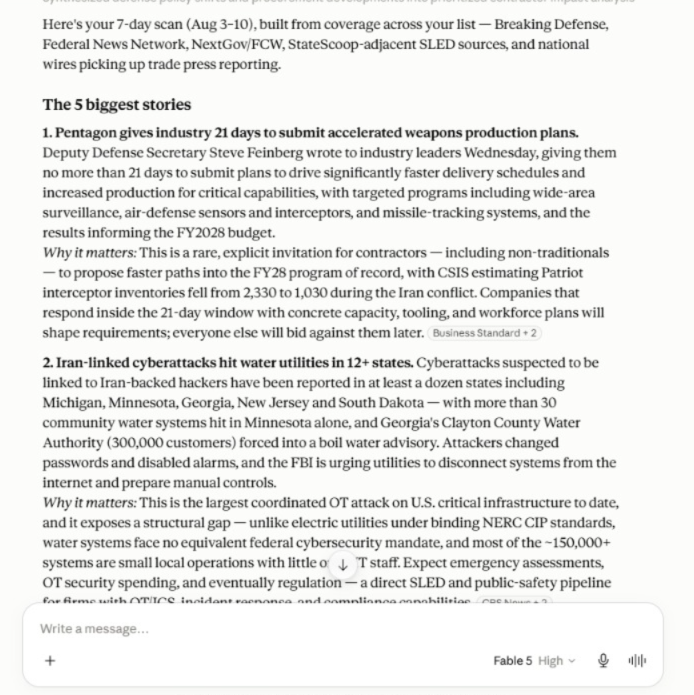
Why Do This Weekly
GovCon moves on budget cycles, policy memos, and protest decisions — miss a week and you’re behind in customer conversations. Being the person who says “did you see the OMB memo Tuesday?” builds instant credibility with customers, executives, and teammates. It also feeds every other prompt on this list.
2. The Agency Deep Dive
The Prompt
“Give me a one-page brief on [AGENCY OR SUB-AGENCY]: its mission, FY26 budget and top priorities, key leaders (and recent leadership changes), major programs and contract vehicles, top incumbent contractors, upcoming recompetes in the next 12–18 months, and 3 smart questions I could ask someone who works there. Cite sources.”
Steps to Execute
- Rotate one agency per week — start with your top customers, then adjacent agencies you want to enter.
- Run the prompt, then verify budget figures and recompetes against SAM.gov, USAspending.gov, or GovWin.
- File the brief in a shared team folder so your agency knowledge base compounds.
- Use the “3 smart questions” the next time you meet anyone connected to that agency.
Why Do This Weekly
In 52 weeks you’ll have working knowledge of 52 agencies — more than most 10-year veterans. Agency fluency is the difference between selling services and solving missions, and shared briefs make you the internal go-to resource, which is office visibility you can’t buy.
3. Policy, Regulation & Budget Watch
The Prompt
“Summarize the past 7 days of federal acquisition and policy activity relevant to contractors: new or proposed FAR/DFARS changes, executive orders, OMB memos, GAO/IG reports, appropriations or continuing resolution updates, and small business/compliance rule changes (e.g., CMMC, SBA). For each: what changed, who it affects, effective dates, and what a [YOUR ROLE] at a [SIZE] contractor should do about it.”
Steps to Execute
- Run with web search enabled; anchor on official sources (Federal Register, acquisition.gov, whitehouse.gov, GAO.gov).
- Flag anything with a comment deadline or effective date and add it to your calendar.
- Forward one relevant item to a colleague it affects (contracts, legal, or your PM) with a one-line summary.
- Keep a running “regulatory change log” — it becomes gold at proposal and compliance time.
Why Do This Weekly
Regulatory change is where risk and opportunity enter GovCon first. Catching a rule change early can shape bid/no-bid decisions, protect you from compliance surprises, and — when you’re the one forwarding the alert — position you as someone who protects the business, not just works in it.
4. Awards, Recompetes & Protests in My Market
The Prompt
“List notable federal contract awards from the past week in [MARKET, e.g., IT services, logistics, cyber, professional services], including agency, winner, value, and vehicle. Then list: (1) any significant bid protests filed or decided, (2) major recompetes announced or forecast, and (3) what patterns these awards suggest about where agency spending is heading. Which 2 awards should I congratulate publicly on LinkedIn?”
Steps to Execute
- Run the prompt; cross-check the big awards against SAM.gov, USAspending, agency press releases, or award trackers.
- Note which competitors are winning and on which vehicles — feed this into your capture and teaming discussions.
- Post one genuine congratulations to a winning company or teammate on LinkedIn (this builds network goodwill fast).
- Add relevant recompetes to your pipeline tracker with dates.
Why Do This Weekly
Awards are the scoreboard of the industry. Tracking them weekly reveals competitor momentum, teaming opportunities, and agency spending shifts before they show up in forecasts. And congratulating winners publicly is one of the highest-ROI, lowest-effort networking moves in GovCon — people remember who cheered for them.
5. Skills to Master Next
The Prompt
“I’m a [ROLE] with [X] years in government contracting. Based on current industry trends (AI adoption, CMMC, agile acquisition, data analytics, OASIS+/GSA vehicles, etc.), what 3 skills should I prioritize mastering in the next 6 months? For each: why it matters now, a free or low-cost way to start this week, a certification or credential worth considering, and how I’d demonstrate the skill visibly at work.”
Steps to Execute
- Run the prompt once a week, but change the lens each time (technical skills, business skills, tools, certifications).
- Pick ONE micro-action from the output and do it within 48 hours (a 20-minute course module, a tool trial, a DAU or Coursera lesson).
- Log skills progress monthly and share one learning with your manager or team (“I’ve been digging into X — here’s what I found”).
- Revisit quarterly to prune and refocus.
Why Do This Weekly
The GovCon skill stack is shifting faster than at any point in a generation — AI literacy alone is redrawing job descriptions in capture, proposals, and contracts. Weekly micro-investments compound into promotions and pay raises, and visibly sharing what you’re learning marks you internally as a grower, not a coaster.
6. Events Radar — Next Two Weeks
The Prompt
“What government contracting, federal technology, and public sector events are happening in the next 2–3 weeks, both virtual and in-person near [LOCATION, e.g., DC metro / Northern Virginia]? Include industry days, AFCEA/NCMA/ACT-IAC/PSC/GovExec events, agency-hosted sessions, and free webinars. For each: date, format, cost, who attends, and whether it’s better for learning, networking, or customer access. Recommend the top 2 for a [ROLE].”
Steps to Execute
- Run with web search; also check SAM.gov for industry days in your target agencies.
- Register for at least one event per week (even a free webinar counts).
- Before attending, ask AI: “Who should I try to meet at [EVENT] and what should I ask them?”
- Afterward, connect on LinkedIn with 2–3 people you met within 24 hours, referencing your conversation.
Why Do This Weekly
GovCon is a relationship business, and events are where relationships start — but most people find out about the good ones after they happen. A weekly radar ensures you never miss an industry day for a target agency, and consistent attendance (even virtual) steadily grows the network that wins work and career opportunities.
7. The LinkedIn Content Engine
The Prompt
“Based on this week’s GovCon news [PASTE 2–3 STORIES OR YOUR NEWS SCAN OUTPUT], draft 3 LinkedIn post options in my voice: (1) a perspective post sharing my take on one trend, (2) a practical post sharing a tip or lesson from my work as a [ROLE] (no confidential info), and (3) an engagement post asking my network a question. Keep each under 150 words, no hashtag spam, strong first line. Also suggest 3 posts from others I should leave a thoughtful comment on.”
Steps to Execute
- Feed it your weekly news scan (Prompt #1) so posts are timely.
- Edit heavily — add your real opinion, a specific example, or a number. Never post AI output verbatim.
- Post 1–2 times per week; comment thoughtfully on 3–5 posts from customers, partners, and industry voices.
- Reply to every comment on your posts within 24 hours.
Why Do This Weekly
Consistency beats brilliance on LinkedIn — one good post a week outperforms a viral post a quarter. In GovCon, where buyers and teaming partners research people before meetings, your feed IS your first impression. Comments on others’ posts are equally powerful: they build relationships with people who would never accept a cold connection request.
8. The Network Builder — 5 People This Week
The Prompt
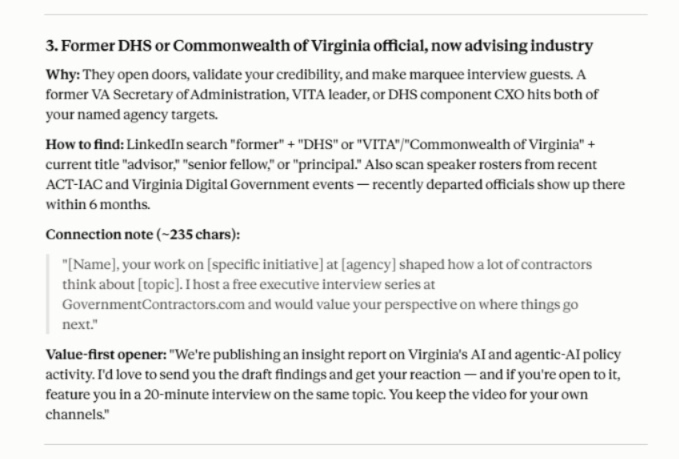
“Help me build my GovCon network strategically. I’m a [ROLE] focused on [AGENCIES/MARKETS]. Identify 5 types of people I should connect with this week (e.g., a capture lead at a potential teaming partner, an association chapter leader, a former government official, a peer at another firm, a journalist covering my market). For each: how to find them, a personalized connection note under 250 characters, and a first conversation opener that offers value rather than asks for it.”
Steps to Execute
- Run the prompt, then find real people matching each type via LinkedIn, event attendee lists, award announcements, and association directories.
- Send 5 personalized connection requests (never blank, never salesy).
- For 2 existing contacts you haven’t spoken to in 90+ days, send a genuine check-in or share an article relevant to them.
- Track connections in a simple spreadsheet: name, org, how you met, last touch.
Why Do This Weekly
Five connections a week is 250+ a year — a network that produces teaming calls, job opportunities, and market intelligence no database can match. In an industry where past performance and trust drive awards, the strength of your network is a genuine business asset, and it only grows through consistent, generous outreach.
9. Government Success Stories
The Prompt
“Find 3 recent government success stories — programs, digital services, or agency initiatives that delivered real results for the public (federal, state, or local). For each: what the agency did, the measurable outcome, which contractors or technologies were involved, and the lesson for industry. Then suggest how I could reference one of these in (a) a customer conversation and (b) a LinkedIn post celebrating public service.”
Steps to Execute
- Run with web search; good sources include agency press releases, Performance.gov, ACT-IAC awards, Service to the Citizen awards, and GovExec/FedScoop coverage.
- Verify the outcome numbers before repeating them.
- Save stories to a “proof points” library organized by agency and mission area — proposal and BD teams will love you.
- Share one story publicly, crediting the government team (not just the contractor).
Why Do This Weekly
Success stories are persuasion fuel: they give you positive, mission-focused material for customer meetings, proposals, and social content in an industry that skews cynical. Publicly celebrating government wins also differentiates you — agency employees notice who champions their work, and that goodwill opens doors.
10. Government Failures & Lessons Learned
The Prompt
“Identify 3 recent government program failures, troubled acquisitions, or critical GAO/IG findings (e.g., cost overruns, failed IT modernizations, schedule slips, protest sustainments). For each: what went wrong, the root causes (requirements, acquisition strategy, vendor performance, oversight), what it cost, and 2 practical lessons a contractor should apply. Which failure patterns are showing up repeatedly across agencies right now?”
Steps to Execute
- Run with web search; anchor on GAO reports, IG audits, GAO’s High-Risk List, and credible trade press.
- Distill one “lesson learned” and share it in a team meeting or capture review (“here’s how we avoid this on our programs”).
- Use failure patterns to sharpen risk sections in proposals and to ask better discovery questions with customers.
- Be careful publicly: discuss lessons and patterns on social media, not dunks on specific agencies or competitors.
Why Do This Weekly
Failures teach faster than successes. Understanding why programs fail makes you sharper in bid decisions, risk mitigation, and customer conversations — you can ask the questions incumbents are afraid to. Internally, the person who says “GAO just flagged this exact risk pattern — here’s how we’re different” earns a seat at strategy discussions.