5 State Government IT Trends for August 2026: Enterprise AI Offices, CIO Turnover, BEAD Re-Scoping, Audit-Driven Modernization, and Cyber Grants for Small Utilities
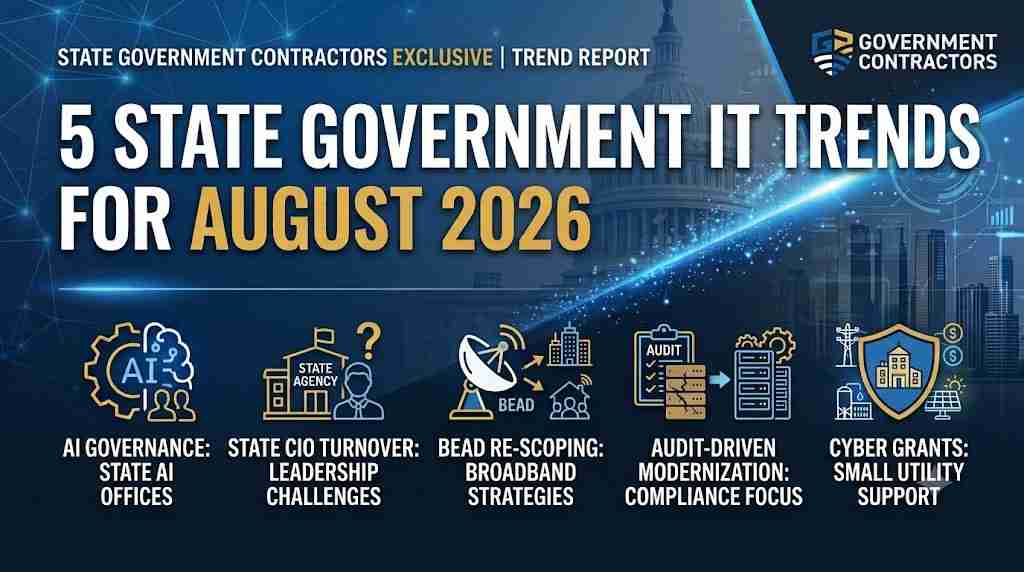
Five shifts are reshaping state government technology this month: states standing up permanent enterprise AI offices and architecture roles instead of pilots; unusually heavy CIO, CISO and privacy-chief turnover; BEAD and Digital Equity Act funding being re-scoped mid-execution; auditor reports surfacing legacy system risk ahead of incidents; and state cyber grants flowing to water utilities and small local agencies.
1. State AI Governance: Why States Are Building Enterprise AI Offices, Not Pilots
What happened: Oklahoma launched an internal AI platform with two initial production tools aimed at legislators and at procurement. Colorado hired a former federal official as principal director for AI architecture. The National Science Foundation announced a $100 million grant program for state and regional AI infrastructure hubs. A governors association partnered on a $1 million AI workforce project. Tennessee detailed cloud and AI work to modernize state services.
Why it matters: The buying unit is shifting from a department running an experiment to a state enterprise standing up architecture, governance roles, and shared platforms. Procurement itself is one of the first AI use cases states are choosing.
Where it lands: Sell into the enterprise AI office, not the line agency. And expect the procurement office you are selling to be using AI on your submission.
2. State CIO and CISO Turnover: What Leadership Changes Mean for Vendors
What happened: California’s chief information security officer is stepping down after seven years. Maryland’s chief digital experience officer is leaving the role. Oregon named a new state privacy chief, hired out of Nevada. New Jersey’s new chief technology officer is publicly framing his mandate around the governor’s platform of improving government performance.
How long do state CIOs and CISOs stay in the role?: State CISO and CIO tenure is short and the replacement cycle resets vendor relationships, roadmap priorities, and often the contract vehicles in favor.
Where it lands: Build a standing leadership-change tracker for your top twenty state accounts. This is one of the highest-yield, lowest-cost intelligence products a small GovCon marketing team can maintain.
3. BEAD and Digital Equity Act Funding Is Being Re-Scoped Mid-Execution
What happened: NTIA said it plans to restore some Digital Equity Act funding after a court ruled the administration could not cancel it. Separately, states may need to cut roughly a third of their BEAD satellite awards following an update to the underlying broadband serviceable location data. As of the most recent NTIA dashboard, all 56 states and territories had submitted final proposals, 55 had NTIA approval, and 52 had signed award agreements.
Has BEAD funding started flowing to states?: BEAD has crossed from planning into execution, which changes the buyer from a broadband office writing plans to an office managing sub-grantees, compliance, and construction. At the same time the data update is forcing award revisions mid-stream.
Where it lands: The near-term opportunity is program management, compliance, mapping, and workforce — not just deployment.
4. State IT Modernization Audits: Legacy System Risk Is Surfacing Before Incidents Do
What happened: An Oregon audit found aging IT systems across state correctional facilities present significant public safety risk. New Jersey’s governor said roughly 4,500 noncitizens would be removed from voter rolls following a software issue. Watchdogs warned that AI-driven data inferencing is outpacing state privacy protections, and a separate report urged governments to weigh privacy and civil rights risk before consolidating data.
Why it matters: Audit findings are procurement fuel. They create documented, cited justification for spending in a way that a CIO’s preference does not.
Where it lands: State auditor reports are an underused pipeline source. They name the system, the risk, and often the remediation timeline.
5. State Cybersecurity Grants Are Funding Water Utilities and Small Local Agencies
What happened: New York moved more than $9 million in cybersecurity grants to water and wastewater systems statewide, fast-tracking the funding after attacks disrupted utilities across multiple states. The Justice Department partnered with six southeastern states on public benefits fraud detection. New reports on emergency management concluded the barrier to AI adoption is implementation capacity rather than the technology.
Why it matters: The money is flowing to small entities — municipal utilities, special districts, county agencies — that have no security staff and no procurement capacity. That is a services problem before it is a product problem.
Where it lands: Grant-funded small-entity work favors firms that can package assessment, remediation, and managed support into something a five-person utility can actually buy.