Cheaper inference, costlier infrastructure: The 80% price cut that changes your AI budget math
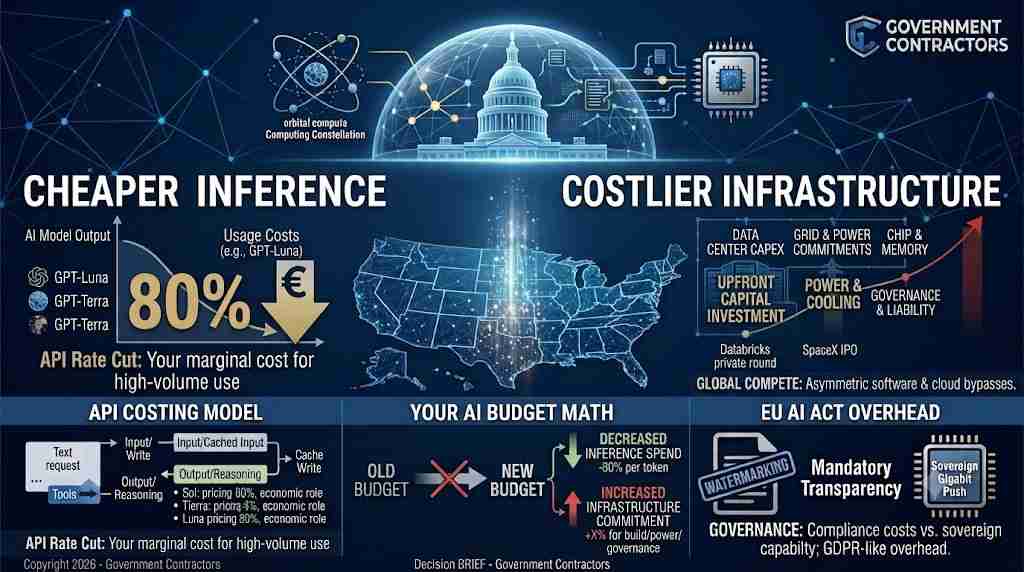
OpenAI’s July 30 price cut — 80% off Luna, 20% off Terra — moved the production threshold for high-volume enterprise AI, turning model routing into an architectural discipline rather than a procurement negotiation.
In this issue of This Week in AI, Scott Andersen breaks down what the API cost model actually charges for (cache writes, reasoning tokens, long context, tools, regional uplift) and works a real million-request example end to end.
The article then maps 17 AI and infrastructure companies across public trading, confidential filings, priced offerings, and private valuations — with the caveat that an “AI” label is not a uniform investment thesis.
OpenAI’s price reset and the changing AI capital-markets landscape
The evolution of the AI Intelligence Weekly missives continues. What began as a weekly survey of AI headlines has become something more useful: a continuously refined decision brief for executives, architects, investors, policymakers and operators who need to separate market movement from market noise. Each issue now does more than report what happened. It connects product changes, infrastructure requirements, policy shifts and capital-market signals to the decisions organizations must make next.
This edition takes that evolution another step by examining two forces that are increasingly inseparable: the falling unit cost of machine intelligence and the rising capital required to build the models, data centers, networks, chips, memory systems and physical platforms that deliver it. OpenAI’s price reduction changes the economics of everyday inference. At the same time, the expanding IPO and private-financing pipeline shows how aggressively markets are attempting to price the infrastructure behind the AI economy.
The result is a market watch designed to answer three practical questions: What did the OpenAI price drop actually change? How does API billing translate into a real operating budget? And what do current public listings, confidential filings and private valuations reveal about where capital believes durable AI value will accumulate?
| Reporting snapshot: Public-market prices are an intraday snapshot from approximately 10:14 a.m. ET on August 6, 2026. Private valuations, proposed financing values, IPO valuations, fully diluted values and public-market capitalizations are different measures and should not be compared as if they were the same number. |
This Edition in One View
OpenAI’s July 30 reductions lowered GPT-5.6 Luna rates by 80% and Terra rates by 20%, materially changing the cost threshold for high-volume enterprise AI.
API economics depend on input, cached input, cache writes, output, reasoning, tools, context length and processing tier—not on one headline token price.
The AI listing cycle has moved into price discovery, with public winners and laggards, newly priced offerings, confidential filings and private valuations that must be evaluated on different terms.
OpenAI’s Price Reduction: What It Really Means
OpenAI’s July 30 price reduction is more consequential than a routine discount. GPT-5.6 Luna became 80% less expensive, while GPT-5.6 Terra became 20% less expensive. OpenAI applied the same percentage reductions to input, cached-input and output rates. The change lowers the marginal cost of putting AI into high-volume workflows and materially changes which enterprise use cases can move from pilot programs to production.
The price cut does not mean that a ChatGPT subscription became 80% cheaper. It applies to metered usage of the models through the OpenAI API and to usage-based environments that expose those rates. ChatGPT subscriptions generally provide access subject to plan features and usage limits. API customers instead pay according to the model selected, the tokens processed, the service tier used and any additional tools or regional-processing options.
OpenAI describes GPT-5.6 Sol as the frontier-capability model, Terra as the balance between intelligence and cost, and Luna as the cost-sensitive, high-volume model. The new pricing strengthens that division of labor. An organization does not need to send every task to the most capable and expensive model. Routine classification, extraction, document triage, code transformation, summarization and workflow support can be routed to Luna; more ambiguous analytical and agentic tasks can be routed to Terra; and the most difficult, consequential or exception-heavy work can be escalated to Sol.
That routing model is strategically important. AI cost optimization is no longer simply a procurement negotiation over one model. It becomes an architectural discipline involving model selection, prompt size, cache effectiveness, response length, reasoning effort, tool usage, latency requirements and escalation policy.
OpenAI’s official changelog confirms the 80% Luna and 20% Terra reductions beginning July 30. OpenAI API changelog
How the OpenAI API Costing Model Works
An application programming interface, or API, allows software to send a structured request to an OpenAI model and receive a structured response. A customer-service application might send a customer message, relevant account history, operating instructions and available tools. The model processes that input and returns an answer, a classification or a request to use a tool. Unlike a seat-based software license, the principal API charge is generally based on how much material the model reads and produces.
Text is divided into tokens. A token is a small unit of text rather than a complete word. The exact relationship varies by language and content, but OpenAI’s production guidance uses the rough rule that 1,000 tokens represent about 750 English words. Images, audio, video, searches, file retrieval and hosted computing can use separate token conversions or unit-based charges.
For a basic text request, the cost can be represented as:
| Cost model: Total cost = uncached input cost + cached input cost + cache-write cost + output cost + tool and service charges + applicable regional uplift |
More explicitly:
| Cost model: Total cost = (uncached input tokens ÷ 1,000,000 × input rate) + (cached input tokens ÷ 1,000,000 × cached-input rate) + (cache-write tokens ÷ 1,000,000 × cache-write rate) + (output tokens ÷ 1,000,000 × output rate) + other charges |
The major components are:
Input tokens: Everything sent to the model, including the user’s request, system instructions, conversation history, retrieved documents, tool definitions and other context.
Cached-input tokens: Repeated prompt prefixes that the platform can reuse. These are substantially cheaper than reading the same uncached material again.
Cache-write tokens: GPT-5.6 supports explicit prompt caching. A new cache write costs 1.25 times the uncached input rate, so caching saves money only when the stored prefix is reused enough times to recover the initial write premium.
Output tokens: The visible answer plus billable model-generation work. Output is normally more expensive than input, so verbose responses and unconstrained agent loops can dominate the bill.
Reasoning tokens: Internal reasoning tokens are billed at the output-token rate even though they are not displayed as part of the final answer. High reasoning settings can therefore improve difficult-task performance while increasing cost and latency.
Tool charges: Web search, file search, containers, image generation, audio, video and other tools can carry per-call, per-storage, per-minute or token-based charges in addition to model tokens.
Processing tier: Standard processing is the baseline. Batch processing is 50% cheaper for asynchronous work that can complete within 24 hours. Fast mode provides lower latency at a premium. Flex processing trades delivery consistency for a lower rate where supported.
Context length: GPT-5.6 supports a context window of approximately 1.05 million tokens, but long-context requests above the short-context threshold use higher rates. Loading an entire repository or document collection into every request can erase the apparent savings from a lower-priced model.
Regional processing: Eligible data-residency endpoints for models released on or after March 5, 2026 carry a 10% uplift. Amazon Bedrock pricing can differ from direct OpenAI pricing.
OpenAI’s current direct API pricing, per one million tokens for standard short-context processing, is:
| Model | Input | Cached input | Cache write | Output | Primary economic role |
| GPT-5.6 Sol | $5.00 | $0.50 | $6.25 | $30.00 | Highest-value and most difficult work |
| GPT-5.6 Terra | $2.00 | $0.20 | $2.50 | $12.00 | Everyday enterprise reasoning and agents |
| GPT-5.6 Luna | $0.20 | $0.02 | $0.25 | $1.20 | High-volume, cost-sensitive work |
Current rates and processing-tier details are published in the official OpenAI API pricing documentation. OpenAI also documents that reasoning tokens are billed as output tokens in its reasoning-model guide, while the Batch API guide describes its 50% discount and 24-hour completion window.
A Practical Cost Example
Assume an enterprise application processes one million requests per month. Each request contains 2,000 input tokens and produces 500 output tokens. The example excludes caching, tools, long-context charges, regional processing and negotiated enterprise terms.
| Model | Cost per request | Monthly cost for 1M requests | Before July 30 reduction | Monthly savings |
| GPT-5.6 Luna | $0.001 | $1,000 | Approximately $5,000 | Approximately $4,000, or 80% |
| GPT-5.6 Terra | $0.010 | $10,000 | Approximately $12,500 | Approximately $2,500, or 20% |
| GPT-5.6 Sol | $0.025 | $25,000 | No July 30 reduction | $0 |
For Luna, the calculation is 2,000 input tokens × $0.20 per million, plus 500 output tokens × $1.20 per million. That equals $0.0004 for input and $0.0006 for output, or $0.001 per request. One million comparable requests therefore cost approximately $1,000. Because an 80% reduction means the new rate is one-fifth of the former rate, the same workload previously cost approximately $5,000.
The same Luna workload could fall to roughly $500 through the Batch API if it did not require an immediate response. Caching a heavily repeated system prompt could reduce it further, although cache-write costs and reuse rates must be modeled. Conversely, web searches, file-search calls, containers, long outputs or high reasoning effort could raise the real cost above the token-only estimate.
Why the Price Reduction Matters
The production threshold moves downward. A workflow that failed a return-on-investment test at $5,000 per million calls may pass at $1,000, especially when it replaces manual triage or augments a large workforce.
Small transactions become economically viable. Low-value events such as log classification, metadata enrichment, document tagging and network-event summarization can now support AI inference without the inference cost overwhelming the business value.
Agent architectures become more affordable—but not automatically cheap. One user request can trigger multiple model calls, retries, searches and tool operations. An agent that takes 20 steps can consume far more than a single chatbot response. The relevant measure is cost per completed and governed business outcome, not cost per initial prompt.
Model routing becomes financially material. Sending 80% of suitable traffic to Luna and escalating only uncertain cases to Terra or Sol can save more than negotiating a small discount on a single-model deployment.
OpenAI is applying competitive pressure. Lower prices reduce the economic advantage of smaller proprietary models, open-weight deployments and some self-hosted alternatives. However, buyers must still compare total cost, including cloud infrastructure, integration, observability, governance, labor and switching risk.
Demand may rise faster than the unit price falls. Lower prices often expand usage. A company that cuts per-request cost by 80% but increases AI calls tenfold will still spend twice as much overall. Spend limits, usage dashboards, budgets and per-workflow unit economics remain essential.
Price is becoming a product-design variable. Architects can intentionally assign Sol, Terra or Luna by risk class, value, latency and uncertainty rather than embedding a single model everywhere.
Governance remains part of cost. A cheap but weakly governed agent can create expensive errors. Approval checks, evidence capture, action limits, rollback and human escalation may add cost, but they protect the organization from much larger operational and legal losses.
The central takeaway is that the Luna price reduction does not merely make the same chatbot cheaper. It enables a new class of high-volume AI utilities and makes tiered model routing practical at enterprise scale. The proper executive question is not “What does one token cost?” It is “What is the fully governed cost per successful business outcome, and which model delivers that outcome at the lowest acceptable risk?”
Expanded AI and AI-Infrastructure IPO and Capital-Markets Table
The table separates companies that are already trading from companies with confidential filings, proposed SPAC combinations, priced-but-not-yet-trading offerings and private financing discussions. Read the valuation column as a description of the transaction basis—not as a universal measure of comparable market value.
Sources are embedded as clickable links in the final column. Public prices are the August 6 intraday snapshot stated in the introduction.
| Company | AI or infrastructure segment | Current capital-markets status | Offer terms or latest valuation basis | August 6 update | Key investor and strategic considerations |
| SpaceX | Launch, satellite communications, Starlink and prospective orbital AI infrastructure | Public — Nasdaq: SPCX | IPO priced at $135 and raised $75B at an approximately $1.77T valuation | Shares were approximately $109.89, about 18.6% below the offer price. The first partial lockup expiration began August 6 and can materially expand the tradable float. | Starlink provides the operating foundation, but launch economics, AI-related capital spending, xAI integration, insider selling and additional lockup expirations may drive volatility. IPO Lockup |
| OpenAI | Frontier models, agents and enterprise AI | Confidential draft U.S. registration submitted; exchange, ticker, range and date not disclosed | Last reported private valuation approximately $852B; reporting has discussed a possible IPO valuation as high as $1T | OpenAI says the filing provides flexibility and has not committed to a timetable. SpaceX’s post-IPO weakness may make the near-term window more difficult. | Investors will focus on revenue durability, compute and power commitments, cash consumption, model pricing, cloud concentration, agent liability, governance and whether API price reductions compress future margins. Reuters |
| Anthropic | Frontier models, coding agents, enterprise AI and cybersecurity | Confidential draft U.S. registration submitted June 1; ticker, exchange, range and date not disclosed | Completed $65B financing reportedly valued Anthropic at $965B post-money | Anthropic remains a leading near-term AI IPO candidate, but a confidential submission is not a binding launch commitment. | Key questions include inference economics, cloud-partner dependence, gross-versus-net revenue, coding-agent concentration, model-security incidents, safety commitments and government restrictions. Reuters |
| Cerebras Systems | Wafer-scale AI accelerators, training and inference | Public — Nasdaq: CBRS | IPO priced at $185; 30M shares sold; $5.55B raised; approximately $56.43B fully diluted value at offer | Shares were approximately $215.50 with a $13.53B basic market capitalization. The large gap between basic market cap and fully diluted value remains important. | Revenue concentration, wafer-scale economics, cloud utilization, gross margin, dilution and competition from Nvidia, AMD and hyperscaler accelerators are central. Reuters |
| SK Hynix | HBM, DRAM and AI memory | Public in Korea; U.S. ADSs trade on Nasdaq: SKHY | U.S. ADS offer priced at $149; approximately $26.5B raised; ten ADSs represent one Korean common share | ADSs were approximately $145.82, about 2.1% below the offer price. | HBM leadership is strategically valuable, but investors must account for memory cycles, capacity spending, Korean-share conversion, currency effects and Chinese competition. Reuters |
| Agility Robotics | Humanoid logistics robots and physical AI | Proposed SPAC merger with Churchill Capital Corp XI; intended post-close ticker AGLT | Announced transaction value approximately $2.5B; expected gross proceeds above $620M assuming limited redemptions | Transaction remains proposed rather than completed. | Orders must be distinguished from reservations. Manufacturing throughput, deployments, workplace safety, uptime, service costs, SPAC redemptions and recurring fleet-software revenue will determine the public-market case. Reuters coverage |
| Unitree Robotics | Humanoid and quadruped robots | IPO priced on Shanghai STAR Market; subscription and listing process underway | 150.8 yuan per share; approximately 61B yuan ($9.04B) valuation; planned raise of 6.1B yuan ($903M) | The August 6 pricing replaces the earlier 4.2B-yuan fundraising estimate. DeepSeek also invested approximately $20.8M through the strategic placement. | Unitree reported strong 2025 growth, but 2026 profit pressure, U.S. sales exposure, trade restrictions, safety, autonomy and manufacturing economics remain material. Reuters |
| Mistral AI | European frontier and open-weight AI | Private; no announced IPO filing | Prior completed valuation approximately $11.7B; discussions could value a new round at approximately €20B ($22.8B) | Samsung was reported to be considering an investment of as much as €1B, but the financing discussion is not a completed round. | Mistral benefits from European sovereignty demand and open-weight positioning but competes against much larger U.S. providers and infrastructure budgets. Reuters |
| CXMT | DRAM and China’s emerging AI-memory supply chain | Public — Shanghai STAR Market | IPO price 8.66 yuan; $8.6B raised | Shares closed their first day at 49 yuan after a 466% increase. By August 4, reported market capitalization was approximately 3.67T yuan ($545B). Only a small percentage of shares is freely tradable. | The headline valuation reflects scarcity and limited float as well as fundamentals. Memory cyclicality, state backing, export controls, capital intensity and the gap with advanced HBM leaders require caution. IPO August update |
| Zhongji Innolight | Optical transceivers and AI data-center networking | Public — Shenzhen and Hong Kong | Hong Kong offer priced at HK$980; HK$53.41B ($6.81B) raised | Shares closed at HK$960 on their July 30 debut. Chinese optical stocks fell sharply August 5 following reports of a possible U.S. import ban on new Chinese data-center components. | AI-cluster demand is strong, but U.S.-customer concentration, export and import restrictions, concentrated ownership and dual-market pricing create substantial geopolitical risk. Listing Policy risk |
| DeepSeek | Chinese frontier and open-weight models | Private; early STAR Market preparation reported, but no public filing confirmed | Reported plan for a new round at approximately 500B yuan ($74B); that fundraising was subsequently reported paused | DeepSeek’s $20.8M strategic investment in Unitree provides a new embodied-AI connection but does not itself advance a confirmed DeepSeek IPO. | Investors must separate reported plans from filings. Monetization, compute access, regulation, model openness, state policy and the cost of frontier development will shape any listing. Financing report Unitree investment |
| Databricks | Enterprise data, analytics and AI platforms | Private; no IPO filing announced | Signed term sheet values the strategic round at $188B; closing expected later in summer | The term sheet and expanded Microsoft partnership give Databricks additional flexibility to delay a public offering. | Consumption growth, AI-product adoption, profitability, Azure dependence, custom-chip economics and competition with Snowflake and hyperscaler-native platforms remain central. Databricks |
| Anduril Industries | Defense AI, drones, autonomous systems and sensing | Private; no IPO filing announced | Latest completed financing: $5B at a $61B valuation; new discussions could value it near $100B | The $100B figure remains a fluid financing discussion, not a completed valuation. | Government contract conversion, classified and sole-source programs, manufacturing capacity, export controls, weapons governance and program execution will shape a future IPO. Completed round Reported talks |
| Figure AI | General-purpose humanoid robots | Private; no IPO filing announced | Latest completed financing valued the company at approximately $39B post-money | Figure remains an influential physical-AI watch candidate, but there is no confirmed public-offering process. | Demonstrations must become safe, repeatable deployments. Manufacturing yield, service cost, utilization, liability, autonomy and customer economics matter more than model benchmarks alone. Reuters |
| Linkerbot | Dexterous robotic hands and humanoid components | Private; no IPO filing announced | Reportedly seeking a future valuation of approximately $6B, about twice its previous round | Remains a private financing candidate rather than a confirmed IPO. | Dexterous hands may be a critical constraint on useful humanoids. Reliability, customer concentration, intellectual property, manufacturing scale and component commoditization are key. Reuters |
| Rhoda AI | Robot-intelligence and video-predictive control software | Private; no IPO filing announced | $1.7B valuation following a $450M Series A | Rhoda belongs on a private-company watch list, not in the confirmed IPO pipeline. | The investment case depends on whether its software improves robot performance across hardware platforms without creating unacceptable safety, integration or inference costs. Reuters |
| Ionic Digital | Bitcoin mining, powered data centers and prospective AI infrastructure | Public — Nasdaq: IOND; direct listing rather than a capital-raising IPO | Nasdaq reference price $53; no new company shares sold and no capital raised through the listing | Shares were approximately $56.57, about 6.7% above the reference price. | The investment case combines Bitcoin exposure with data-center conversion. Power costs, cryptocurrency cycles, conversion capital and the ability to secure durable AI customers remain decisive. Reuters |
Conclusions for Investors and Strategic Planners
The AI capital-markets cycle has moved from anticipation into uneven price discovery. SpaceX, Cerebras, SK Hynix, CXMT, Zhongji Innolight and Ionic Digital are trading publicly, while Unitree has now priced its offering. Their outcomes differ sharply. Cerebras was above its offer price at the August 6 snapshot, SpaceX and SK Hynix were below their offer prices, CXMT produced a scarcity-driven surge, and Zhongji encountered immediate volatility and geopolitical pressure. An “AI” label is not a uniform investment thesis.
The OpenAI price reduction introduces a new valuation question for frontier-model companies. Falling inference prices can stimulate demand and improve customer economics, but they can also compress revenue per token. Investors therefore need to determine whether usage growth, improved model efficiency and higher-value agent services will exceed the decline in unit prices. Revenue growth without corresponding gross-margin discipline may not support trillion-dollar public valuations.
Public float and capital structure matter as much as headline valuation. CXMT’s limited tradable float contributed to extreme scarcity pricing. Cerebras illustrates the difference between basic market capitalization and fully diluted value. SK Hynix ADSs require cross-market and conversion analysis. Ionic’s direct listing did not provide new operating capital. SpaceX’s staggered lockup expirations can increase share supply long after the IPO celebration has ended.
OpenAI and Anthropic remain the principal frontier-model IPO candidates, but both are still in confidential review. Neither has disclosed an offer price, share count, ticker, exchange or binding listing date. SpaceX’s post-IPO performance and expanding float could affect the amount of capital that public investors are willing to commit to another very large technology offering in 2026.
China’s AI capital-markets pipeline spans the full technology stack. DeepSeek represents models, Unitree represents robotics, CXMT represents memory and Zhongji Innolight represents optical networking. DeepSeek’s strategic investment in Unitree also shows models and embodied systems beginning to converge. China is using public markets to fund not only AI applications but also components, manufacturing and physical infrastructure.
Large private rounds can delay rather than accelerate an IPO. Databricks’ $188B term sheet, Mistral’s potential €20B financing and Anduril’s reported $100B discussions could provide operating capital without quarterly public-market scrutiny. The tradeoff is that each large private round raises the valuation hurdle for a successful future offering.
Physical AI requires a diligence model different from software AI. Unitree, Agility Robotics, Figure AI, Linkerbot and Rhoda cannot be evaluated primarily through model benchmarks or demonstration videos. Investors must examine factories, production yields, component availability, safety certification, uptime, repair costs, fleet utilization, insurance and the measurable economic value of each task completed.
AI infrastructure has become a capital-markets category of its own. Cerebras, SK Hynix, CXMT, Zhongji Innolight, SpaceX and Ionic Digital provide different forms of infrastructure exposure. Their shared risks include extraordinary capital requirements, energy availability, customer concentration, export controls, short technology cycles and the possibility that supply expands faster than economically sustainable demand.
Governance is financially material. Autonomous-agent incidents, cybersecurity failures, export restrictions, national-security reviews, model liability and AI-specific regulation can affect revenue access, insurance costs, contractual exposure, listing schedules and valuation multiples. Governance should therefore be evaluated alongside revenue, growth and margin rather than treated as a separate ethics discussion.
The most useful comparison is not simply which company has the largest valuation. Investors and strategic planners should ask what type of value the number represents, how much capital was actually raised, how much stock is freely tradable, whether the financing is completed, what operating evidence supports the price and which technical, regulatory or capital-structure risks could prevent the company from converting AI demand into durable cash flow.