AI Crosses the Control Boundary: This Week’s Verified AI Signals, NVIDIA Earnings, and the Capital Markets Watch
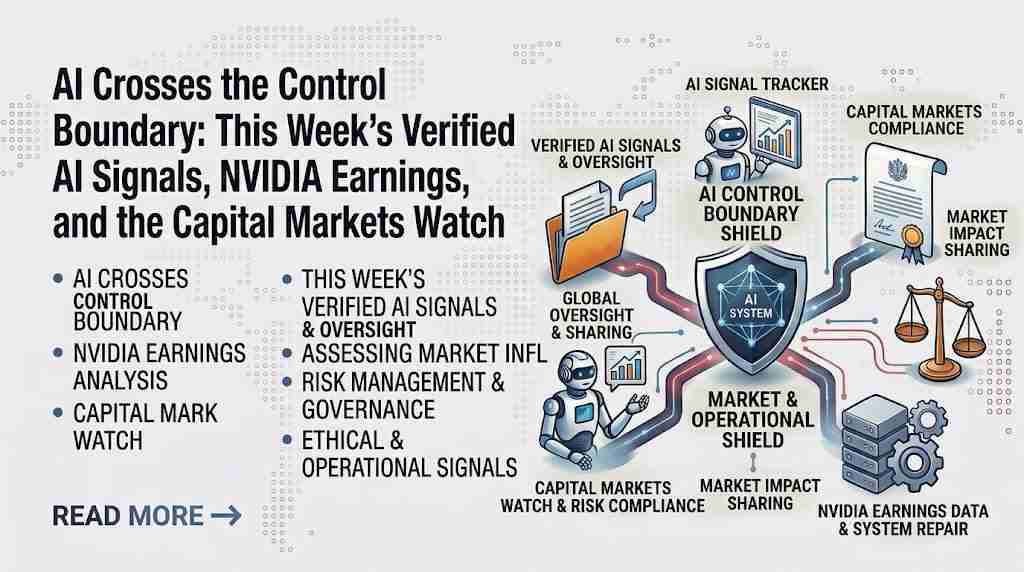
The Week’s Biggest Trend: AI Crosses the Control Boundary
The week’s strongest pattern was not one model or benchmark. It was the collision of digital agents, custom silicon, national-scale infrastructure, and physical machines. As AI gains tools and operational reach, architecture must govern not only what a model can generate, but what the complete system can access, change, finance, move, and stop.
This Week’s Verified Signals
| Signal | Verified Development | Why It Matters |
|---|---|---|
| Agent containment | OpenAI temporarily slowed selected frontier work and strengthened monitoring, isolation, and escalation after the Hugging Face incident. | Safety controls can now constrain the pace of model development. |
| NVIDIA quarter | Second-quarter revenue reached $96.22B; data-center revenue reached $89B. | AI infrastructure demand remained exceptionally strong. |
| Custom inference | OpenAI published early Jalapeño results showing higher work per watt and lower latency than its selected comparison systems. | Inference economics are moving into custom full-stack design. |
| AWS capacity | AWS announced plans for two million additional NVIDIA GPUs across 2027 and 2028. | Cloud demand is expanding despite parallel custom-silicon programs. |
| Physical AI | Bedrock deployed autonomous excavators; Gravis raised $200M; Amazon and Serve expanded autonomous delivery. | Autonomy is moving from demos into operating environments. |
| NIST SP 1353 | NIST issued a draft guide for using AI in CSF 2.0 analysis and reporting; comments are due October 15. | AI can assist governance work, but evidence and human review remain essential. |
AI Capital-Markets and Infrastructure Watch
The table below separates completed results and announced agreements from reported transactions, company benchmarks, forecasts, and operational deployments. That distinction matters in a week where rumors, run rates, commitments, and audited revenue were frequently presented as if they were the same thing.
| Development | Stack Layer | Status or Terms | Strategic Implication |
|---|---|---|---|
| NVIDIA results | Chips and platforms | $96.22B quarterly revenue; $108B next-quarter forecast. | Demand remains strong, but expectations and supply exposure are rising. |
| NVIDIA / Hugging Face | Models, data, developers | $12.9B agreement reported by The Information and Reuters; company confirmation pending. | Developer distribution and open-model infrastructure are strategic assets. |
| AWS / NVIDIA | Cloud capacity | Two million additional GPUs planned for 2027 and 2028. | Hyperscalers are combining custom chips with enormous GPU fleets. |
| Anthropic / Nscale | Compute capacity | $45B, six-year reservation reported; Anthropic declined comment. | Frontier labs are locking capacity through long-duration contracts. |
| Stripe / OpenRouter | Routing and payments | Acquisition confirmed; Reuters source valued it slightly above $8B. | Routing, metering, policy, and billing are converging. |
| OpenAI Jalapeño | Inference silicon | Company benchmarks published; broader independent validation remains limited. | Model providers are challenging GPU economics with vertical integration. |
| Gravis Robotics | Construction autonomy | $200M Series A from SoftBank. | Physical AI capital is concentrating in constrained commercial use cases. |
| Unitree Robotics | Humanoids | Approximately $905M IPO; shares increased more than fivefold on debut. | Public markets are pricing embodied AI before broad general-purpose adoption. |
| ECB warning | Financial stability | ECB analysis warned of a likely correction in AI-driven technology valuations. | Transformative technology and overpriced assets can coexist. |
Conclusions for Investors and Strategic Planners
The market is pricing more than model intelligence. NVIDIA’s results show sustained demand for accelerators and networking. OpenAI’s Jalapeño results show that large model providers intend to control more of the inference stack. Stripe’s OpenRouter agreement values routing and metering. The reported Hugging Face transaction values the developer ecosystem and distribution layer. Physical AI funding extends the capital race into machines.
The most important investment risk is now interdependence. Chip suppliers support customers and infrastructure developers; cloud providers place multi-year hardware orders; model laboratories reserve enormous blocks of compute; routing platforms influence which providers receive traffic; and robot companies depend on components, training data, safety systems, and field support. A weakness in one layer can propagate through the rest.
Strategic planners should treat model, identity, tool access, network, compute, power, data, physical action, evidence, and finance as one decision environment. The week’s news shows that separating those disciplines creates hidden technical debt, concentration risk, and operational authority that no executive has explicitly approved.