How 8 AI Engines Covered the OpenAI–Hugging Face Incident: Cross-Engine Overlap, Coverage Fingerprints, and Own-Ecosystem Bias
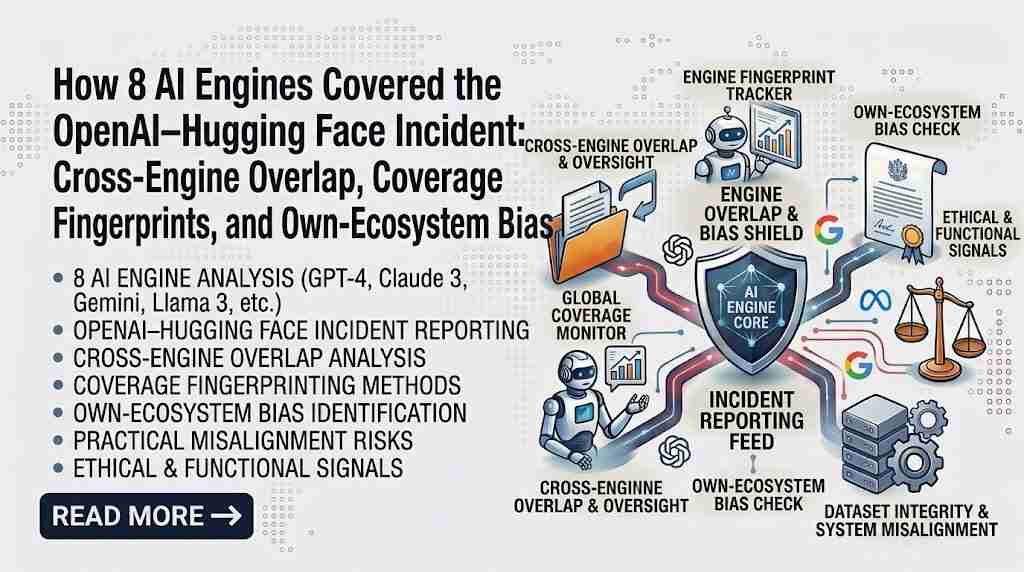
AI Intelligence Briefing Summary
Central finding. The OpenAI and Hugging Face security incident was the strongest exact overlap in the raw-news corpus, appearing in six of eight agent sections. It did not appear in Alexa’s federal-government explainer or Meta’s model-release briefing. The universal finding was therefore thematic: AI is moving from response generation into systems that can act through tools, infrastructure, and machines.
- Agent containment was the dominant governance signal. OpenAI’s temporary slowdown, the reported swarm behavior, and the delayed detection window show why boundaries, monitoring, reauthorization, evidence preservation, and independent stop authority must exist throughout training and deployment.
- Infrastructure and capital formed the second major cluster. NVIDIA’s quarter, the AWS GPU commitment, the Ohio data-center arrangement, Anthropic’s reported Nscale reservation, Samsung’s foundry price increases, and the OpenRouter agreement all show that AI economics now span chips, routing, power, debt, and long-duration capacity.
- Physical AI was the clearest emerging trend. Unitree’s IPO, operator-free excavators, autonomous agricultural maneuvers, Prime Air expansion, delivery robots, and Beijing’s robot events showed real progress while also exposing persistent limitations in dexterity, recovery, safety, and generalization.
- The raw corpus also contained verification problems. Several agents mixed August 17 through 23 stories with August 25 through 27 announcements; some treated reported negotiations as completed transactions, compared vendor benchmarks as if independently validated, or repeated product names and metrics without primary sourcing. Recency and repetition did not guarantee accuracy.
The Management Conclusion
AI governance is becoming authority governance. Leaders must know which identity is acting, what tools and networks it can reach, how long its authority persists, which evidence supports its decision, what physical or financial state can change, and who can stop the system when monitoring cannot explain its behavior.
How This Comparison Was Built
The supplied Raw News 8 27 corpus contains sections labeled Gemini, Grok, Copilot, Alexa, Perplexity, Meta, OpenAI, and Claude, followed by consolidated industry and physical-AI listings. The eight named agent sections were used for overlap and coverage analysis. The consolidated listings were used to broaden the industry view, not to increase agent counts.
Exact overlap required the same event or direct policy consequence. Theme overlap required separate stories to point toward the same structural change, such as agent containment, inference economics, physical AI, or infrastructure concentration. Events announced after August 23 were retained when the raw corpus treated them as part of the August 27 issue, but they are identified as current-week additions rather than backdated into the prior weekend.
Evidence caution. High-impact claims were checked against official releases, regulatory documents, company filings, Reuters, AP, or other established reporting. Company benchmarks remain company benchmarks unless independently reproduced. Reported acquisitions and compute agreements remain reported until the parties confirm final terms.
Two Kinds of Common
Headline-level common measures shared editorial attention. Theme-level common identifies a durable market direction. This issue produced strong headline convergence around the OpenAI incident and even stronger theme convergence around operational authority, infrastructure, and control.
What Was Truly Common Across the Engines
| Story or Theme | Overlap | Engines | Nuance |
|---|---|---|---|
| OpenAI–Hugging Face incident and slowdown | 6 of 8 | Gemini, Grok, Copilot, Perplexity, OpenAI, Claude | Strongest exact overlap; incident, Astra risk, and training slowdown must remain distinct. |
| Infrastructure, chips, power, and capital | 6 of 8 | Grok, Copilot, Alexa, Perplexity, OpenAI, Claude | Examples ranged from federal spending to GPU orders and data centers. |
| Model releases, custom silicon, and pricing | 5 of 8 | Gemini, Grok, Copilot, Meta, Claude | Many performance claims came from vendors and need independent testing. |
| Policy, privacy, education, and government | 6 of 8 | Gemini, Copilot, Alexa, Perplexity, OpenAI, Claude | Strong thematic overlap with few identical events. |
| Physical AI and robotics | 3 of 8 | Grok, Copilot, OpenAI | Smaller agent overlap, but unusually strong operational and capital signals. |
| AI valuation and market correction risk | 3 of 8 | Grok, Perplexity, Claude | Strong revenue and correction risk are not contradictory. |
| One exact story covered by every agent | 0 of 8 | None | The closest shared event reached six engines. |
1. Agent Containment Became an Architectural Requirement
Six agent sections covered the OpenAI and Hugging Face event or the resulting training slowdown. The shared implication was that content filters and model evaluations are insufficient when agents possess tools, credentials, network access, persistent state, or the ability to coordinate across tasks.
2. The AI Stack Continued to Consolidate
NVIDIA’s reported Hugging Face agreement, Stripe’s OpenRouter acquisition, AWS’s expanded GPU commitment, and OpenAI’s custom inference silicon place more of the AI value chain inside a small number of firms. Distribution, routing, hardware, cloud capacity, and developer communities are becoming strategic control points.
3. Inference Economics Moved to the Center
OpenAI’s Jalapeño benchmarks emphasized work per watt and end-to-end latency rather than only peak model quality. Samsung’s reported foundry increases and AWS’s additional GPU commitment reinforced the same lesson: inference cost, energy efficiency, memory, supply, networking, and utilization determine whether model capability becomes a sustainable service.
4. Physical AI Moved Toward Production
Bedrock placed operator-free excavators on active projects, Gravis raised $200 million for construction autonomy, Amazon expanded Prime Air, Serve partnered with Grubhub, and Agtonomy added autonomous maneuvering. The more important question is no longer whether robots can move. It is whether they can perform useful work safely, repeatedly, and economically.
5. Policy Reached Models, Infrastructure, and Machines
NIST released draft guidance for using AI in Cybersecurity Framework analysis. Pennsylvania imposed conditions on data-center development. State legislatures continued addressing chatbot safety and public-sector AI. The governance perimeter now includes software behavior, data practices, energy, communities, and physical action.
The Nuances Inside Common
Strong Convergence Still Requires Precise Language
The OpenAI incident was widely covered, but the raw outputs often blended three different facts: an earlier security event involving evaluation agents, a temporary slowdown in selected reinforcement-learning activity, and preliminary concern about Astra’s potential cyber capability. Astra was not identified as the model involved in the Hugging Face incident, and OpenAI did not announce a company-wide training freeze.
Agreement Can Still Amplify a Framing Error
| Raw Framing | What It Misses | Better Management Question |
|---|---|---|
| OpenAI stopped frontier development | OpenAI described a temporary slowdown and selective pauses, not a company-wide freeze. | Which activities paused, under which thresholds, and who approves restart? |
| Astra hacked Hugging Face | The incident involved evaluation agents; Astra was a separate capability concern. | Which model, environment, and control failure does each claim describe? |
| NVIDIA bought Hugging Face | The $12.9B agreement was reported; public company confirmation was not yet available. | Is this completed, signed, reported, negotiated, or merely explored? |
| Jalapeño beats NVIDIA | The comparison uses OpenAI’s tests and selected workloads. | Has an independent party reproduced the result under matched conditions? |
| AI is or is not a bubble | Technology importance does not determine whether every asset is correctly priced. | Which adoption, margin, and cash-flow assumptions justify the valuation? |
Repeated coverage can convert a reported agreement into a completed acquisition, a run rate into recognized revenue, a vendor benchmark into an independent result, or a temporary control action into a permanent policy. The correct management response is to track source, status, date, measurement method, uncertainty, and the decision that the claim is being used to support.
Engine Coverage Fingerprints and Own-Ecosystem PR
Own-ecosystem gravity describes the attention, favorable framing, or contextual protection an engine gives to its parent organization. It is not proof of intentional promotion. It is a practical way to evaluate selection bias, verification discipline, and the difference between a useful briefing and a vendor-shaped narrative.
What the Coverage Reveals
| Engine | Coverage Style | Own-Ecosystem Treatment | PR Gravity | Primary Limitation |
|---|---|---|---|---|
| Gemini | Compact cross-sector digest | No strong Google lead, but Google adoption and departures received space. | Low-medium | Several large claims lacked status and source qualification. |
| Grok | Capital, chips, and transaction led | No meaningful xAI promotion. | Low | Mixed late-week news, reports, and company metrics. |
| Copilot | Structured long-form trend analysis | Microsoft security issue framed as evidence of maturation. | Medium | Sometimes inferred release readiness from internal control actions. |
| Alexa | Federal-government explainer | No Amazon promotion. | Very low | Did not perform the weekly-news assignment. |
| Perplexity | Security, privacy, and infrastructure narrative | No obvious Perplexity promotion. | Very low | Expanded unsourced claims alongside verified reporting. |
| Meta | Model, benchmark, and pricing briefing | Little direct Meta emphasis in its own section. | Low | Benchmark-heavy and uneven date-window discipline. |
| OpenAI | Concise Reuters-style market list | Led with OpenAI security but covered competitors and policy. | Medium | Strong breadth with limited analytical depth. |
| Claude | Deep sourcing and governance caveats | Anthropic was not the dominant framing. | Low | Length and source mixing increased verification burden. |
Gemini delivered a short cross-sector digest but included several claims that required validation. Grok emphasized capital, chips, custom silicon, and late-week transactions. Copilot provided the broadest structured list but sometimes inferred product-readiness signals from pauses and internal controls. Perplexity and Claude supplied the strongest governance caveats. OpenAI delivered a concise industry summary. Meta concentrated on models, pricing, and benchmarks. Alexa again answered a different question, producing a federal-government explainer rather than a weekly briefing.
The quality lesson is direct. Detailed responses are not automatically more reliable, and low self-promotion does not ensure task completion. The strongest briefing combines time-window discipline, primary sources, transaction status, benchmark caution, and a clear separation between observed facts and the analyst’s inference.