State & Local AI Policy: States Defend Their Authority as Federal Preemption Pressure Builds
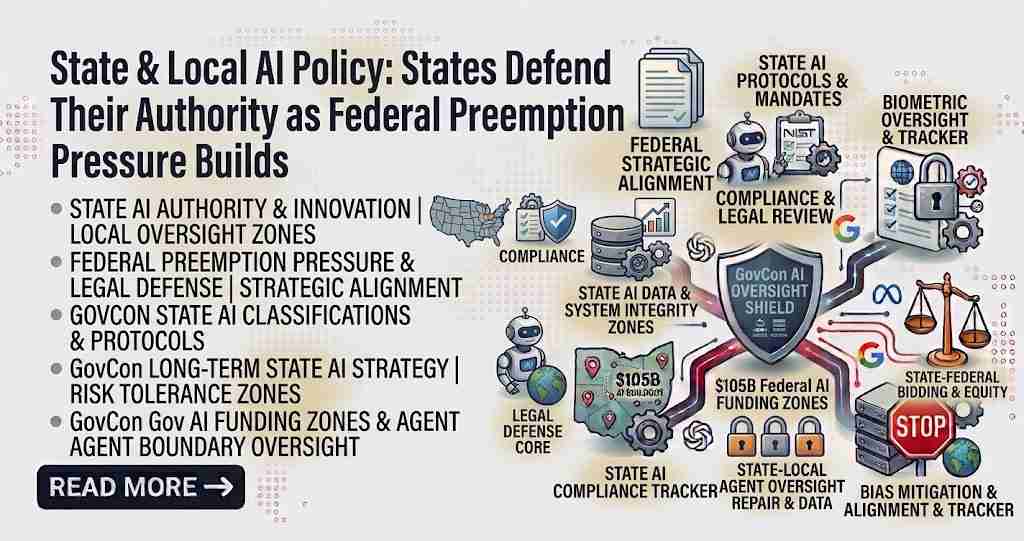
Summary: State governments are fighting a two-front battle this quarter — defending their legislative authority against federal deregulatory pressure while simultaneously deploying AI inside their own agencies. Colorado and California have built enforceable risk frameworks, more than 35 states have criminalized deepfakes, and social service departments are using conversational AI to clear benefits backlogs. But a widening capability gap between resource-rich and smaller states is becoming its own governance risk.
State Laws Around AI
• The federal-state preemption battle. A sharp legal battle is underway between state-level consumer protections and federal deregulatory directives. While federal policy seeks to challenge local restrictions under the Commerce Clause (and condition broadband grants on regulatory restraint), states continue to defend independent legislative authority.
• Comprehensive risk frameworks. States led by Colorado (SB 205) and California (AB 2013, SB 942) have established enforceable frameworks requiring algorithmic impact assessments, anti-discrimination auditing in employment and lending, and clear training-data transparency disclosures.
• Targeted deepfake and election bans. More than 35 states have passed strict legislation criminalizing non-consensual deepfake pornography, banning synthetic voice-cloned voter suppression calls within 60 to 90 days of an election, and mandating watermarks on campaign media.
State Government
• Clearing administrative backlogs. State social service and labor departments are deploying conversational AI to eliminate massive backlogs in unemployment claims, Medicaid eligibility processing, and public housing applications.
• Digital divide among states. A capability gap has emerged between resource-rich states (such as California, New York, and Texas, which maintain dedicated state AI sandboxes and advisory boards) and smaller states reliant on generic third-party software with minimal technical audit capabilities.
• Public workforce upskilling. States are instituting mandatory AI training programs for civil servants, focusing on preventing public data leakage into commercial models and identifying bias in algorithmic decision systems.