US Federal AI Policy: A Deregulatory Pivot Pairs Fast-Tracked Compute With New NIST Guardrails
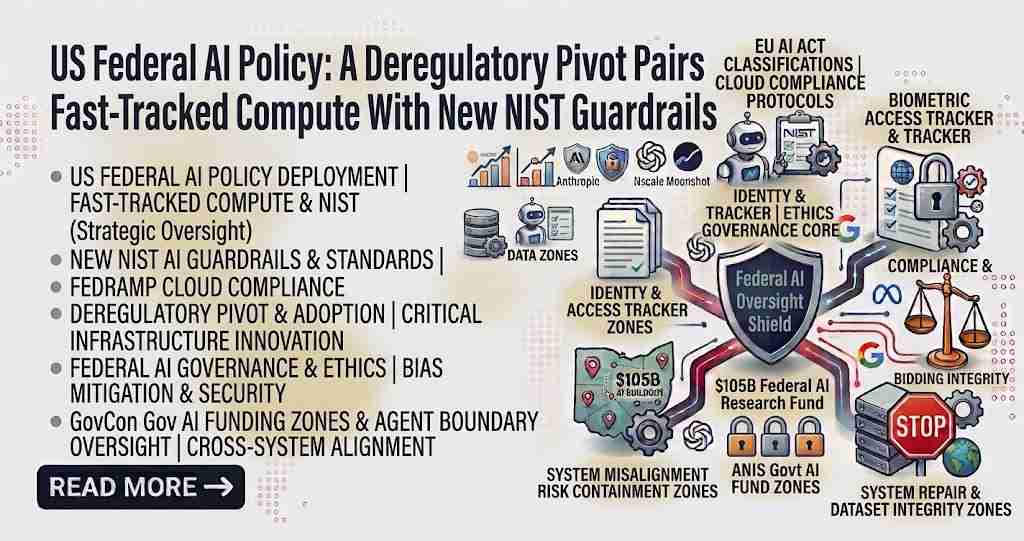
Summary: Federal AI strategy has moved decisively toward acceleration. Executive Order 14179 rescinded the prior administration’s mandatory safety reporting regime, AI compute has been classified as critical economic infrastructure with expedited energy permitting, and export controls have tightened around advanced semiconductors. At the same time, NIST is standing up economic security centers and expanding frontier model evaluation — creating a federal posture that is simultaneously more permissive on deployment and more technical on measurement. For contractors, the most immediate change is procurement: GSA and OMB have standardized the vehicles agencies use to buy enterprise LLM seats.
US National Policy and Federal Government
• Deregulatory and innovation-first pivot. Guided by Executive Order 14179 (“Removing Barriers to American Leadership in Artificial Intelligence”) and the national AI Action Plan, federal strategy has replaced mandatory safety reporting requirements (rescinding the prior administration’s EO 14110) with policies designed to eliminate bureaucratic hurdles and accelerate commercial deployment.
• Energy and data center fast-tracking. The federal government has classified AI compute as critical economic infrastructure, expediting federal permitting for nuclear, natural gas, and clean energy generation directly tied to large-scale data center clusters.
• Export controls and silicon sovereignty. National policy continues to aggressively tighten outbound export controls on advanced semiconductor manufacturing equipment, high-bandwidth memory (HBM), and gate-all-around (GAA) chip designs to strategic rivals.
NIST
• Launch of AI Economic Security Centers. NIST awarded $20 million in partnership with the nonprofit MITRE Corporation to launch two dedicated hubs: the AI Center for U.S. Manufacturing Productivity and the AI Center to Secure U.S. Critical Infrastructure from Cyberthreats.
• AI RMF profile expansion. The agency released updated, operational profiles for its AI Risk Management Framework (AI RMF), establishing concrete guidelines for managing generative AI hallucinations, third-party vendor risks, and autonomous agent tool safety.
• Frontier model evaluation at CAISI. The Center for AI Standards and Innovation (formerly the US AI Safety Institute) has expanded testing protocols to measure systemic risks in autonomous models, specifically evaluating autonomous cyber-weaponization and recursive self-improvement.
US Government Operations
• Procurement overhaul. The General Services Administration (GSA) and the Office of Management and Budget (OMB) established standardized federal procurement vehicles, enabling civilian agencies to license enterprise LLM seats and workflow automation tools under streamlined clearance paths.
• Agency-level integration. Civilian agencies have transitioned internal operations to AI: the IRS uses automated models to identify high-net-worth tax evasion schemes, while the USPTO uses computer vision to streamline patent prior-art searches.
• National security prioritization. Defense and intelligence agencies are prioritizing the integration of air-gapped commercial foundation models into tactical edge systems, war-gaming simulations, and automated satellite imagery analysis.