Federal Procurement Is Changing
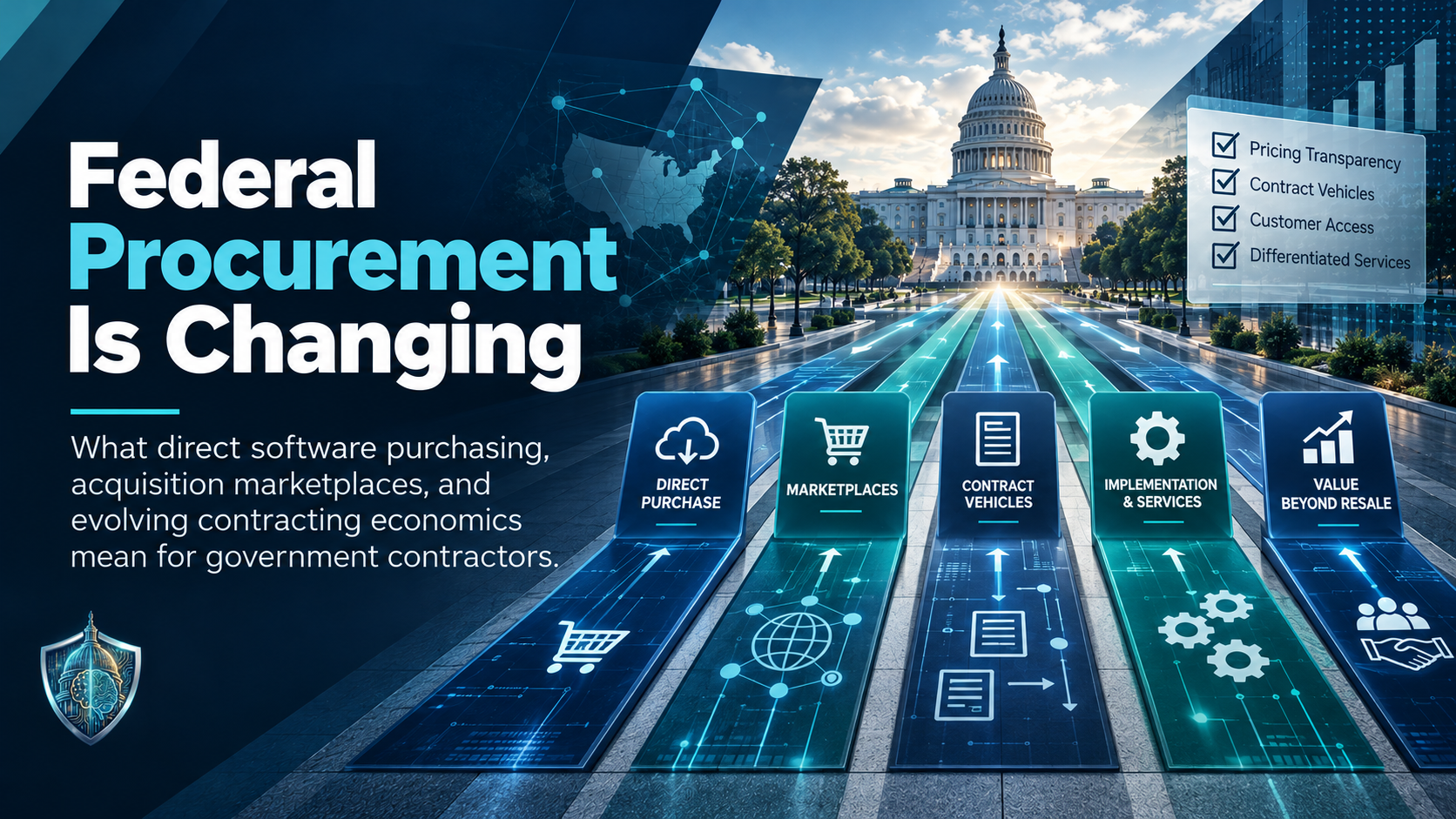
What direct software purchasing, acquisition marketplaces, and evolving contracting economics mean for government contractors
Key Takeaways
- Federal purchasing practices are evolving, not replacing traditional contracting models. Prime contractors, subcontractors, resellers, and implementation partners remain essential, but their roles and economics may shift.
- Direct software purchasing is changing how value is distributed. Initiatives such as GSA’s OneGov can reduce license resale opportunities while increasing the importance of integration, cybersecurity, implementation, and ongoing support.
- Government marketplaces are expanding procurement options. New acquisition mechanisms may create opportunities for contractors, but obtaining a contract award or marketplace listing does not guarantee revenue.
- Contractors must demonstrate measurable value beyond product resale. Pricing transparency and scrutiny of reseller markups increase the importance of differentiated services and documented outcomes.
- The impact varies by market and business model. Contractors should evaluate changes in customer relationships, pricing, contract structures, and actual spending before adjusting their growth strategies.
Federal contracting has always relied on multiple ways to reach the customer. Agencies award prime contracts; primes bring in subcontractors; manufacturers work through resellers and implementation partners; and businesses form teaming agreements and joint ventures. None of those relationships is new. The developments of 2026 are significant for a different reason: in several technology markets, federal buyers are reconsidering how they purchase products, how they use contract vehicles, and which services warrant separate payment.
For contractors, the question is not whether the partnership model has suddenly arrived. It is whether familiar relationships will carry the same economics, responsibilities, and customer access as procurement practices evolve. Events from July through September offer useful evidence—but they do not establish one universal model for all federal spending.
OneGov and the push toward manufacturer pricing
GSA launched OneGov in 2025 to coordinate federal purchases of widely used technology, including commercial software and artificial intelligence offerings. During 2026, officials reported substantial estimated savings associated with negotiated offers and limited-time discounts. Those reported savings should be interpreted in the context of the agreements and assumptions behind them, not automatically as realized reductions across every agency budget.
The commercial issue for government contractors is straightforward. If an agency can obtain some enterprise licenses on government-negotiated terms directly from the manufacturer or through a manufacturer-centered arrangement, the resale component of a traditional integrator-led transaction may shrink. That does not eliminate the need for systems integration, cybersecurity, migration, training, governance, adoption, or operational support. It can, however, change which party sells each component and how the overall solution is priced.
The significance is strongest where repeatable commercial licenses account for a meaningful share of contract value. The impact is not necessarily comparable for labor-intensive professional services, construction, mission-specific development, or other segments with distinct acquisition and performance requirements.
CACI and Oracle: a change in sequence, not the invention of teaming
CACI chief executive John Mengucci offered a practical example in August. Discussing the federal government’s interest in purchasing software licenses more directly, he described historical license pass-through revenue as generating little or no margin for integrators. The shift could reduce reported revenue tied to license resale while supporting a more favorable percentage margin on services. That is not a guarantee of higher total profit; companies still have to protect services pricing, utilization, and scope.
The Office of Personnel Management’s Federal HR 2.0 modernization provides an example: Oracle received a 10-year contract valued at approximately $395.8 million and identified CACI, Baker Tilly, and Deloitte as teammates. These are established types of partnerships. What makes the example noteworthy is the ordering and economics: the technology provider anchors the transaction while implementation specialists deliver complementary work. Mengucci characterized the arrangement as “merely changing the order of things.”
This distinction prevents a misleading takeaway. An integrator does not become strategically irrelevant when it is not the license seller. Yet it must be able to articulate why its implementation capability, government mission knowledge, security expertise, and long-term support deserve a distinct share of spending.
Marketplaces: several different models under one label
“Marketplace” is an appealing term, but it can conceal substantial differences. Some arrangements are online catalogs, others are multiple-award contracts, and still others combine evaluation mechanisms with ordering pathways. A listing, an award, and a funded task order are not interchangeable milestones.
In September, DISA published the final JWCC Unified Cloud Marketplace Core solicitation for a follow-on cloud acquisition. The Core solicitation concerns a particular cloud-provider requirement; announcements about additional JWCC marketplace opportunities should not be mistaken for active awards or open eligibility for every smaller vendor. Contractors evaluating opportunities must read the specific solicitation, qualification standards, teaming requirements, and ordering procedures.
Also in September, the Army announced ten counter-unmanned aircraft system IDIQ awards in support of JIATF-401 and Domestic Shield, within an acquisition approach that uses a multi-vendor marketplace and common technical requirements. The published award ceilings represent potential ordering capacity rather than money committed to each company. Winning access to a vehicle is therefore a business-development milestone, not proof of customer demand or revenue.
Resellers face a clearer test of value
Federal Acquisition Service discussions in July emphasized pricing transparency and the value provided by resellers beyond the underlying product markup. That direction reinforces an established commercial discipline: customers should be able to identify what they are paying for, whether it is licensing, configuration, architecture, security, support, or continuous improvement.
For value-added resellers, the strategic response is not simply to rename resale as implementation. It is to develop demonstrable services, separate scopes and pricing when appropriate, and present evidence of outcomes that cannot be purchased as an undifferentiated license.
Who may be affected—and how
Software manufacturers and product companies
Manufacturer-centered purchasing can create a clearer pricing conversation with federal buyers, but it also raises expectations around government-specific terms, compliance, onboarding, account support, and delivery partnerships. Direct relationships do not remove the need to manage the full customer lifecycle.
Systems integrators and implementation firms
Integrators should examine the mix of resale and higher-value services in existing pursuits. The better measure is not headline contract revenue alone but gross profit, delivery risk, customer outcomes, access to renewals, and defensibility at recompete.
Small and emerging contractors
New contract vehicles or marketplace mechanisms may provide opportunities to pursue qualifications or team with awardees, but entry requirements can still be substantial. A company needs technical proof, compliance readiness, references, and a credible demand-generation plan; being eligible to compete is not the same as being selected for work.
Resellers and distributors
Firms dependent on license markups may face the greatest pressure to document differentiated work. Firms already providing deployment, managed operations, analytics, security, or customer-success services may be better positioned to explain their contribution.
Five signals contractors should monitor
- New solicitations and awarded vehicles: which services and suppliers are in scope, and which are only proposed?
- Contract structure: who signs with the agency, who invoices, who owns delivery responsibility, and who holds the customer relationship?
- Pricing language: how are licenses, migration, implementation, support, and consumption charges separated?
- Actual obligations and task orders: is purchasing activity following the headline ceilings and announcements?
- Renewal and recompete practices: which party maintains adoption data, performance records, and executive relationships?
The strategic implication
The best reading of the third quarter is narrower—and more useful—than a declaration that the traditional prime model is obsolete. In selected technology markets, agencies are testing or expanding ways to buy commercial capabilities while making associated services more visible. That can shift revenue presentation, negotiating leverage, and the order in which partners enter a deal. It does not erase prime contracting, subcontracting, or strategic teaming.
Contractors should map these developments against their own customers and offerings, then review the economics and relationships in the next opportunity pipeline. The businesses that respond effectively will not be those chasing a newly named “route,” but those that understand where their value remains indispensable.
Companion article: “Prime, Partner, or Subcontractor? How to Choose the Right Route Into a Government Market” provides a decision framework and route-selection worksheet for evaluating specific opportunities.
Sources and further reading
GSA OneGov initiative
https://www.gsa.gov/technology/it-contract-vehicles-and-purchasing-programs/onegov
Nextgov/FCW, CACI and OneGov, Aug. 11, 2026
https://www.nextgov.com/acquisition/2026/08/how-caci-looks-governments-software-license-buying-shift/415346/
Nextgov/FCW, OneGov savings, Aug. 13, 2026
https://www.nextgov.com/acquisition/2026/08/onegov-savings-balloon-over-16-b-agencies-weigh-future-ai-contracting/415416/
SAM.gov, JWCC UCM Core Solicitation, Sep. 2026
https://sam.gov/opp/1081ea461a094cc187ccd7608f8041f5/view
U.S. Army, JIATF-401 C-UAS awards, Sep. 29, 2026
https://www.army.mil/article/295771
Federal News Network, FAS industry day, July 2026
https://federalnewsnetwork.com/commentary/2026/07/fas-industry-day-new-transparency-focus-follows-a-major-reorganization/