Prime, Partner, or Subcontractor?
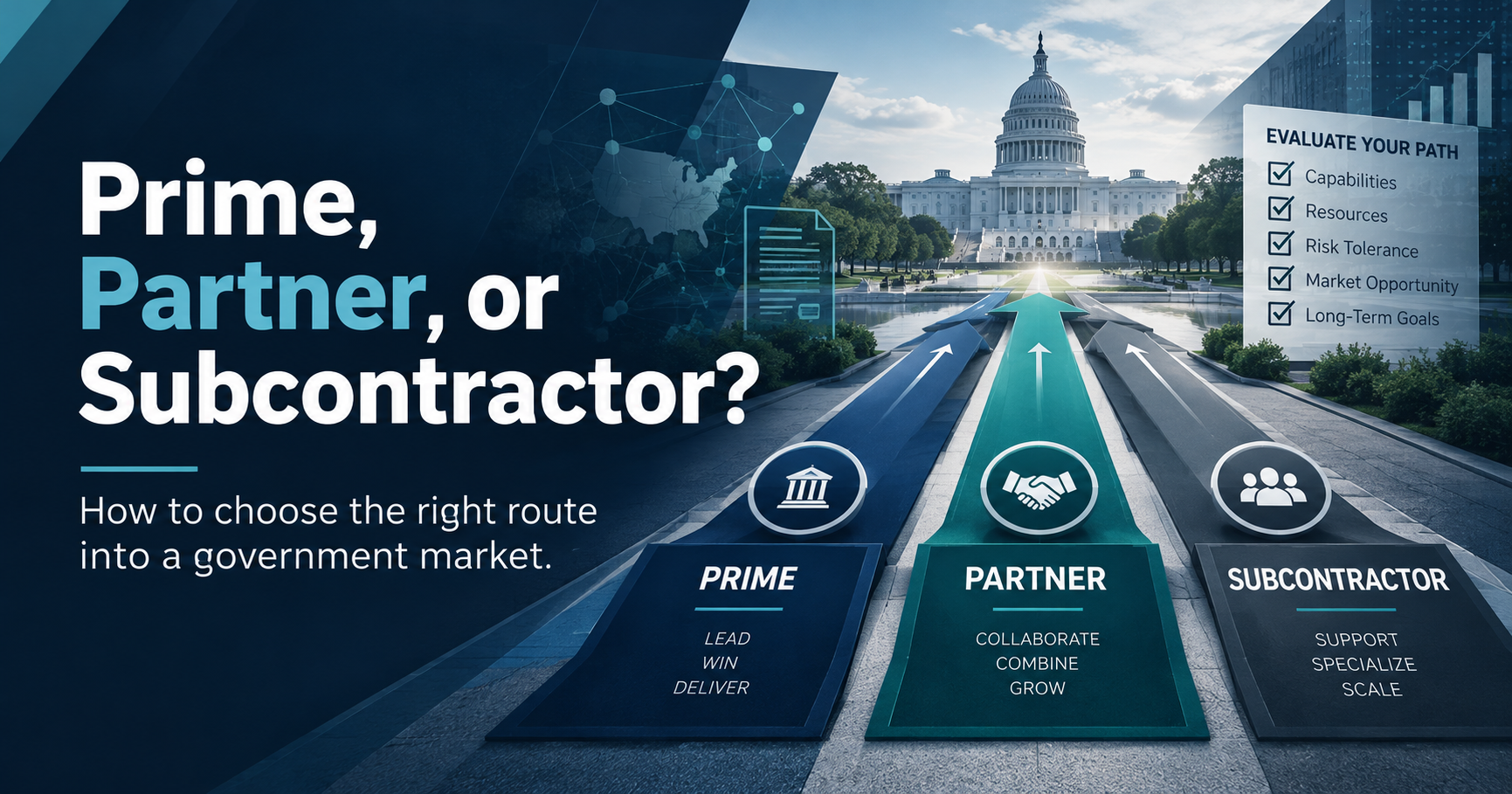
How to choose the right route into a government market—with a practical, weighted route-selection worksheet
Download the Government Contractors – Route Selection Worksheet which is referenced in this article to help your company or organization better identify the best pathway forward.
Key Takeaways
- There is no single best route into government contracting. Prime contracting, subcontracting, strategic teaming, implementation partnerships, and other approaches offer different advantages depending on the opportunity and a company’s capabilities.
- Contracting roles, partnerships, and purchasing channels are different decisions. Companies can combine multiple approaches to reach customers, deliver services, and pursue opportunities.
- Evaluate each route against seven critical factors. Customer access, profitability, delivery readiness, past performance, capture investment, customer control, and long-term strategic value should guide decisions.
- Use a weighted route-selection worksheet to compare opportunities. Scoring potential approaches helps identify strengths, weaknesses, risks, and the most practical path forward, after mandatory eligibility requirements are satisfied.
- Turn the assessment into an actionable growth strategy. Validate assumptions, establish partner relationships, and develop a 30–60–90-day plan while reassessing opportunities as market conditions change.
A company may prime one federal contract, subcontract on another, deliver implementation services for a software manufacturer, and participate in a government purchasing vehicle at the same time. These are not new inventions, and they are not always competing alternatives. The strategic question is which combination gives a specific business the best chance to win profitable, deliverable work with an attractive long-term position.
Recent developments in direct software licensing and acquisition marketplaces make this assessment timely. But the same discipline applies when entering an agency, pursuing a new mission area, launching a product line, or expanding from commercial into federal business. Begin with the opportunity, not with a preferred label.
Separate three decisions that are often confused
A contracting role answers who is accountable to the government: prime contractor, subcontractor, or joint-venture participant. A commercial relationship answers how partners contribute: OEM, integrator, reseller, distributor, or specialist. A purchasing channel answers how the government orders: a schedule, governmentwide acquisition contract, agency-specific IDIQ, marketplace-style mechanism, or stand-alone procurement. One pursuit can combine all three dimensions.
A cybersecurity integrator, for example, could subcontract to a large prime, implement a manufacturer’s product, and deliver the work under a contract vehicle. Treating those descriptions as rival “routes” would obscure the actual negotiation and risk allocation.
Seven pathways worth evaluating
Prime contractor
Best when you have a viable path to the procurement, relevant past performance, pricing discipline, the operational capacity to manage subcontractors, and tolerance for full contract accountability.
Subcontractor
Useful for accessing a mission or customer through an established prime, particularly when your expertise fills a genuine gap. Protect workshare, scope, data access, and payment terms.
Strategic teaming partner
Suitable when firms combine account access, technical capability, delivery capacity, or complementary offerings. Teaming must be translated into a specific pursuit plan and enforceable agreements.
OEM implementation or service partner
Fits firms with specialized integration, migration, training, security, operations, or adoption expertise. The manufacturer may sell the underlying product, but the service partner still needs durable economics and customer visibility.
Reseller or channel partner
Works when the firm contributes procurement access, support, solution architecture, or other recognized value. Thin product markup alone can create commercial exposure.
Joint venture or mentor-protégé arrangement
Potentially useful where authorized and eligible; it requires careful analysis of ownership, control, compliance, workshare, and applicable SBA rules rather than treating a relationship as automatic procurement eligibility.
Marketplace or contract-vehicle participation
Can facilitate access to government orders where a company satisfies the particular admission and technical standards. A contract award, catalog listing, and funded order are distinct outcomes.
The seven tests for a specific opportunity
Evaluate each plausible pathway using the same criteria. Rate its expected fit for the target agency or program, not your company in the abstract. For consistency, 1 always means poor fit and 5 means excellent fit; for risk and cost dimensions, a higher score means more manageable risk or a more feasible investment.
Buyer access
Can we credibly reach a decision-maker and meet the actual vehicle or competition rules?
Profit potential
Will likely gross profit justify pursuit and delivery effort after partner fees and discounts?
Delivery readiness
Can we perform our role and manage the obligations without overextending the team?
Past performance and proof
Do we have customer evidence, qualifications, and relevant references?
Capture investment and speed
Can we afford the pursuit, qualification effort, and expected time to first order?
Customer visibility and control
Will we obtain access to stakeholders, feedback, and performance data?
Durability and strategic value
Does this relationship support renewals, follow-on work, and future positioning?
How to use the route-selection worksheet
1. Define one customer, mission, and realistic opportunity.
2. Select two or three feasible pathways and state your assumptions.
3. Apply go/no-go gates first: eligibility, security/compliance, required capabilities, customer access, and partner commitment.
4. Assign importance weights from 1 (low) to 3 (critical) across seven criteria.
5. Score each route from 1 (poor fit) to 5 (strong fit); multiply each score by the criterion weight.
6. Total the weighted scores and divide by the maximum possible points—five times the sum of the weights—to obtain a comparable percentage.
7. Stress-test the top choice against downside cases and build an action plan. A score informs judgment; it does not predict a contract award.
Do not count a pathway as viable if it fails a non-negotiable eligibility or performance requirement, regardless of the numerical score. Compare the scenarios on the same assumptions; do not treat an unawarded marketplace opportunity as a currently available sales channel.
Route-selection worksheet — blank template
Download the Government Contractors – Route Selection Worksheet which is referenced in this article to help your company or organization better identify the best pathway forward.
| Criterion | Weight 1–3 | Prime 1–5 | Sub 1–5 | OEM partner 1–5 |
| Buyer access | ____ | ____ | ____ | ____ |
| Profit potential | ____ | ____ | ____ | ____ |
| Delivery readiness | ____ | ____ | ____ | ____ |
| Past performance and proof | ____ | ____ | ____ | ____ |
| Capture investment and speed | ____ | ____ | ____ | ____ |
| Customer visibility and control | ____ | ____ | ____ | ____ |
| Durability and strategic value | ____ | ____ | ____ | ____ |
Weighted total = Σ(weight × route score). Maximum = 5 × Σ(weights). Route fit = weighted total ÷ maximum × 100%. You may replace a column with JV, reseller, or an eligible marketplace pathway.
Illustrative scenario: small cybersecurity integrator
Consider a 20-person cybersecurity business pursuing a federal agency where it has technical expertise but limited agency-specific past performance and no direct access to the anticipated prime contract vehicle. A credible incumbent prime is open to discussing a defined subcontract; an OEM has a product requiring implementation services. This hypothetical company wants near-term services revenue while developing a stronger agency position.
Using illustrative scores and a maximum of 95 points: prime = 45/95 (47%); subcontract = 72/95 (76%); OEM implementation partner = 69/95 (73%).
Subcontracting emerges as the best immediate fit because the prime offers access, relevant pursuit infrastructure, and a feasible route to first revenue. OEM implementation remains a useful second line of business. Prime contracting ranks lower for this opportunity—not because it is intrinsically inferior, but because the company currently lacks vehicle access and agency-specific proof. The rational next step is to validate subcontract workshare and deal economics, not automatically award itself a prime role.
Turn the assessment into a 30–60–90-day plan
- First 30 days: verify the actual opportunity, the acquisition vehicle, target buyer, eligibility, and expected contract economics; interview potential partners.
- Days 31–60: secure documented teaming or subcontract scope, build a proof package, and model pricing, delivery costs, and downside scenarios.
- Days 61–90: pursue the selected opportunity, establish a customer-engagement and performance-data plan, and reassess whether the prime or OEM path deserves parallel investment.
What the worksheet cannot tell you
A weighted score is a planning aid, not a win-probability model or legal determination of eligibility. It can obscure uncertainty when based on guesses. Record assumptions, verify the relevant solicitation and SBA requirements, and rerun the assessment when access, customer requirements, funding, partner commitments, or scope changes.
Companion article: “Federal Procurement Is Changing” examines the 2026 shifts in direct purchasing, marketplace-style acquisition, and implementation economics that make route selection worth revisiting.
Need help comparing routes for a specific customer or opportunity? Contact Government Contractors LLC at 703-996-9029 or team@governmentcontractors.com. Visit GovernmentContractors.com.
Sources and further reading
GSA OneGov initiative
https://www.gsa.gov/technology/it-contract-vehicles-and-purchasing-programs/onegov
Nextgov/FCW, CACI and OneGov, Aug. 11, 2026
https://www.nextgov.com/acquisition/2026/08/how-caci-looks-governments-software-license-buying-shift/415346/
Nextgov/FCW, OneGov savings, Aug. 13, 2026
https://www.nextgov.com/acquisition/2026/08/onegov-savings-balloon-over-16-b-agencies-weigh-future-ai-contracting/415416/
SAM.gov, JWCC UCM Core Solicitation, Sep. 2026
https://sam.gov/opp/1081ea461a094cc187ccd7608f8041f5/view
U.S. Army, JIATF-401 C-UAS awards, Sep. 29, 2026
https://www.army.mil/article/295771
Federal News Network, FAS industry day, July 2026
https://federalnewsnetwork.com/commentary/2026/07/fas-industry-day-new-transparency-focus-follows-a-major-reorganization/