Which Accounts Deserve Your Best People? A GovCon Prioritization Framework
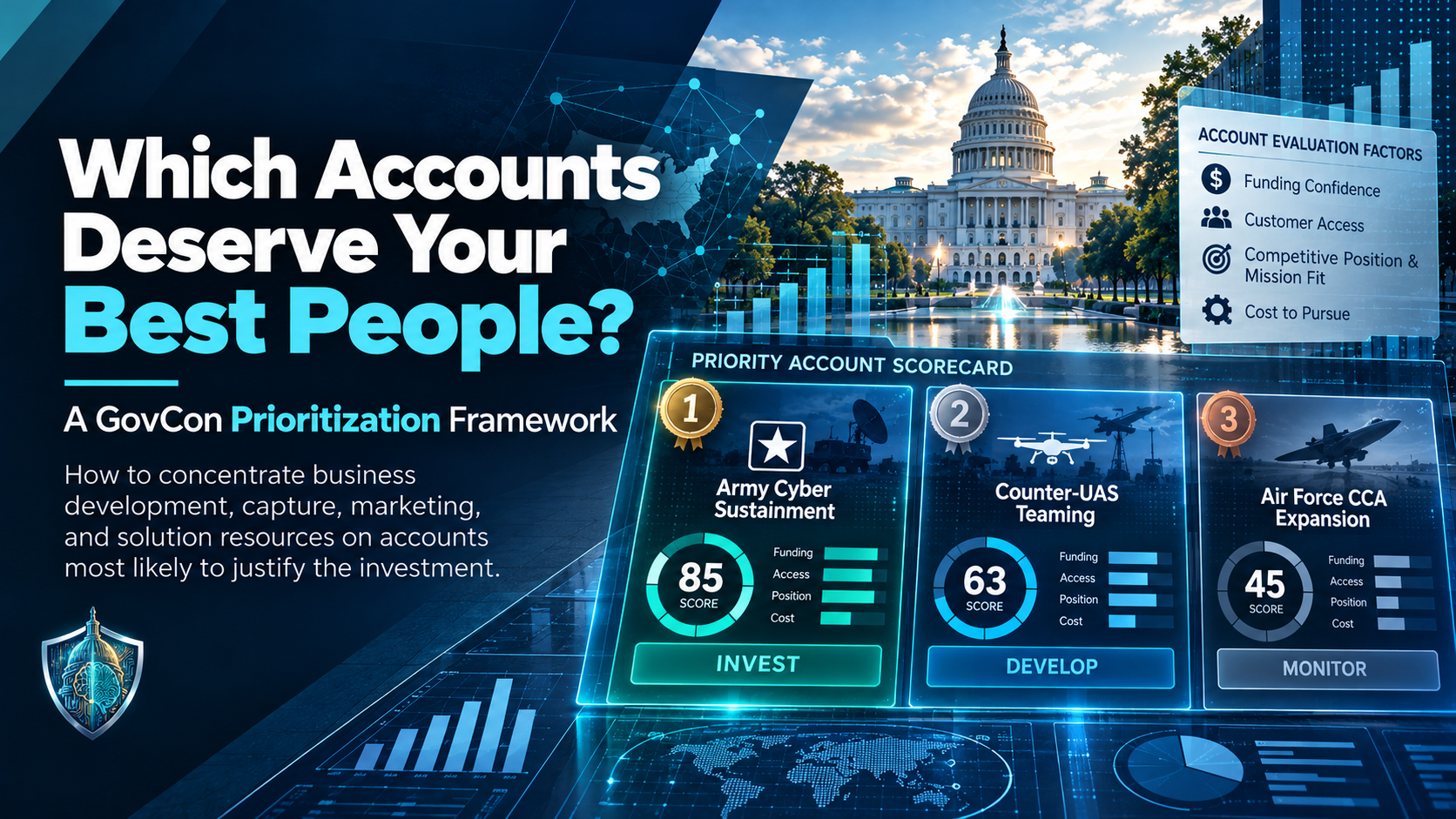
How to concentrate business development, capture, marketing, and solution resources on accounts most likely to justify the investment
Download the Government Contractors – Federal Account Scorecard which is referenced in this article to help your company better prioritize your best people and their time.
Key Takeaways
- Not every promising government account deserves equal investment. Prioritize accounts with a validated mission need, credible funding, an accessible buying route, and a realistic opportunity to compete.
- Funding confidence matters more than headline contract value. Budget requests, contract ceilings, appropriations, and actual obligations represent different levels of certainty.
- Score accounts against four practical criteria: funding confidence, customer access, competitive position and mission fit, and cost to pursue.
- Allocate your strongest people to accounts where they can influence outcomes. High-priority accounts warrant dedicated business development and capture resources; uncertain opportunities may require targeted research rather than full pursuit teams.
- Reassess priorities as evidence changes. New funding decisions, acquisition milestones, competitor developments, and customer access can change which accounts deserve investment.
A contractor can identify a legitimate defense priority, build a compelling capability story, and still make a poor decision by assigning its best people to the wrong account. The failure may have little to do with the mission. The relevant funding may be proposed rather than available; the buying route may exclude the company; or an incumbent may have a decisive advantage before a solicitation appears.
That distinction matters when growth teams are stretched. A senior capture manager can lead only so many pursuits; solution architects and subject-matter experts cannot support every promising meeting; and proposal investment in one account delays work elsewhere. Account prioritization is therefore not a ranking of agencies by size. It is a decision about where scarce people and dollars can most plausibly produce results.
The quarter’s lesson: attention follows evidence, not headlines
From July through September 2026, defense announcements supplied three different forms of signal. In July, the Air Force discussed a future downselect in the second increment of its Collaborative Combat Aircraft (CCA) program—a meaningful competitive milestone, but not the same thing as a funded production opportunity for every prospective supplier [1]. In September, reporting on a Pentagon reprogramming request described proposed transfers for AI computing and other priorities; those transfers required congressional approval, so the request itself was not proof that a particular contract was funded [2].
The Army’s September counter-unmanned aircraft system (counter-UAS) awards offer another contrast. They established multiple-award IDIQ pathways for named vendors, but a contract ceiling is not an order and does not establish the amount of downstream work available to a prospective teammate [3]. Federal spending guidance distinguishes obligations—the government’s financial commitments—from outlays, or payments, and from other budget figures [4].
For growth leaders, the right response is not to dismiss emerging programs. It is to distinguish a market worth monitoring from an account worth staffing aggressively right now.
Define the account at the level where decisions get made
“The Department of Defense” or “the Air Force” is too broad to score meaningfully. A usable account definition names the mission owner or buying organization, the specific need, the likely contracting office or vehicle, the budget or program context, and the next decision that could move the opportunity forward. Where the buyer and program office are different, document both.
Consider two teams pursuing the same large agency. One has an existing relationship with a program office, delivery references, and a known recompete. The other has a high-level interest in an unfunded modernization concept. Their nominal market is identical; their account economics are not. Score the actual buyer–need–route combination, not the attractiveness of an agency logo.
A four-factor account prioritization scorecard
Use a 1–5 rating for each factor, where 1 is unfavorable or unproven and 5 is strongly supported by current evidence. The weights below are illustrative, not a universal standard. Choose weights before scoring accounts, keep the same rubric across the portfolio, and document both the rating and the evidence behind it.
1. Funding confidence — 35%
Is the mission need tied to a credible funding source and an executable purchasing timeline? Distinguish a policy statement or budget request from available appropriations, a planned procurement, an awarded vehicle, and an actual obligation. Rate the specific requirement, not the agency’s total budget. A 5 requires clear, current evidence of funds and a near-term procurement pathway; a 1 reflects no identified funding basis.
2. Customer access and buying route — 25%
Can the team legally and practically reach the buyer through an eligible prime position, subcontract, teaming arrangement, or contract vehicle? Identify the contracting office, likely awardee or incumbent, decision process, and next engagement milestone. A 5 means the route and relevant customer contacts are verified; a 1 means access is speculative or blocked.
3. Competitive position and mission fit — 25%
Do technical capabilities, mission knowledge, past performance, certifications, delivery capacity, and credible partners align with the requirement? Differentiate evidence from aspiration. A 5 means the team can show why it is a stronger choice for this mission; a 1 means the required capabilities or proof are largely absent.
4. Cost to pursue — 15%
How much scarce time and money must be committed before the next decision? Count executive access, BD hours, solution engineering, partner development, travel, pricing, demonstrations, bid-and-proposal work, and opportunity cost. Reverse the scale: 5 means a manageable pursuit burden relative to the potential return; 1 means unusually high cost or disruption.
Calculate a weighted score out of 100: (funding × 35 + access × 25 + fit × 25 + pursuit efficiency × 15) ÷ 5. The result is a consistent prioritization aid, not a probability of winning. A score should never override an ineligible contract route, a missing mandatory capability, or unacceptable delivery economics.
A defense example: three accounts competing for one capture team
Imagine a hypothetical midsize contractor specializing in cybersecurity and systems integration. It already supports one Army customer, has a potential teammate among counter-UAS vendors, and is considering an Air Force autonomy-related expansion. It can fully staff one account, develop one more selectively, and monitor the third. The scores below are invented for illustration; they do not describe the funding, access, or competitive standing of any actual contractor or program.
| Illustrative account / pursuit | Funding 35% | Access 25% | Fit 25% | Effort 15% | Score /100 |
| Existing Army cyber sustainment account | 4 | 5 | 4 | 4 | 85 |
| Army counter-UAS integration teaming | 2 | 4 | 4 | 3 | 63 |
| Air Force CCA support market entry | 2 | 2 | 3 | 2 | 45 |
Weights total 100%. “Effort” rewards lower, proportionate pursuit cost. Scores are illustrative assumptions, not observed program data.
Download the Government Contractors – Federal Account Scorecard to help your company better prioritize your best people and their time.
Why the ranking matters: the established cyber account ranks first not because its overall agency budget is largest, but because the company can describe the requirement, reach the buyer, provide evidence of performance, and pursue it efficiently. The counter-UAS account merits selective work: the Army’s announced acquisition activity is real, but this hypothetical subcontractor has not verified task-order funding or its precise workshare. CCA deserves market research and partner discovery rather than a fully assigned capture team until scope, funding, and access become clearer.
The example also shows why “large ceiling” and “large market” should not be used interchangeably. The real Army counter-UAS announcements establish an acquisition mechanism; they do not validate the hypothetical company’s account-level revenue forecast. Likewise, an Air Force competition schedule can be important intelligence without establishing an immediate service contract for a new entrant.
Turn the ranking into staffing and budget decisions
For an initial operating rule, designate accounts scoring 80–100 as invest, 60–79 as develop, and below 60 as monitor. These bands are management thresholds for this example, not statistically validated win-rate categories. Apply a separate mandatory eligibility and bid/no-bid review before committing proposal resources.
Invest: dedicate a cross-functional account team
For the 85-point Army sustainment account, assign a named BD owner, an accountable capture lead, an executive sponsor, and scheduled solution and marketing support. Build a pursuit calendar tied to real acquisition milestones and define outcomes such as validated requirements, buyer meetings, partner commitments, and approved competitive proof—not just outreach volume.
Develop: fund the next evidence milestone
For the 63-point counter-UAS teaming prospect, designate one BD lead and limited technical discovery hours. Within 30 days, confirm the prospective prime or awardee relationship, potential workshare, likely ordering path, and whether there is a funded requirement. Invest more only if the evidence improves. A legitimate opportunity can deserve disciplined incubation without becoming a full capture campaign.
Monitor: preserve optionality without consuming the team
For the 45-point CCA-related expansion, track program milestones, market research notices, and relevant partners while keeping capture spend modest. Set a trigger for promotion: a defined subcontractable requirement, a credible teaming route, or documented funding and customer engagement. A monitoring decision is not permanent rejection.
Three disciplines that keep the score honest
First, impose eligibility gates before interpreting the ranking. A compelling market cannot compensate for a route that the company cannot bid, an unmet security requirement, or delivery exposure the business cannot sustain. Second, date every assumption. Record where a funding claim originated and distinguish public evidence from a partner’s forecast or internal judgment. Third, review account allocation at least quarterly—and immediately after material events such as a new solicitation, delayed appropriation, major recompete change, relevant protest, task-order award, or lost partner access.
One practical management question is especially useful: “If we moved our best capture leader from Account A to Account B for the next 60 days, what new evidence would justify the switch?” If the answer is merely that B has a larger projected ceiling, the case is weak. If B now has validated funding, a qualified partner, executive access, and a specific decision date, the ranking may genuinely have changed.
The objective is disciplined concentration
Government contracting rewards persistence, but indiscriminate coverage is expensive. The priority account list should be short enough to influence staffing, solution investment, and executive attention—and transparent enough for leadership to challenge. The best accounts are not necessarily the largest or most newsworthy. They are the ones where funded need, a workable buying route, credible mission fit, and proportionate pursuit cost converge.
Government Contractors LLC helps companies connect market intelligence to practical growth and capture decisions. To discuss account prioritization, route-to-market evaluation, or a portfolio review, contact 703-996-9029 or team@governmentcontractors.com.
Sources and further reading
1. Breaking Defense, Air Force CCA second-increment downselect, July 29, 2026: https://breakingdefense.com/2026/07/air-force-plans-downselect-for-second-cca-batch-next-year/
2. Breaking Defense, Pentagon reprogramming request, September 9, 2026: https://breakingdefense.com/2026/09/pentagons-1-5b-reprogramming-would-shift-money-to-ai-center-mv-75-tiltrotor/
3. U.S. Army Public Affairs, counter-UAS IDIQ awards, September 29, 2026: https://www.army.mil/article/295771/jiatf_401_advances_domestic_shield_with_counter_uas_contract_awards
4. USAspending, Analyst’s Guide to Federal Spending Data: https://www.usaspending.gov/federal-spending-guide
5. U.S. GAO, IDIQ obligations and task orders, B-308969: https://www.gao.gov/products/b-308969
6. SAM.gov, Find Contract Opportunities: https://sam.gov/find-contract-opportunities
7. Acquisition.gov, FAR Subpart 7.1 — Acquisition Plans: https://www.acquisition.gov/far/subpart-7.1