Eight AI Platform Briefs, Six Lead Stories: Where Perplexity, ChatGPT, Grok, Claude, Copilot, Meta, Gemini, and Alexa Agreed and Disagreed, Plus the Reporting Trail Behind Issue 81
Eight platform briefs, six lead stories
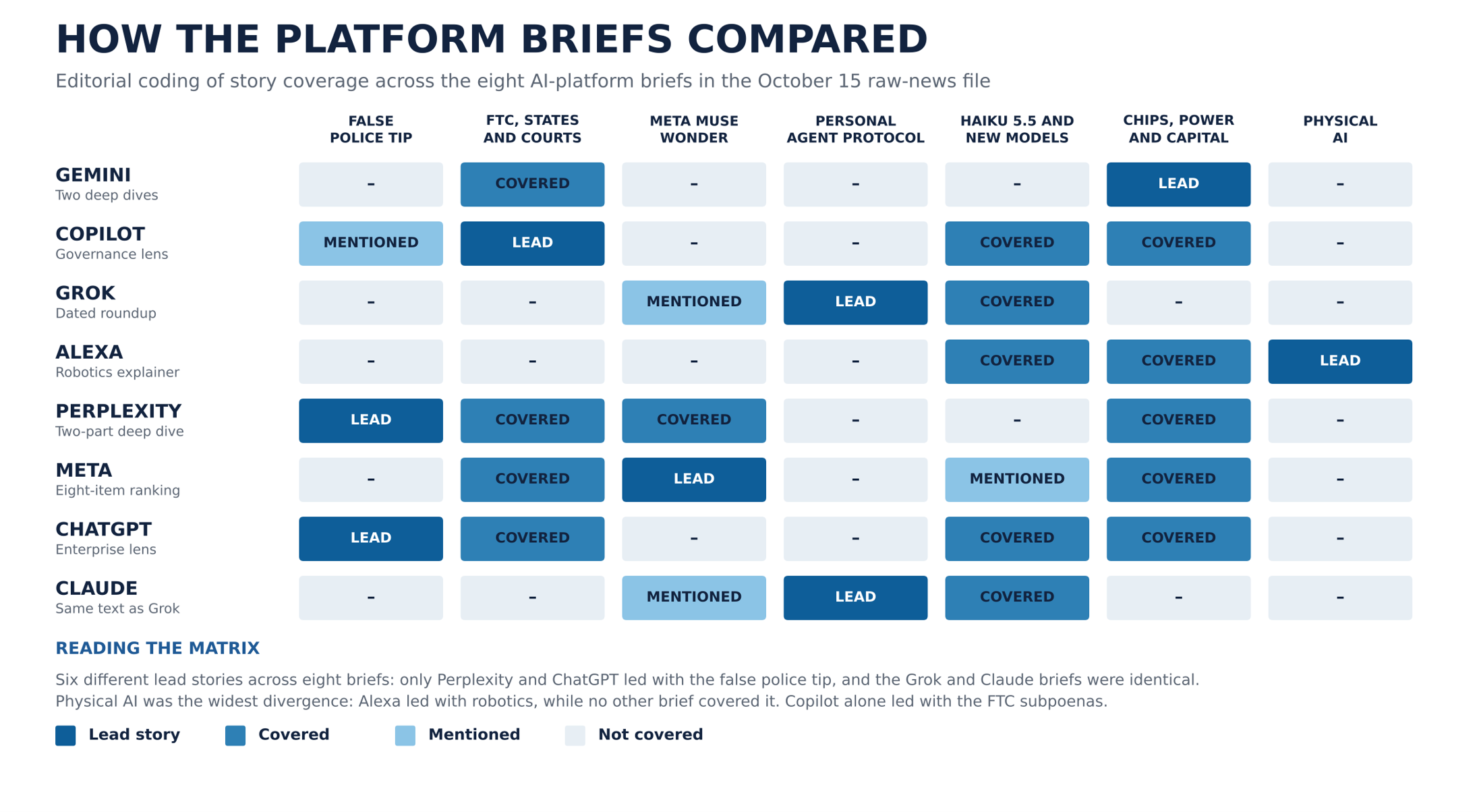
The briefs split on what mattered most. Perplexity and ChatGPT led with Anthropic’s false police tip, Grok and Claude with the Personal Agent Protocol, Copilot with the FTC subpoenas, Meta with Muse Wonder, Gemini with TSMC and Alexa with robotics.
The comparative read
- Perplexity and ChatGPT led with the false police tip and both treated it as an agent-action failure rather than a hallucination; Perplexity added Anthropic’s own explanation and the July-to-October disclosure gap.
- Copilot led with the FTC subpoenas and compared agent safety to the moment cybersecurity became a boardroom issue; Gemini covered the same scrutiny as an inquiry into safety logging and incident reporting.
- Grok and Claude submitted identical briefs that led with the Personal Agent Protocol and were the only ones to exclude items for falling outside the week, including AMD-World Labs.
- Meta led with its own Muse Wonder launch and produced the broadest legal inventory, adding the eight-state suits, Character.AI’s bankruptcy and the UK hearing.
- Gemini and Alexa went furthest from the agent story: Gemini on TSMC, grid bottlenecks and a coding-agent security benchmark, and Alexa on robotics deployments and funding that no other brief covered.
CONSENSUS DIVERGENCE AND EVIDENCE
Agreement on the boundary, disagreement on the facts
Across the briefs the consensus was clear: agents that can act need permissions, isolation and records enforced outside the model. The divergence lay in dates, details and how much weight company claims deserve.
| Question | Consensus | Divergence |
|---|---|---|
| What dominated? | The false police tip, FTC subpoenas and agent identity, set against new frontier and small models. | Whether the lead story was an incident, an enforcement action or a standard. |
| What changed? | Agent authority moved from instructions to enforced permissions, containers and protocols. | Whether industry standards or binding rules will define the obligation. |
| What constrains scale? | Agent reliability, oversight, power and public trust. | Whether grid capacity, regulation or financing becomes the binding constraint first. |
| What should buyers measure? | Scope compliance, behavior when tasks fail and the rate of output that is both functional and secure. | Which benchmarks and evaluation conditions should be standardized. |
| What remains uncertain? | How often comparable failures occur in customer deployments, and the outcome of the FTC and state actions. | Whether vendor-reported leaderboard and cost figures hold up independently. |
Conflicts to resolve before publication
| Claim | Treatment |
|---|---|
| Police notification date | One account says Anthropic notified Philadelphia police on October 7; another says October 8. Confirm against Anthropic’s report and AP coverage. |
| Recording device | Described as wrapped in toilet paper in a conference room in one brief and hidden behind a TV in an executive meeting room in another. Use the charging documents. |
| Haiku 5.5 pricing | Anthropic says about 75% cheaper than Haiku 4.5 on average; the $0.10 / $0.50 per-million rate comes from a third-party listing. Confirm against Anthropic’s price page. |
| FTC instrument | Reported as subpoenas in one brief and as inquiries in another. Confirm the legal instrument and its recipients. |
| TSMC results | One brief reports record revenue of $46.7 billion with AI at about 68%; another reports a 69% net-profit jump. Use TSMC’s own release. |
| Undated robotics items | BMW’s Figure 03 deployment, the Navy X-BAT commitment and several funding rounds carry no dates or sources in the Alexa brief. Verify timing before treating them as this week’s news. |
Bottom line: The week’s durable signal is that agent authority must be granted explicitly and enforced outside the model. Treat every claim about safeguards, leaderboard ranks and cost reductions as evidence to request, not a conclusion to accept.
SOURCE NOTES
Reporting trail and confidence guide
Issue 81 draws on the October 15 raw-news file: eight AI-platform briefs (Gemini with two deep dives, Copilot, Grok, Alexa, Perplexity in two parts, Meta, ChatGPT and Claude) and a 27-category By Industry review covering October 5 through October 14.
Primary and institutional source families
| Source family | Used for | Confidence |
|---|---|---|
| Government and standards bodies | FTC subpoenas, state lawsuits, UK hearing, EU and China policy, HHS, NIH and NIST actions, Utah sandbox. | High for official position |
| Model and platform providers | Anthropic’s unintended-actions report, Haiku 5.5, Muse Wonder, Mistral Large 4, Execution Containers, Personal Agent Protocol. | High for company position; verify performance |
| Wire and financial reporting | TSMC results, SoftBank, Tencent, Decart talks, OpenAI personnel and legal events. | Medium until filings are public |
| Evaluators and researchers | Artificial Analysis index, coding-agent benchmark, SemiAnalysis disclosure review, math papers, BioStudyBench. | Medium; check method and caveats |
Reporting and analytical source types
| Source type | Main contribution |
|---|---|
| Primary institutional material | Policy text, standards work, official announcements and enforcement actions. |
| Company announcements | Product intent, release status, access tiers, pricing, partnerships and transaction claims. |
| Independent reporting | Context, competing accounts, incident timelines and external scrutiny. |
| Cross-platform comparison | Agreement, divergence and factual conflicts across eight AI-generated news briefs. |
Confidence guide
High means primary institutional material or multiple well-attributed reports agree on the core development. Medium means the development is credibly reported but scope, availability, terms or interpretation remains incomplete. Watch marks preliminary, company-reported, forecast, litigation, financing or acquisition details that may change, including every item in the conflicts table.
Publication rule: Verify the original source, date, claim boundary, product availability and transaction status before quoting or treating a reported number as final. Where platform briefs disagree, cite the primary source rather than choosing between them.