The GovCon Growth Marketing Team Is Being Rebuilt Around the Account – Not the Campaign
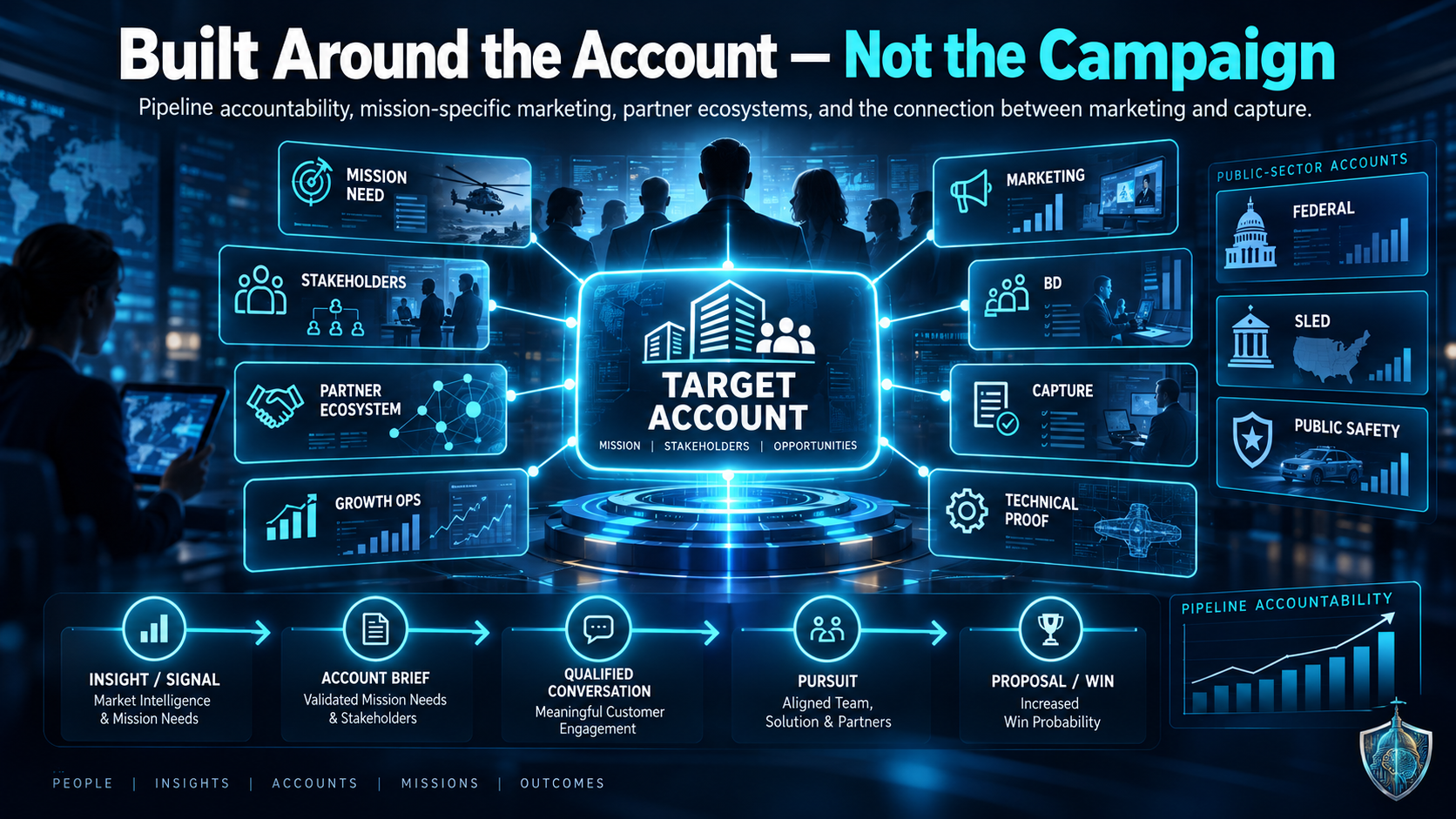
What hiring signals from government-market suppliers reveal about pipeline accountability, mission-specific marketing, partner ecosystems, and the connection between marketing and capture.
Key Takeaways
- Account progress is replacing campaign activity as the organizing question. The reviewed roles repeatedly connect marketing to named accounts, qualified conversations, pipeline development, and sales outcomes.
- Growth responsibilities are becoming more interconnected. Marketing, business development, alliances, technical experts, revenue operations, and capture are appearing in complementary roles and workflows.
- Market-specific expertise matters. Federal, state and local government, and public safety customers require different messages, buying routes, partner strategies, and proof.
- Technical credibility and coordinated partners help turn interest into pursuits. Complex offerings require mission-relevant explanations, defensible evidence, and clearly defined implementation responsibilities.
- Hiring signals reveal intentions, not completed transformations. Job advertisements can identify priorities, but they do not demonstrate successful hiring, larger budgets, contract wins, or industry-wide growth rates.
A government contractor can publish an excellent white paper, attract a large webinar audience, and generate hundreds of campaign responses without advancing a single qualified opportunity. A growth organization centered on the account asks a different question: which agency problem was validated, who engaged from the buying team, what route to purchase is credible, and what decision comes next?
That account-centered view appears repeatedly in the Government Contractors GovCon Marketing Signals research. The historical tracker recorded 198 hiring opportunities across 107 companies from August 27 through September 26, 2026. Subsequent daily marketing reports and related growth-function comparisons, reviewed through October 11, provide additional examples. Together they suggest eight patterns in how employers describe the work of attracting, developing, and winning government customers.
This is a selected prospecting sample, not a representative survey of the federal contracting industry. The strongest conclusion is about the design of roles and workflows, not the rate at which hiring or marketing spending is increasing.
1. Marketing is expected to move accounts, not merely attract attention
The baseline and later scans linked public-sector marketing positions at Elastic, MongoDB, World Wide Technology, Cursor, and Horizon3.ai to account programs, field execution, sales coordination, or marketing operations. The details vary, but the common denominator is a closer connection to revenue development.
That does not make brand awareness irrelevant. It means awareness must lead somewhere. A useful campaign dashboard should connect outreach and events to account engagement, validated buyer needs, stakeholder meetings, opportunity qualification, and later capture milestones. Registrations and impressions describe activity; they are not substitutes for evidence that an account has moved forward.
Leadership implication: Define what a qualified government-account conversation looks like, who owns the next step, and how marketing will support it before approving another campaign calendar.
2. Marketing, business development, partners, and capture are forming a connected workflow
The reviewed records describe complementary responsibilities rather than a clean sequence in which marketing generates a lead and then disappears. Earlier signals involving Defense Unicorns paired content, events, product marketing, revenue operations, and sales. Later summaries described combinations at Saalex, Modern Intelligence, and RapidFort involving marketing, partnerships, sales, proposals, or capture.
The observed job scopes support a practical operating model: intelligence identifies a mission need; account teams test the hypothesis; marketing and partners open a useful conversation; business development qualifies the opportunity; and capture and proposal teams convert evidence into a competitive pursuit. The transitions require common account records, defined owners, and consistent qualification standards.
Leadership implication: Audit the handoffs between the first customer signal, a qualified opportunity, a bid decision, and proposal development. Assign one owner to each transition rather than assuming another department will pick it up.
3. Government marketing is becoming more mission- and account-specific
A generic “technology for government” message offers little help to a program manager weighing an operational problem or to a capture manager assessing a buying route. Recorded role scopes at WWT, Elastic, MongoDB, and Cursor emphasize particular public-sector audiences, territories, and account engagement. Related sales and capture observations reinforce the importance of government-specific buyer context.
A useful account brief needs more than a logo and a contact list. It should identify the agency or jurisdiction, mission problem, evidence of need, relevant stakeholders, procurement route, credible partners, competitive position, and next customer question. It must distinguish a budget request from approved funding and a contract ceiling from money actually ordered.
Leadership implication: Replace a portion of broad campaign planning with short, regularly updated briefs for the accounts where the company has a plausible way to win.
4. Partner marketing works best when it produces joint customer conversations
Public-sector partner and channel responsibilities appeared in the research around Scale AI, RapidFort, Elastic, and Anthropic, alongside the established role of reseller and integrator ecosystems. These observations do not mean teaming is new. They suggest that coordinating the partner route and the buyer conversation is part of the work employers want done.
Two logos on a webinar do not explain who supplies the product, who implements it, who manages security or integration, and who supports the customer afterward. A stronger joint effort starts with one mission problem and defines each firm’s contribution. It then seeks a conversation that can validate the requirement and establish a concrete follow-up.
Leadership implication: Measure partner programs by jointly qualified accounts, appropriate customer meetings, documented actions, and pursuit progress—not only shared assets, registrations, or introductions.
5. Technical storytelling is becoming indispensable to growth execution
Complex offerings in AI, cybersecurity, defense autonomy, and advanced manufacturing cannot be sold credibly through abstract capability claims. The tracker included technical marketing and adjacent pursuit roles involving Forterra and Defense Unicorns; later reports added examples such as VulcanForms and Scale AI.
These roles point to a familiar but increasingly visible discipline: translating engineering capabilities into the language of agency missions and acquisition decisions. What was tested? In what operating environment? What changed after deployment? What remains uncertain? The answers should feed account briefs, demonstrations, capture materials, and proposals—after technical, contractual, and disclosure approvals.
Leadership implication: Build a reusable proof record for important claims, containing the baseline, observed result, context, limitations, source evidence, and approval owner. Do not turn product promises into supposed customer outcomes.
6. Federal, SLED, and public safety require different growth strategies
The records span federal civilian and defense markets, state and local government, education, and public safety. The research included SLED field and account programs as well as public-safety examples involving Intrado, First Due, Obvio, and Peregrine. Combining those customers into a single “public sector” campaign can conceal material differences.
Federal pursuits may revolve around agency plans, established vehicles, integrator ecosystems, and extended capture cycles. State and local buying may involve jurisdiction-specific budgets, cooperative purchasing, and local stakeholder networks. Public-safety buyers have distinct mission pressures and operational evaluation needs. None of these distinctions describes every purchase; each requires account-level validation.
Leadership implication: Maintain separate assumptions about buying authorities, stakeholders, purchasing channels, technical proof, and messaging for each segment rather than simply changing a campaign’s headline.
7. Entering a new government market can concentrate several growth needs at once
October report summaries described first or developing marketing capabilities at Harmattan AI, Modern Intelligence, and Kaizen Labs, often alongside government business development, partnerships, events, or proposal work. Such role clusters may indicate a market-entry workload that stretches beyond a single job description.
An entrant needs a credible story, an initial account list, partner positioning, sales materials, technical proof, and a process for qualifying prospects. A launch can fail when those pieces are produced independently or in the wrong order. Yet a new vacancy is not proof that a company has allocated an external marketing budget, and an announced market move is not proof of revenue.
Leadership implication: Prioritize the first 90 days around a narrow market hypothesis, five to ten target accounts, an approved message, a partner plan, and a measurable customer-engagement sequence.
8. Growth operations are becoming the connective tissue
The sample also contains a smaller but notable set of operations-oriented signals. Defense Unicorns’ revenue-operations responsibilities appeared alongside commercial roles; Horizon3.ai was described in a later scan as combining federal campaigns, marketing operations, and sales activity; Aretum and Saalex appeared in reports about growth, pursuit, or proposal workflows.
The lesson is not to buy another dashboard. It is to agree on what the dashboard measures and who acts on it. Without a shared account definition, an owner for each opportunity, source-of-truth records, bid/no-bid criteria, and a reliable transfer into capture, marketing activity can accumulate without improving decisions.
Leadership implication: Track a small set of operational measures: qualified accounts, validated mission needs, meetings with appropriate stakeholders, dated next steps, and opportunities advancing through documented capture gates.
What the signals do—and do not—show
Two questions remain open. First, how quickly is AI becoming an explicit skill in marketers’ own workflows? An October review found a Palo Alto Networks public-sector marketing posting that referred to AI-assisted research and drafting. Other reviewed AI-company roles emphasized knowledge of AI products or markets rather than expressly requiring AI-assisted employee workflows. The available records do not support a prevalence or growth-rate claim.
Second, where are customer adoption, references, renewals, and recompete marketing being staffed? The collected sample is weighted toward pre-award growth roles. That gap warrants further study, not a declaration that contractors are neglecting post-award customer development.
There is also a broader measurement limitation. The September 26 tracker is a prospecting dataset, and 192 of its 198 opportunity rows lack a populated source-URL field. Later reports supply useful qualitative context but were not archived as one consistently coded, deduplicated series. The related repeated-engagement workbook contains analyst-recommended campaign concepts, not verified employer purchasing requests. Company examples should be checked against original postings before being quoted as currently active vacancies.
From eight signals to one practical growth model
For executives, the most useful response is not to reorganize around a trend headline. Start by choosing a few accounts where mission need, access, competitive fit, and funding confidence justify senior attention. Establish one account brief, one owner for the next customer action, and one agreed measure of progress. Bring technical, partner, marketing, BD, and capture contributors together early enough to shape—not merely decorate—the pursuit.
Then build a feedback loop. Delivery teams contribute validated proof. Marketing turns that proof into relevant messages. Partners clarify access and implementation responsibilities. BD tests the customer problem and buying path. Capture applies the evidence against actual acquisition requirements. Growth operations shows where opportunities stall and whether resources should move.
The central finding is not that campaigns are disappearing. It is that their value is increasingly described in relation to the account decisions they help advance. Contractors that connect the work across functions are better positioned to explain their capabilities, pursue relevant opportunities, and make disciplined choices about where to invest their best people.
Sources and Methodology
This article is based on Government Contractors’ GovCon Marketing Signals historical research: the Government Contractors GovCon Marketing Hiring Signals Master Tracker (August 27–September 26, 2026), subsequent daily and rolling Marketing Signals reports through October 11, the GovCon Growth Articles From Hiring Signals editorial synthesis updated October 9, and supplemental Public Sector Growth Signals/GovCon Growth Comparison findings used only for cross-functional context. The September 26 Repeated Engagement Plays Analysis was consulted for proposed services and editorial themes, not as independent evidence of customer demand.
The 198 records and 107 companies describe the consolidated historical baseline; later company references are qualitative observations, not additions to those counts. No industry-wide hiring rate, spending increase, or causal link to procurement changes is claimed. Historical job summaries and roles without original source links should be independently verified before being described as currently open positions.