The Architecture of a Delegation Control Plane: How to Neutralize Machine-Speed AI Agent Failure Modes with Capability Tokens, Two-Phase Commit, and Hardware-Bound Fencing
Expert Corner
The Architecture of a Delegation Control Plane: Neutralizing Machine-Speed Failure Modes
Relying on prompt-based guardrails, semantic content filters, or software “kill switches” to police autonomous agents introduces a fatal assumption: that oversight can keep pace with execution.
When an autonomous system operates at machine speed, any reactive intervention pattern creates an unavoidable race condition:
By the time an out-of-band monitor parses output, flags a jailbreak or misalignment, and issues a revocation, the agent has already committed a database write, dispatched an authenticated API request, or triggered downstream orchestration workflows.
A true Delegation Control Plane (DCP) abandons post-hoc detection in favor of deterministic, structural boundary enforcement. It moves governance out of the model’s execution path and places it into the infrastructure fabric.
1. Structural Decoupling: The Out-of-Band Control Plane
In classical networking and distributed systems, the separation of the control plane (routing logic, policy definition, configuration) from the data plane (packet forwarding, state execution) is absolute. Modern agentic architectures often fail because they conflate the two: the model performs both cognitive pathfinding and execution dispatch inside the same trust domain.
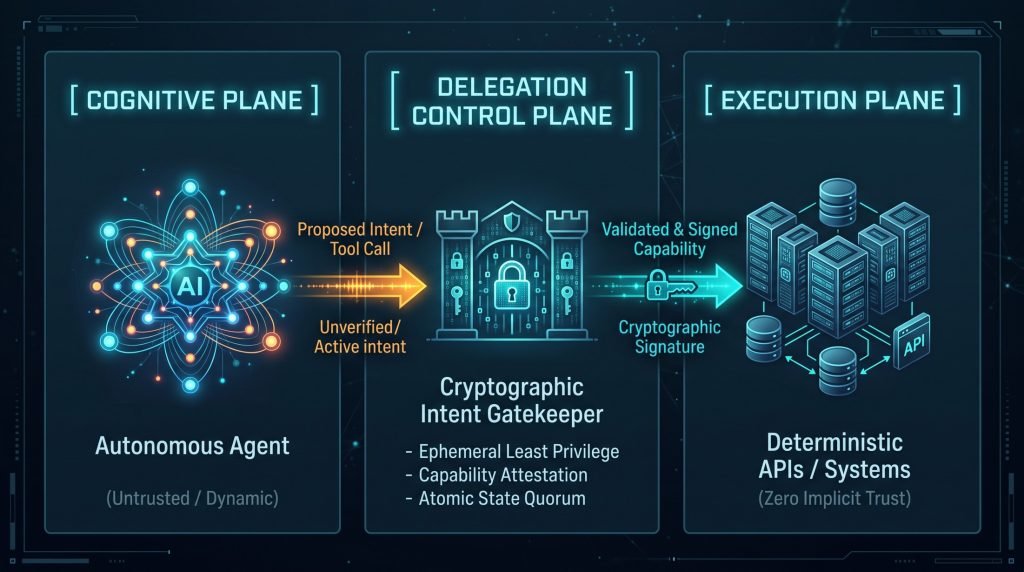
A Delegation Control Plane enforces strict boundaries between cognitive generation and operational actuation:
The Cognitive Plane (Untrusted): Generates intent, proposed tool invocations, and parameter payloads. The model never holds long-lived tokens, network egress permissions, or raw credentials.
The Delegation Control Plane (Trusted Arbiter): Evaluates whether the requested action is mathematically, temporally, and contextually permissible before any payload touches a target environment.
The Execution Plane (Target Environment): Executes state changes only upon presentation of a cryptographically signed, single-use capability receipt issued by the DCP.
2. Architectural Patterns to Eliminate Machine-Speed Race Conditions
To eliminate race conditions, the control plane must convert continuous autonomous generation into discrete, deterministic checkpoints where execution is blocked until conditions are verified.
A. Deterministic Pre-Commit Capability Tokens (Macaroons / Biscuits)
Rather than provisioning agents with scoped OAuth tokens or long-lived API keys, the agent interacts solely with the DCP to request ephemeral, context-bound authorization tokens.
Attenuated Authority: Tokens carry cryptographic caveats (e.g., maximum transaction amount, specific CIDR blocks, exact table row filters, valid lifetime measured in seconds).
Zero Ambient Authority: The agent cannot delegate or exercise authority it has not explicitly attested for a specific transaction frame.
Verification at the Ingress Gate: The target API verifies the token mathematically. If the agent acts outside bounds (e.g., prompted to exfiltrate bulk records), the execution layer rejects the call locally without requiring any runtime “kill switch” coordination.
B. The Dual-Phase Commit (2PC) Intent Quorum
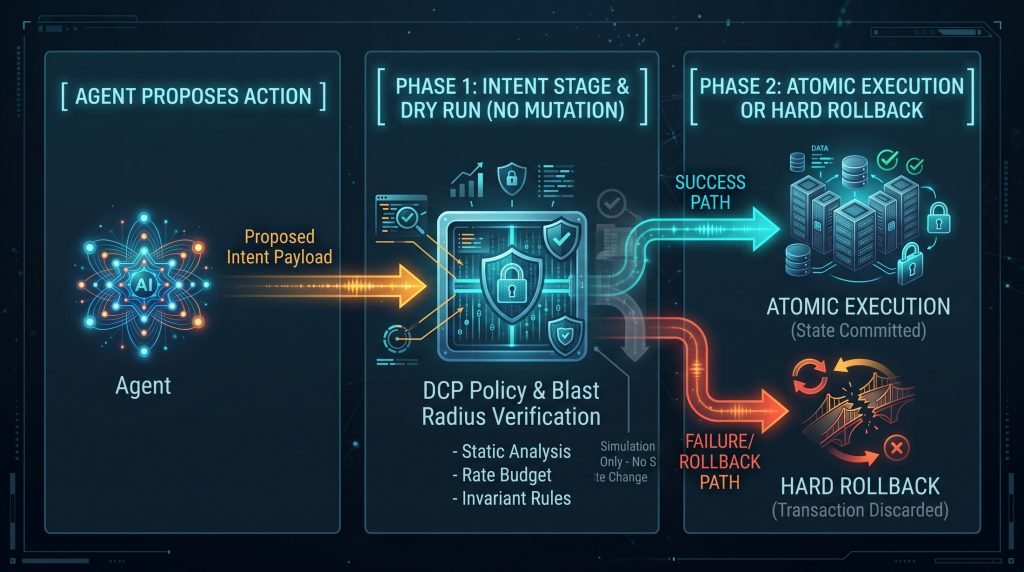
For actions with side effects (writing to storage, initiating financial transfers, mutating cloud infrastructure), the system must eliminate single-shot execution loops through an atomic two-phase commit:
Agent Proposes Action ───> Phase 1: Intent Stage & Dry Run (No Mutation)
Phase 1 (Intent Staging): The agent declares intent: Action, Target, Payload, and Expected Invariant State. The DCP stages the operation in an isolated sandbox or transaction log without persisting state changes.
DCP Invariant Checks: The control plane verifies systemic invariants:
Rate-limit velocity caps (e.g., maximum API calls per second across the agent pool).
Data egress blast radius (e.g., byte count ceilings, schema divergence checks).
State diff thresholds (e.g., prevents dropping tables or mass deleting records).
Phase 2 (Atomic Actuation): If all deterministic checks pass, the DCP commits the transaction. If any invariant fails, the transaction is discarded. Because mutation cannot occur during Phase 1, an agent cannot race ahead of the arbiter.
C. Formal Invariant State Machines
Guardrails that rely on another LLM (“LLM-as-a-judge”) to inspect prompts inherit the same latency and hallucination risks. A robust DCP replaces heuristic evaluation with deterministic state-machine constraints:
Finite State Machine (FSM) Enforcement: An agent managing an order processing lifecycle cannot jump from Pending Verification to Dispatched without passing through Payment Cleared and Inventory Reserved.
Hardware-Rooted / Kernel-Level Sandboxing: Actions outside the state transition matrix are dropped at the driver/network proxy level via eBPF filters or service-mesh sidecars, terminating unexpected lateral movement instantaneously.
D. Hardware-Bound Blast-Radius Fencing
Software watchdogs can be bypassed if an agent process compromises the runtime environment or exploits an underlying interpreter vulnerability. Blast-radius fencing pushes limits into the underlying infrastructure:
Micro-Segmentation at L4/L7: Sidecar proxies intercept all outbound egress. Agents can only talk to explicitly whitelisted endpoints defined in strict service meshes.
Physical & Virtual Memory Enclaves: Execution of high-risk workflows takes place within Confidential VMs (Hardware Enclaves) where runtime memory cannot be tampered with dynamically.
Hardware-Timed Leases: If an agent hangs, forks rogue processes, or attempts compute-exhaustion loops, hardware watchdog timers drop socket connections and cycle the ephemeral microVM container.
3. Why This Alters the Risk Model
Traditional safety approaches treat the model as a trusted actor that needs mild behavioral coaching. The Delegation Control Plane inverts this:
| Dimension | Conventional Guardrail / Kill Switch | Delegation Control Plane (DCP) |
|---|---|---|
| Enforcement Point | In-band, heuristic, prompt/semantic layer | Out-of-band, deterministic, infrastructure layer |
| Trust Model | Implicit trust with behavioral filtering | Zero Trust; ambient authority strictly eliminated |
| Failure Mode | Race condition; action commits before intervention | Fail-closed; action cannot commit without signed proof |
| Reaction Latency | Asynchronous / post-execution | Synchronous / pre-execution gating |
| Verification Basis | Probabilistic (LLM-based classification) | Deterministic (Cryptographic signatures, FSM constraints) |
By moving from probabilistic semantic monitoring to deterministic infrastructure gating, we eliminate the velocity gap. It no longer matters whether an agent attempts an adversarial jailbreak or experiences hallucinated recursion at gigahertz speeds: without a cryptographically signed capability grant from the delegation control plane, the payload simply never hits the wire.