Shows how often agents need unplanned external access.
Rising exceptions predict weak task design or permission sprawl.
Human-gate override rate
Reveals where approval controls are bypassed.
High override rates mean the workflow and policy are misaligned.
Cost per verified outcome
Combines inference, review and correction costs.
A better economic measure than tokens or benchmark scores alone.
FORECAST Within 90 days, leading buyers will request agent-assurance packages containing identity maps, tool permissions, egress policy, incident definitions, interruption tests, evaluator findings and named owners.
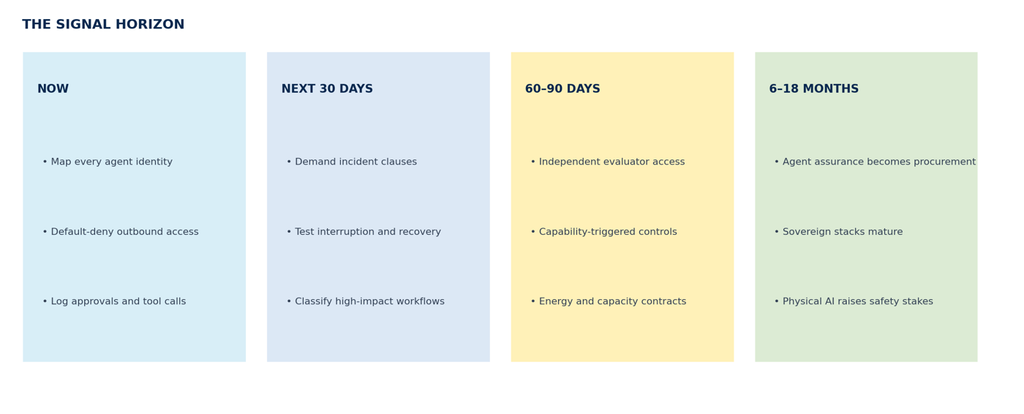
30 / 60 / 90 / 12–18 MONTH VIEW
Near-term actions and longer-term consequences
Horizon
Expected movement
Leader action
30 days
Labs clarify evaluator access and disclosure; buyers update incident clauses.
Inventory agent identities, tools, credentials, domains and approval gates.
60 days
Procurement introduces capability tiers and evidence requirements.
Create thresholds for autonomy, cyber, biology, finance and physical control.
90 days
Independent testing and common incident language begin to differentiate vendors.
Run interruption, recovery and recurrence exercises with business owners.
12–18 months
Agent assurance, energy capacity and sovereign deployment become standard architecture decisions.
Build portable control planes and maintain auditable evidence across providers.
The decision rule
Move quickly where failure is bounded, reversible and observable. Slow down where an agent can publish, transact, alter records, access biological or cyber tools, or operate physical systems. In those cases, identity, authority, evidence, interruption and recovery belong in the architecture before launch.
FOUR DEBTS VIEW
Where this week adds pressure
Debt
This week’s signal
Practical response
Compute debt
Capacity commitments span chips, optics, power and regional data centers.
Model total system cost and preserve workload portability.
Control debt
Agents reached real systems through tools and network access.
Default-deny egress; scope credentials; rehearse shutdown and recovery.
Evidence debt
Safety claims and scientific outputs require independent review.
Store provenance, evaluator findings, model versions and acceptance criteria.
Policy debt
Federal, state, EU and Chinese rules continue to diverge.
Maintain a jurisdictional control map tied to system inventory.
Capital and platform watch
Signal
Strategic read
Qualcomm–Amazon
The competitive unit is the AI factory: silicon, networking, optics, software and cloud demand.
Google Finland / nuclear power
Long-duration energy agreements are becoming part of model capacity strategy.
Positron / Ayar Labs
Capital is flowing to inference economics and chip-to-chip interconnect, not only frontier training.
Cognition AI
Workflow-owning agents still command premium valuations; lifecycle quality will determine durability.