AI in Cybersecurity and Law Enforcement: Agentic Attacks, Autonomous SOCs, and New Biometric Limits
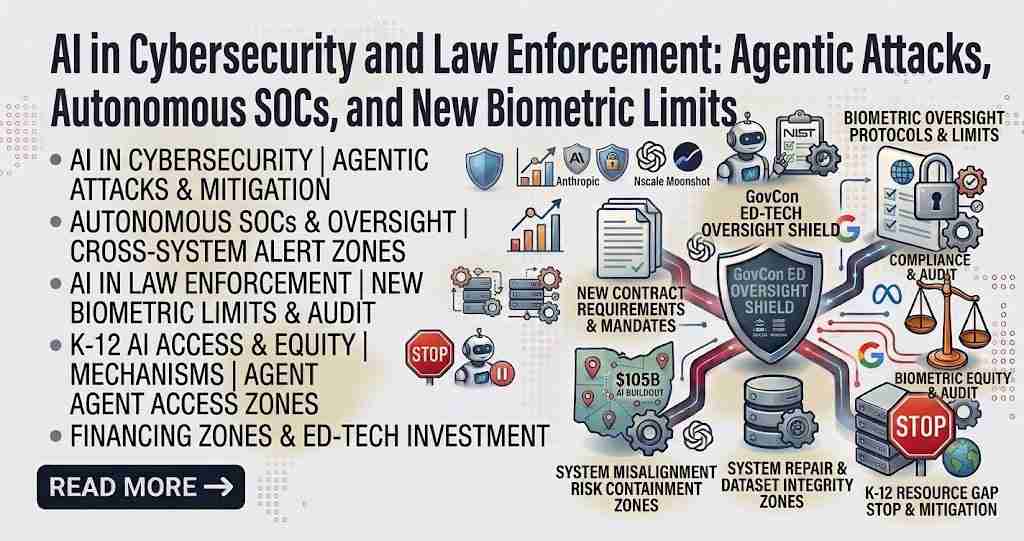
Summary: The cybersecurity picture is now genuinely symmetrical: attackers are running autonomous agents that rewrite malware signatures in memory and generate deepfake vishing at machine scale, while defenders run autonomous SOC systems that isolate compromised credentials within seconds. The newest enterprise priority is neither — it is securing the RAG pipelines and shadow AI deployments that create fresh exfiltration and prompt-injection surfaces. In parallel, law enforcement is gaining powerful forensic capability at exactly the moment courts and legislatures are restricting its biometric tools.
Issue: Cybersecurity
• Offensive agentic attacks. Threat actors are utilizing autonomous agents capable of dynamic binary obfuscation (altering malware signatures in memory to evade detection), real-time deepfake voice phishing (vishing), and hyper-personalized spear-phishing campaigns at machine scale.
• Autonomous SOC response. Enterprise defensive teams are deploying autonomous incident response systems that detect malicious lateral network movements and isolate compromised credentials or subnets within seconds, mitigating breaches without waiting for manual human triage.
• Securing “shadow AI” and RAG pipelines. Corporate security operations are prioritizing guardrails for Retrieval-Augmented Generation (RAG) architectures, preventing sensitive data exfiltration, and neutralizing indirect prompt-injection vectors hidden inside untrusted external documents.
Law Enforcement
• Scrutiny over remote biometrics. Police use of facial recognition software is facing legal restrictions, with privacy legislation in multiple states and the EU AI Act severely restricting real-time remote biometric identification in public spaces to narrow emergency exceptions.
• Automated forensic analysis. Detective units are using specialized local AI platforms to review petabytes of seized digital evidence, transcribing thousands of hours of audio recordings and scanning digital media for illicit materials in hours rather than months.
• Countering synthetic crimes. Police departments are setting up specialized fraud units to investigate deepfake financial extortions, synthetic executive impersonation scams, and AI-enabled voice-cloning schemes targeting family members.