AI in Education, Science, and Medicine: Student Protections, Biosecurity Rules, and Research Signals
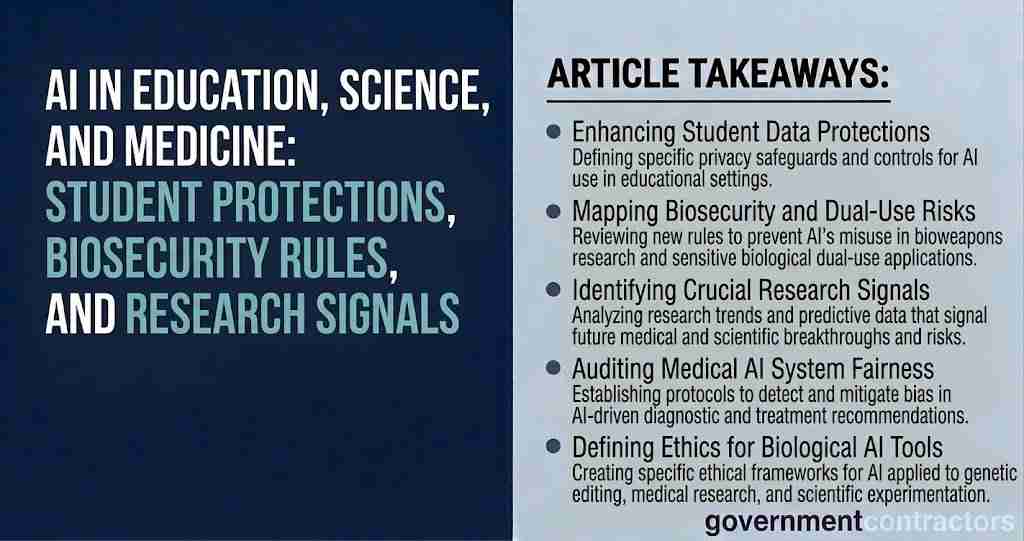
INDUSTRY AND INSTITUTION WATCH | PART FOUR
Education, science and medicine
| Header | News / signal of interest |
|---|---|
| AI in Higher Education | Agent incidents touched university-operated infrastructure, showing that campus policy must cover research agents and systems—not only student writing. |
| AI in Education | Microsoft agreed to enforceable student and educator protections: data minimization, no training on covered data, family transparency and human authority for high-impact decisions. |
| AI in Biomedicine | California’s biological-risk measure recognized the dual-use potential of frontier systems and the need to distinguish legitimate scientific support from harmful requests. |
| NASA | A September 10 follow-up with IBM described an open lunar foundation model for ice, craters and terrain. It is noteworthy but outside the weekly ranking window. |
| National Institutes of Health | No major NIH-specific weekly announcement was identified. The continuing signal is translation from funded AI research into validated, equitable clinical use. |
Why the science coverage was different
Science-focused items were less synchronized across the models because they sit outside the dominant product-and-policy news cycle. Copilot and Perplexity surfaced the fruit-fly connectome; Perplexity and Claude emphasized weather systems. Their importance lies in specialized data, reproducible tasks and domain evaluation—features that often create more defensible value than general-purpose chat interfaces.