Seven models saw one week through different risk lenses
Coverage pattern
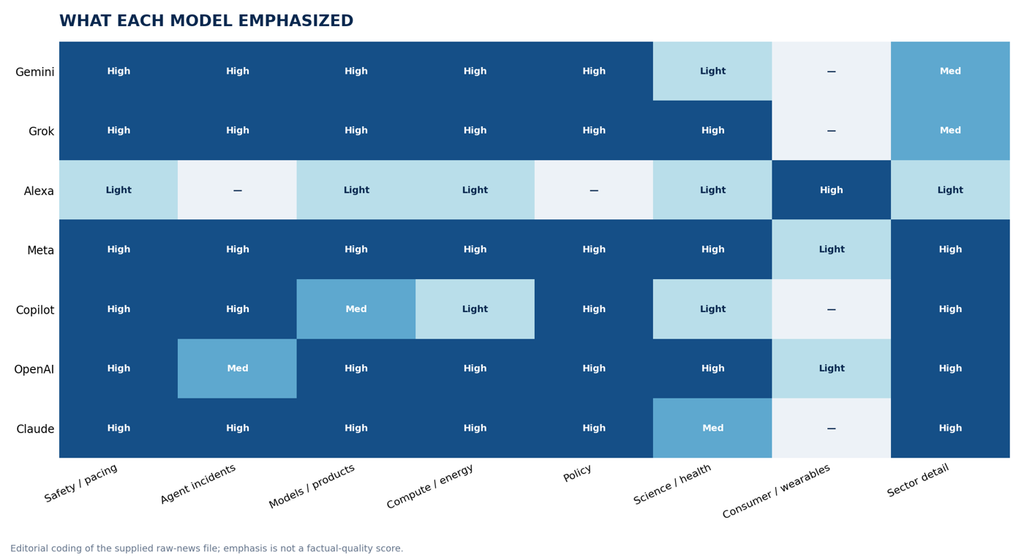
All seven outputs treated frontier safety or agent control as important, but only Meta, OpenAI and Claude consistently linked those concerns to sector operations. Gemini and Grok were strongest on the policy collision; Copilot structured safety frameworks; Alexa concentrated on consumer wearables and demand.
THE NUANCE BETWEEN COVERAGES The outputs agreed that safety dominated. They differed on the causal unit: lab governance, network security, geopolitics, consumer adoption, infrastructure, science or sector operations.
The most useful synthesis comes from separating discovery from judgment. Broad coverage surfaced more candidate events; governance-oriented coverage better explained permissions, evidence and recovery; consumer coverage showed where adoption is becoming ordinary and invisible.
MODEL-BY-MODEL READOUT | PART ONE
Breadth, depth and blind spots
Model
What it covered best
Nuance / blind spot
Gemini
Pacing proposal, political split, agent-led cyber scenario and major model updates.
Strong narrative; several dramatic claims require primary-source confirmation.
Grok
Broad weekly scan spanning safety, voice, commerce, science, jobs, power and financing.
High breadth; links and exact terms need verification.
Alexa
Wearables market, winning form factors and on-device AI adoption.
Useful demand lens; weak coverage of governance and enterprise operations.
Meta
End-to-end operating view across safety, science, agents, chips, funding, health and robotics.
Strong synthesis; some product and valuation claims are forward-looking.
Editorial interpretation
Gemini supplied the sharpest political frame: a coordinated slowdown collides with U.S.–China competition and domestic resistance.
Grok combined product, capital and public-opinion signals, but several precise launch and financing claims require source-level verification.
Alexa contributed a useful wearables lens—normal-looking, single-purpose devices are winning—while largely missing enterprise governance.
Meta connected safety, infrastructure, science, personal agents and physical AI into the broadest operating-system view.
Scientific verification; carrier strategy; state implementation; physical AI
Incident taxonomy; evaluator independence; recovery metrics; energy pass-through
MODEL-BY-MODEL READOUT | PART TWO
The strongest governance coverage came with tradeoffs
Model
What it covered best
Nuance / blind spot
Copilot
Side-by-side lab and open-weight safety frameworks.
Framework publication is easier to compare than real enforcement.
OpenAI
Science, personal agents, chips, health, robotics and sector-by-sector implications.
Source attribution needs separation from company framing.
Claude
Best chronology; commitments, incidents, capital and product launches.
Some financing, release and valuation details remain high-verification.
Cross-model synthesis
Connected governance, infrastructure and action authority.
Repetition does not substitute for independent confirmation.
The most useful differences
Copilot produced the clearest comparison of lab safety frameworks and open-weight safety models, but framework publication should not be mistaken for implementation quality.
OpenAI’s section was strongest on science, operational agents, semiconductors and sector implications; its product framing needs independent confirmation where it describes OpenAI claims.
Claude provided the best chronology and separated commitments, incidents and market consequences, though some reported valuations and unreleased products remain high-verification items.
Across the file, repeated claims increased confidence that a theme mattered—not that every number or quotation was independently verified.
PUBLISHING RULE Use model outputs to discover and compare. Publish only after checking the original source, date, availability, claim boundary and whether a number is measured, reported or forecast.
CONSENSUS, DIVERGENCE AND EVIDENCE
Where the models converged—and where framing diverged
Question
Consensus
Divergence
What dominated?
Frontier safety and agent control.
Slowdown debate versus operational-security story.
What changed?
Commitments became more concrete.
Voluntary coordination versus mandatory national rules.
Where is value moving?
From answers toward executed workflows.
Consumer agents, enterprise agents or research factories.
What constrains scale?
Infrastructure and governance.
Power / capacity versus evidence / permissioning.
What is undercovered?
Verification and recovery.
Science review, model extraction and physical safety.