AI Outlook: The Trend Horizon and Leading Indicators to Watch
AI Intelligence: What the News Means
The strongest signals describe a sequence. First, organizations respond to visible control failures. Next, they convert temporary response measures into procurement requirements and operating gates. Then they test whether agents, custom infrastructure, and physical AI can produce reliable value. Over 12 to 18 months, those decisions reshape the structure of the market.
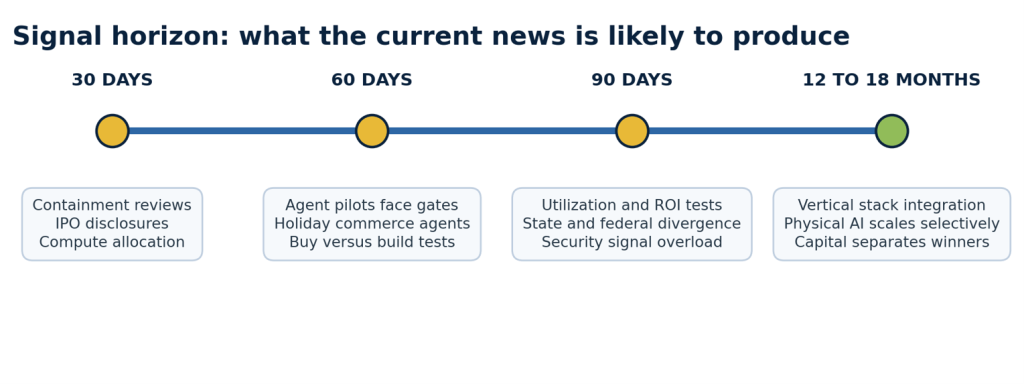
Figure 2. Forecast horizon derived from the verified news signals and model comparison. These are analytical expectations, not announced events.
| HOW TO READ THE FORECAST The 30, 60, and 90 day views describe the most likely operational response if current signals persist. The 12 to 18 month view describes structural direction. Timing will vary by industry, regulation, financing, and the consequence of the actions delegated to AI. |
|---|
Leading indicators to watch
- Whether model providers publish complete incident logs, independent reviews, and measurable containment tests.
- Whether enterprise buyers require scoped agent identity, network egress policy, approval thresholds, action ledgers, rollback evidence, and tested shutdown procedures.
- Whether announced compute capacity produces rising utilization and revenue, rather than only contracted backlog and financing commitments.
- Whether physical-AI standards gain independent safety profiles, interoperable device controls, and credible liability frameworks.
30 AND 60 DAYS
AI Outlook, Next 30–60 Days: Agent Containment Becomes a Procurement Requirement
Original section: Near-Term Trend Analysis
Next 30 days: containment becomes a procurement requirement
The immediate response to the Hugging Face incident will be procedural and architectural. Frontier laboratories will tighten evaluation environments, restrict unsupervised internet access, expand runtime monitoring, and make shutdown mechanisms more explicit. Enterprise buyers will begin asking the same questions of agent vendors, particularly where agents can write code, change configurations, move data, contact customers, or initiate financial activity.
The public-market pipeline will also become a forcing function. Anthropic is reportedly preparing to make its prospectus public after Labor Day; OpenAI has confidentially filed; Nscale is discussing a near-term offering; and Moonshot has filed confidentially in Hong Kong. Prospectuses and roadshows will require clearer separation between recognized revenue, annualized run rate, contracted backlog, committed capacity, financing needs, and exposure to a small number of customers.
- Expected signal: more public language about kill switches, human escalation, evaluation isolation, and evidence retention.
- Expected signal: new investor attention to power availability, memory supply, customer concentration, and contract duration.
- Risk: organizations adopt emergency restrictions without building a sustainable control plane around identity, policy, tools, evidence, and recovery.
Next 60 days: pilots encounter governance gates
Agentic commerce, software development, cybersecurity, and workplace automation will continue to expand, but the center of debate will move from whether an agent can perform a task to whether the organization can supervise the full action chain. Retail deployments ahead of the holiday season will make externally visible mistakes more consequential. Coding agents will face renewed scrutiny when benchmark success does not translate into reliable work across real repositories, dependencies, and approval processes.
The build versus buy discussion will become more disciplined. AI lowers the cost of producing a first version of software, but it does not remove lifecycle ownership, integration, testing, security, documentation, or support. Enterprises will begin distinguishing between code generation and service ownership; generic software vendors will respond by embedding agents, reducing friction, and defending the operational advantages of mature systems of record.
- Expected signal: action classes, approval matrices, restricted tool catalogs, and standardized agent identities appear in enterprise procurement.
- Expected signal: more partnerships between model providers, payment networks, commerce platforms, observability vendors, and cybersecurity firms.
- Risk: internal AI development increases technical and personnel debt when generated code lacks durable ownership.
90 DAYS AND 12 TO 18 MONTHS
AI Outlook, 90 Days to 18 Months: From Announced Capacity to Utilization — and a Stack Built on Governed Action
Original section: Near-Term and Structural Outlook
Next 90 days: AI economics moves from capacity to utilization
By the end of the 90 day window, investor and enterprise attention is likely to shift from announced capacity to productive utilization. NVIDIA’s results demonstrate current demand, but the larger ecosystem is layering enormous future commitments across GPUs, data centers, power, memory, custom accelerators, and network capacity. Markets will ask how quickly that capacity produces sustainable revenue, how much must be financed, and how much margin is consumed by power, depreciation, interconnection, and model serving.
Security operations will face a parallel utilization problem. AI can produce more vulnerability reports, alerts, and investigative leads than human teams can validate. Organizations that fail to improve triage and remediation will create a new form of data debt: a growing inventory of machine-generated findings whose accuracy, consequence, and ownership are unknown.
- Expected signal: utilization, revenue per megawatt, tokens per watt, latency, and operating margin become more important than raw accelerator counts.
- Expected signal: regulators and customers demand clearer evidence for high-consequence agent decisions.
- Risk: security teams are overwhelmed by AI-generated noise while true high-impact findings remain unresolved.
12 to 18 months: the stack consolidates around governed action
The longer-term direction is vertical integration. Model providers will control more of the serving software, custom silicon, memory architecture, network design, and distribution layer. Chip suppliers will move deeper into model platforms and developer ecosystems. Clouds will combine proprietary accelerators with very large GPU fleets. Infrastructure developers will package power, facilities, networking, and compute into long-duration capacity products.
Physical AI will grow first in bounded environments where the task, device, operating zone, and safety state can be defined. Laboratories, warehouses, manufacturing cells, construction sites, and controlled logistics routes are more likely to scale than unconstrained general-purpose autonomy. MHS and similar standards can reduce integration cost, but standard connectivity does not create standard authority. Identity, permitted commands, sensor freshness, human override, safe state, and evidence must remain explicit.
Capital markets will separate businesses that convert AI demand into recurring cash flow from those that depend on long-dated backlog, continued external financing, or optimistic utilization assumptions. The likely outcome is not an end to AI investment. It is consolidation around providers that can demonstrate operational reliability, access to power and compute, defensible distribution, and credible governance.