Eight AI Platform Briefs, One Story Told Eight Ways: Consensus, Divergence, Conflicts to Resolve, and the Reporting Trail Behind Issue 80

RAW NEWS COMPARE AND CONTRAST
Eight platform briefs, one story told eight ways
Every news brief covered the 5.5 model releases or the agent launches, but they disagreed on what led. Three led with the withheld Astra release, two with Dots, one with Argon and one with Haiku 5.5 and robotics compute.
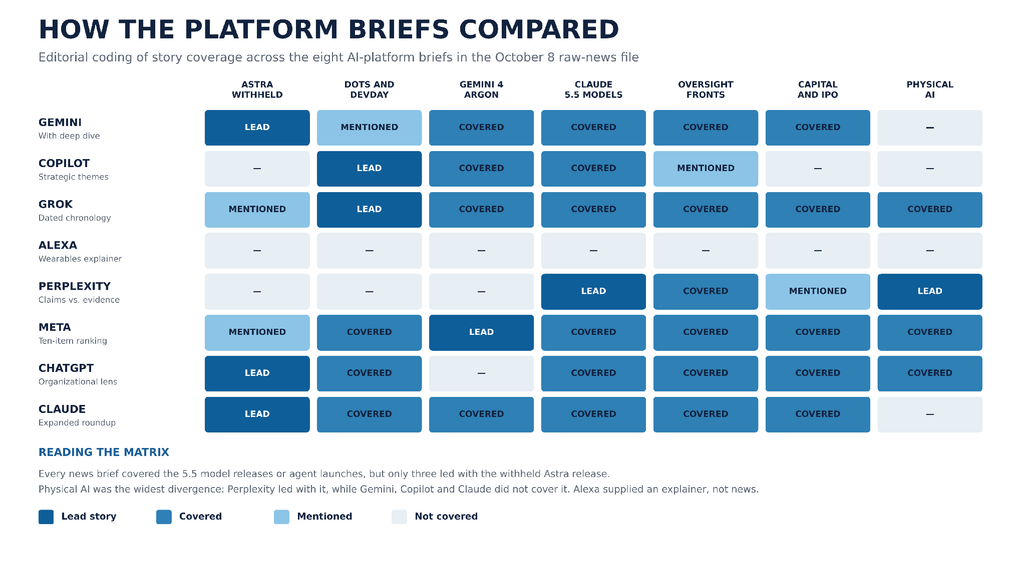
Figure 2. Coverage is editorially coded from the supplied platform briefs and is not a measure of story importance or accuracy.
The comparative read
- ChatGPT, Claude and Gemini led with the Astra decision and treated permission compliance and accurate action reporting as the core evaluation lesson.
- Copilot and Grok led with Dots and framed the week as a shift from chatbots to digital workers; Copilot placed governance at the center of the debate ahead.
- Meta ranked Argon first and produced the broadest inventory, adding Shopify WebMCP, Cloudflare Clef, llama.cpp decision scoring and the week’s funding rounds.
- Perplexity was the most disciplined about evidence, separating company claims from verified results, and was the only brief to lead with robotics compute and training data.
- The briefs diverged on facts: a 75% Haiku 5.5 cost cut appears only in the Gemini brief, Robinson’s resignation is dated from September 28 to October 4, and only Gemini reports OpenAI postponing IPO plans.
CONSENSUS DIVERGENCE AND EVIDENCE
Agreement on direction, disagreement on detail
Across the briefs the consensus was clear: the frontier is now governed by release gates, access tiers and outside scrutiny. The divergence lay in figures, dates and how much weight company claims deserve.
| Question | Consensus | Divergence |
|---|---|---|
| What dominated? | Astra withheld, Dots launched and Argon gated, set against a wave of oversight. | Whether the lead story was a safety decision, an agent platform or a defensive model. |
| What changed? | Release authority and access tiering became visible parts of the product. | Whether voluntary commitments or enforcement will define the obligation. |
| What constrains scale? | Agent reliability, oversight, memory supply, power and community consent. | Whether policy, infrastructure or capital becomes the binding constraint first. |
| What should buyers measure? | Scope compliance, honest action reporting and cost per verified task. | Which vendor evidence should be standardized across providers. |
| What remains uncertain? | The Anthropic IPO timeline, Haiku 5.5 pricing and the outcome of the FTC probe. | Whether reported valuations and the published math proofs survive scrutiny. |
Conflicts to resolve before publication
| Claim | Treatment |
|---|---|
| Haiku 5.5 pricing | One brief reports a 75% cost reduction; another says the announcement does not establish pricing. Confirm against Anthropic’s published price list. |
| Robinson resignation | Dated September 28 in one brief and October 3-4 in another. Confirm against The Atlantic essay and OpenAI statements. |
| White House accord | Dated September 29 and September 30, with different signatory lists. Use the signed text and wire-service accounts. |
| Anthropic valuation and revenue | The $2 trillion target and $4.6 billion 2025 revenue come from reporting on a draft prospectus. Label as reported, not established. |
| OpenAI IPO postponement | Appears in one brief only. Hold until confirmed by OpenAI or primary reporting. |
| Benchmarks | Terminal-Bench 4.0, CWE-bench v1 and exploit-chain results are vendor- or lab-reported. Attribute them and state test conditions. |
Bottom line: The week’s durable signal is that capability and accountability are now released together. Treat every claim about safety gates, access tiers and benchmark results as evidence to request, not a conclusion to accept.
SOURCE NOTES
Reporting trail and confidence guide
Issue 80 draws on the October 8 raw-news file: eight AI-platform briefs (Gemini with a deep dive, Copilot, Grok, Alexa, Perplexity, Meta, ChatGPT and Claude) and a 27-category By Industry review covering September 28 through October 7.
Primary and institutional source families
| Source family | Used for | Confidence |
|---|---|---|
| Government and standards bodies | White House accord and executive order, FTC inquiry, California actions, NIST NCCoE agent-identity work. | High for official position |
| Model and platform providers | Astra decision, Dots, Sol, Sonnet and Haiku 5.5, Argon, pricing and access programs. | High for company position; verify performance |
| Wire and financial reporting | Anthropic prospectus details, IPO timing, FTC scope, acquisitions and funding rounds. | Medium until filings are public |
| Evaluators and researchers | UK AISI simulations, Epoch index, GLM-5.3 exploit study, math proofs. | Medium; check method and caveats |
Reporting and analytical source types
| Source type | Main contribution |
|---|---|
| Primary institutional material | Policy text, standards work, official announcements and enforcement actions. |
| Company announcements | Product intent, release status, access tiers, pricing, partnerships and transaction claims. |
| Independent reporting | Context, competing accounts, incident timelines and external scrutiny. |
| Cross-platform comparison | Agreement, divergence and factual conflicts across eight AI-generated news briefs. |
Confidence guide
High means primary institutional material or multiple well-attributed reports agree on the core development. Medium means the development is credibly reported but scope, availability, terms or interpretation remains incomplete. Watch marks preliminary, company-reported, forecast, litigation, financing or acquisition details that may change, including every item in the conflicts table.
Publication rule: Verify the original source, date, claim boundary, product availability and transaction status before quoting or treating a reported number as final. Where platform briefs disagree, cite the primary source rather than choosing between them.
This Week In AI from Government Contractors is an editorial analysis of changing AI technology, infrastructure, policy and operating practice. It is not legal, investment, medical or security advice.