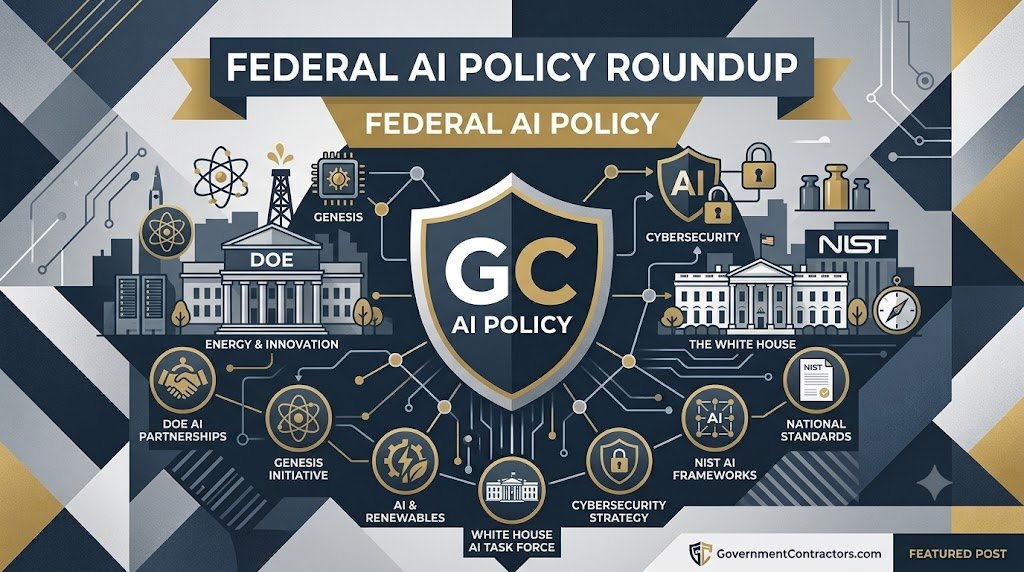
U.S. DOE Unveils First 278 Genesis Mission Projects
Federal Scope: The U.S. Department of Energy (DOE) officially selected 278 projects under the historic Genesis Mission initiative, backed by over $5 billion in federal scientific commitments.
Core Focus Areas:
Nuclear & Fusion Energy: A flagship $60 million three-year project uses agentic AI workflows to streamline nuclear reactor lifecycle design, licensing, and operational simulation.
Materials & Chemistry: Closed-loop AI models link predictive physics with automated lab synthesis to discover novel superconductors and microelectronics.
Climate & Agriculture: In coordination with the USDA, multi-modal models are analyzing germplasm data, satellite imagery, and soil sensors to accelerate resilient crop breeding.
Access Model: Participating teams gain access to the American Science and Security Platform, connecting DOE exascale supercomputers (Frontier, Aurora) directly with state-of-the-art foundation models and automated laboratory instruments.
White House AI-Cybersecurity Coordination Group
The Mandate: Established by the White House, this coordination group connects frontier AI labs (OpenAI, Anthropic, Meta, NVIDIA) directly with critical infrastructure operators and defense agencies.
Operational Mechanism: Creates a structured, rapid-disclosure pathway for reporting software vulnerabilities discovered by agentic AI coding models before they are publicly disclosed or exploited.
Strategic Takeaway: The initiative treats autonomous zero-day discovery as a national security issue, establishing proactive defensive postures for power grids, water systems, and financial networks.
US National Policy
The U.S. Center for AI Standards and Innovation evaluated China’s GLM-5.2 model. The government assessment found that GLM-5.2 was probably the most capable open-weight model when released, signaling increased federal scrutiny of foreign frontier models. NIST/CAISI
Federal AI policy is increasingly connected to national security. Model evaluations are examining cybersecurity, biological and chemical misuse, foreign influence, data integrity, model safeguards, and strategic dependence on foreign AI systems.
Congressional debates continued over frontier models, automated vehicles, AI infrastructure, and federal-versus-state authority. The absence of a single comprehensive federal AI law means agencies and states are still building overlapping requirements. U.S. Technology Policy Update
NIST
NIST’s Center for AI Standards and Innovation published its assessment of GLM-5.2. The evaluation examined the performance and risk characteristics of the Chinese open-weight model. NIST/CAISI
The assessment demonstrates NIST’s expanding national-security role. CAISI is moving beyond voluntary risk-management guidance toward direct technical evaluation of strategically important models.
NIST also highlighted AI and digitalization in international measurement standards. The International Conference of Weighing addressed AI, robotic measurement, traceability, and machine-readable certificates. NIST
US Government
A federal judge warned the Justice Department about an apparently nonexistent legal citation. The judge said the citation was likely generated by AI and emphasized that attorneys must verify all AI-assisted legal work. Reuters
The incident reinforces that government accountability cannot be delegated to AI. Agencies require approved systems, source verification, human review, records management, audit trails, and clearly assigned professional responsibility.
Federal agencies are increasing their scrutiny of foreign AI models. CAISI’s assessment of GLM-5.2 reflects growing concern about performance, cybersecurity, national-security risks, and dependence on foreign model ecosystems.
Law Enforcement
Western Australia began a real-time facial-recognition trial. More than 130,000 people were reportedly scanned during the first week, producing 33 alerts, 19 arrests, and two false alerts. Officers were required to confirm matches rather than treating an AI alert as sufficient grounds for arrest. News.com.au
The trial illustrates the need for human confirmation and appeal. Facial recognition can create investigative leads, but false positives, demographic performance differences, retention, surveillance scope, and public consent remain major concerns.
Law-enforcement AI governance should distinguish detection from legal authority. An automated alert should not independently establish probable cause, justify detention, or trigger enforcement action.
NASA
No major NASA-specific AI announcement was identified for the reporting week.
NASA continues integrating AI across Earth science, autonomous systems, robotics, mission planning, spacecraft operations, and scientific-data analysis.
AI remains important to missions operating with communication delay. Future lunar and Mars systems will need local perception, navigation, fault detection, scheduling, and decision support while retaining safe-state and human-command capabilities.
National Institute of Health
No major NIH-specific AI release was identified during July 13–19.
NIH’s All of Us Research Program remains an important foundation for biomedical AI. Its integrated genomics and health database now includes information from more than 747,000 participants, supporting precision-medicine research. NIH
The central governance requirement is responsible data access. AI research using large health datasets must address consent, privacy, reidentification, representativeness, bias, reproducibility, and clinical validation.