Five Key State and Local Government News Stories in Q3 2026
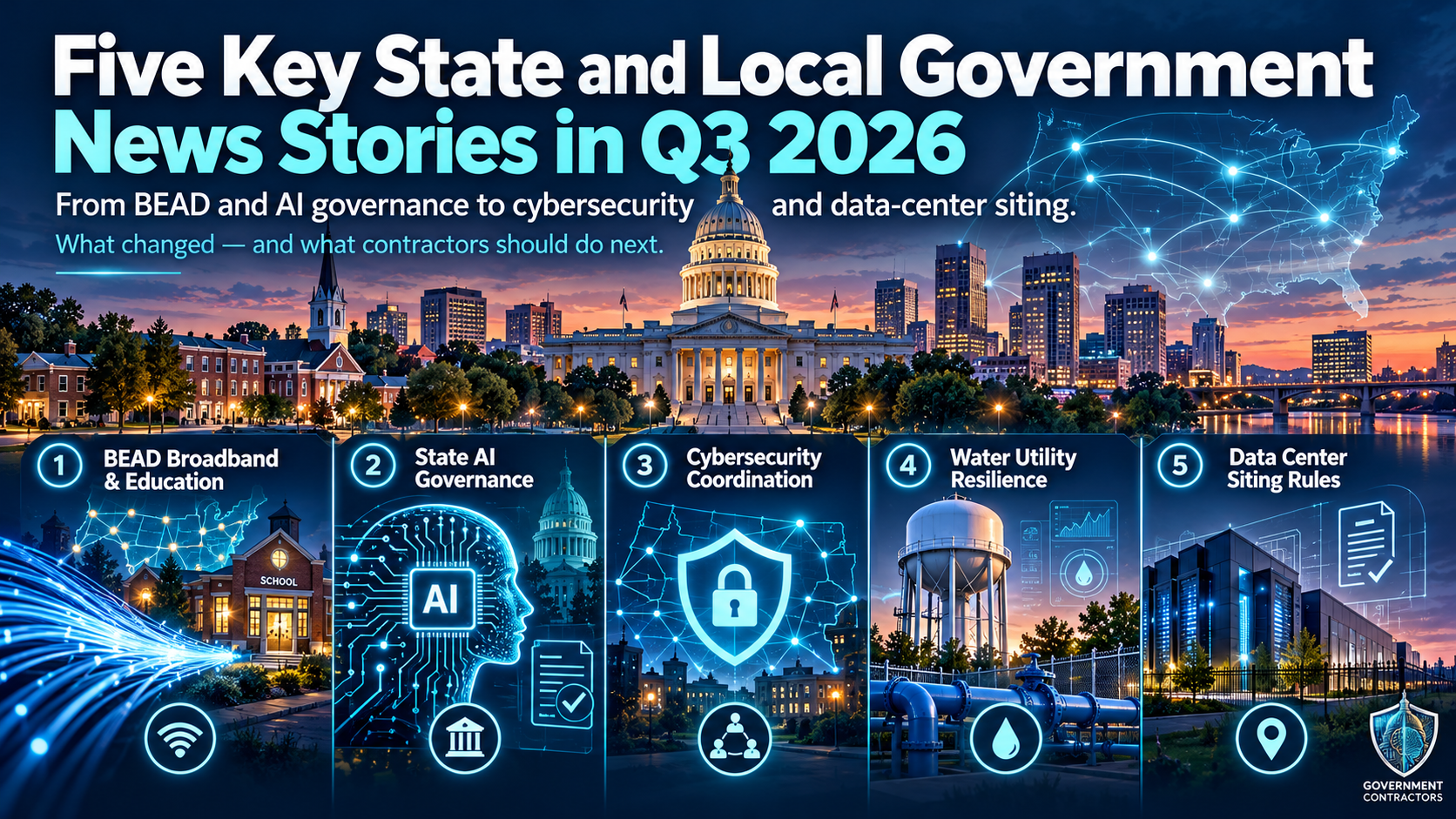
From BEAD and AI governance to cybersecurity and data-center siting: implications and actions for contractors
KEY TAKEAWAYS
- State and local contracting opportunities are increasingly shaped by enterprise purchasing and standards, not just individual agency needs.
- BEAD plan approvals, grant awards and funded construction are separate milestones; broadband contractors must confirm actual authorization to proceed.
- AI governance and cybersecurity initiatives can create implementation demand, but proposed standards or new responsibilities do not automatically produce RFPs.
- Water utility attacks and targeted grants highlight growing needs for operational-technology security and practical resilience services.
- Data-center moratoria and zoning restrictions make location-specific permitting, power and water access essential capture considerations.
State and local government purchasing rarely moves on a single national timetable. In the third quarter of 2026, broadband offices reworked award assumptions, central IT organizations formalized AI purchasing, states expanded cybersecurity initiatives, water utilities confronted operational threats and local governments changed the rules for data-center development. Each story creates potential contractor demand while making clear why jurisdiction-specific funding and approvals must be checked before a pursuit begins.
01 BEAD: State broadband awards move from plan approval toward execution
AGENCY / GOVERNMENT: STATE BROADBAND OFFICES, INCLUDING COLORADO / NTIA FEDERAL OVERSIGHT
What happened. The $42.45 billion Broadband Equity, Access, and Deployment (BEAD) program remained an active state-government story through all three months. July reporting followed reassessment of satellite service locations after new broadband data changed eligibility. In late August, NTIA said every state and territory had secured approval for its final proposal. September then brought further guidance on potential uses of remaining funds as well as a Colorado review that rescinded certain previously announced awards. These are different milestones: federal proposal approval is not the same as a final enforceable state grant agreement or a construction notice to proceed.
Why it matters to contractors. Network builders, broadband providers, engineering firms, construction contractors, equipment manufacturers and rural deployment partners face possible changes to serviceable-location counts, technology mix, award packages and project sequencing. Even a company named in an approved state plan may need to clear additional procurement and grant conditions before work becomes funded and executable.
What contractors should do. Use state broadband-office award maps and actual grant agreements—not headline funding totals—as the basis for pursuit decisions. Recheck challenged or newly served locations, eligible technology, match requirements, milestones and permitting. Track reopened rounds and leftover-funding rules, but do not commit crews or inventory until the agency confirms award status, financial terms and implementation authority.
Sources for this story: 1, 2, 3, 4, 5.
02 Oklahoma, New York and Oregon: State AI buying becomes more centralized and governed
AGENCY / GOVERNMENT: OKLAHOMA OMES; NEW YORK OFFICE OF IT SERVICES; OREGON ENTERPRISE IT AND PROCUREMENT LEADERSHIP
What happened. Oklahoma’s Office of Management and Enterprise Services introduced BEACON, a shared internal AI development platform, in July, with early applications aimed at administrative-rule review and procurement guidance. In August, New York’s technology office reported a statewide arrangement with IBM for AI and hybrid-cloud capabilities. In September, Oregon directed state government to develop procurement safety criteria for frontier AI, including third-party review standards. The stories point in a common direction but not to a uniform national policy: statewide purchasing organizations are increasingly shaping platform selection, controls and agency deployment patterns.
Why it matters to contractors. AI vendors face fewer opportunities to treat every agency as an independent buyer when enterprise platforms, licensing agreements and security guardrails are established centrally. Integrators may gain demand for data preparation, application integration, workflow redesign, oversight, testing and adoption work, but will need to meet state-specific governance, privacy, security and procurement expectations.
What contractors should do. Identify both the central procurement owner and the mission department that will use a solution. Map existing approved platforms before proposing standalone subscriptions. Prepare documentation on data residency, model evaluation, human oversight, security controls, interoperability and costs. Where the state is still drafting standards, monitor implementation guidance rather than assuming an executive direction is already a complete procurement rule.
Sources for this story: 6, 7, 8, 9, 10.
03 California, Pennsylvania and Nebraska: Cybersecurity moves toward whole-of-state coordination
AGENCY / GOVERNMENT: CALIFORNIA STATE AGENCIES; PENNSYLVANIA OFFICE OF ADMINISTRATION; NEBRASKA CIO
What happened. Q3 reporting highlighted several approaches to strengthening state and local security. California directed agencies to establish AI cyber-defense responsibilities and program leadership. Pennsylvania added budget support for cybersecurity and digital services. Nebraska discussed expanding statewide threat-information sharing and the potential to use shared purchasing to improve local access to cyber services. The approaches ranged from announced organizational requirements to appropriated funds and proposals still requiring operational decisions.
Why it matters to contractors. The shifts can open opportunities for security assessment, identity management, managed detection, response planning, architecture, secure application modernization and shared-services support. But a statewide mandate is not always a new solicitation, and an approved budget line does not show exactly which agency will buy which service. Smaller municipalities may become buyers through state agreements or cooperative arrangements rather than individual RFPs.
What contractors should do. Trace each initiative to its budget authority, lead agency, implementation timeline and procurement mechanism. Prepare capabilities that can be delivered at scale, with clear per-agency responsibilities and measurable service levels. Look for cooperative contracts and regional partnerships. Avoid presenting a generic AI-security pitch where the requirement is a specific operational control, staffing capability or response service.
Sources for this story: 11, 12, 13, 14.
04 Minnesota and New York: Water-system cyber incidents meet targeted resilience funding
AGENCY / GOVERNMENT: MINNESOTA MUNICIPAL WATER UTILITIES / NEW YORK WATER AND WASTEWATER AGENCIES
What happened. A coordinated cyberattack caused disruption at water utilities serving more than 30 Minnesota communities in July, according to StateScoop. August reporting also documented persistent technology and staffing weaknesses in water and wastewater operations. New York announced more than $9 million for 153 local water-infrastructure cybersecurity projects through its SECURE grant program, including support for assessments and upgrades. The quarter illustrated both operational exposure and a concrete public-sector funding response—without establishing that every affected community would issue an immediate contract.
Why it matters to contractors. Water utilities operate operational technology (OT) and industrial controls with constraints that differ from enterprise office IT. Potential work includes device inventory, privileged access, network segmentation, monitoring, remote-access hardening, backup and recovery, operator training and incident-response planning. Contracting opportunities often depend on utility ownership, grant eligibility, specialized engineering approvals and local purchasing capacity.
What contractors should do. Identify eligible grant recipients and the terms of their funding. Lead with a realistic assessment-to-remediation sequence rather than a broad software suite. Coordinate with water engineering and OT partners to avoid creating operational disruption. Document the utility’s existing controls, response capability and operator requirements, and price scoped improvements that can be verified after deployment.
Sources for this story: 15, 16, 17, 18.
05 Data centers: A patchwork of state and municipal siting rules reshapes project risk
AGENCY / GOVERNMENT: NEW YORK STATE; TUCSON, ARIZONA; DURHAM COUNTY, NORTH CAROLINA; AND OTHER MUNICIPALITIES
What happened. Throughout Q3, Government Technology reported a growing number of state and municipal actions focused on data-center siting, infrastructure and public impacts. New York imposed a one-year state-level pause on certain hyperscale data-center environmental approvals, with exemptions that matter for already-complete applications and local permissions. Tucson adopted restrictive rules and Durham County voted to pause new development while reviewing standards. Other jurisdictions—including Manatee County, Chicago and Charlotte—were considering or debating moratoria and extensions. Enacted restrictions, administrative pauses and proposed measures should not be conflated.
Why it matters to contractors. Site development, electrical infrastructure, cooling, water infrastructure, engineering, environmental services and construction contractors face schedule and cost exposure when permits, utility interconnection, zoning or mitigation requirements change. Some governments may also commission studies, planning, grid and water assessments or new public infrastructure, but those possibilities are not funded procurements until local authorities act.
What contractors should do. Build a jurisdiction-specific approvals register for each proposed site. Confirm the status of legislation or ordinances, zoning eligibility, grandfathering, environmental permits, power and water service, community benefits and public hearing dates. Stress-test delivery schedules against possible delays, and do not mobilize a pursuit around a project that lacks credible land, energy and permitting pathways.
Sources for this story: 19, 20, 21, 22, 23, 24, 25.
The next capture decision
For state and local markets, the next step is not to assume that a national trend creates the same opportunity everywhere. Compare named jurisdictions against four tests: a funded need, an accessible procurement route, demonstrable mission fit and a manageable cost to pursue. Recheck the conditions that can reverse a decision—grant award status, enterprise platform restrictions, local contracting rules, permitting and project readiness—before dedicating your best people to an account.
Government Contractors LLC helps teams turn policy, procurement and market changes into account priorities and actionable growth plans. Contact us at 703-996-9029 or team@governmentcontractors.com to discuss agency intelligence, account research and capture positioning.
Sources and further reading
Q3 2026 coverage listed in story order. Opinion, syndication and primary agency releases are labeled. Developments are reported as of September 30, 2026.
[1] S01 | StateScoop | Jul 16, 2026. States review satellite BEAD locations after new broadband data changed eligibility
[2] S01 | StateScoop | Jul 23, 2026. States may need to cut one-third of BEAD satellite awards after broadband data update
[3] S01 | StateScoop | Aug 26, 2026. All states and territories secure approvals from NTIA on BEAD final proposals
[4] S01 | StateScoop | Sep 4, 2026. NTIA shares long-awaited update on use of leftover BEAD funds
[5] S01 | StateScoop | Sep 22, 2026. Colorado rescinds over $100M in BEAD awards after investigation
[6] S02 | StateScoop | Jul 24, 2026. Oklahoma debuts internal AI platform with lighthouse tools
[7] S02 | Government Technology | Jul 28, 2026. Enterprise platform helps Oklahoma create, deploy AI tools
[8] S02 | StateScoop | Aug 13, 2026. New York tech office signs agreement with IBM for AI, cloud services
[9] S02 | Government Technology | Sep 24, 2026. Digital States 2026: AI moves from experiment to infrastructure (Survey / analysis)
[10] S02 | Government Technology | Sep 25, 2026. Oregon is latest state to move on frontier AI regulation
[11] S03 | StateScoop | Aug 13, 2026. Pennsylvania boosted budget for cybersecurity, digital services
[12] S03 | StateScoop | Aug 14, 2026. Each California agency will get an AI cybersecurity officer
[13] S03 | Government Technology | Sep 9, 2026. Report: States tackling local gaps in infrastructure cybersecurity (Survey / analysis)
[14] S03 | Government Technology | Sep 22, 2026. Nebraska eyes statewide cybersecurity sharing, broader grant use
[15] S04 | StateScoop | Jul 28, 2026. Coordinated cyberattack disrupts water utilities in 30+ Minnesota communities
[16] S04 | StateScoop | Aug 5, 2026. New York boosts funding for water cybersecurity grants
[17] S04 | StateScoop | Aug 5, 2026. Water utility cyberattacks product of expedient decisions, IT staff shortages (Podcast / analysis)
[18] S04 | Government Technology | Sep 25, 2026. Expert urges water utilities to focus on cybersecurity basics
[19] S05 | Government Technology | Jul 14, 2026. New York is first to enact statewide data center moratorium
[20] S05 | Government Technology | Jul 31, 2026. In Manatee County, Fla., a data center moratorium looms
[21] S05 | Government Technology | Aug 7, 2026. Tucson, Ariz., approves strict data center rules
[22] S05 | Government Technology | Aug 25, 2026. Durham County, N.C., votes for pause on data centers
[23] S05 | Government Technology | Sep 10, 2026. List of Alabama cities with data center moratorium grows
[24] S05 | Government Technology | Sep 23, 2026. Chicago mayor proposes data center moratorium for city
[25] S05 | Government Technology | Sep 29, 2026. How long will Charlotte, N.C., extend data center moratorium?