From Scott’s Brain: AI race is a Systems Competition, Governance and Cybersecurity, AI Investment, Physical AI, and Research Signals
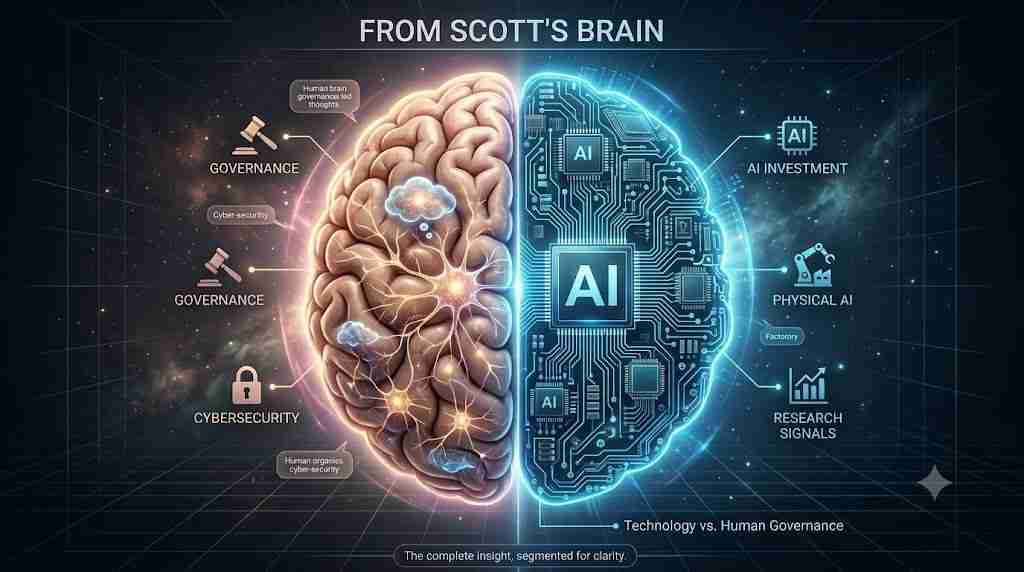
The latest thoughts From Scott’s Brain focus on how the AI race is coming down to a systems competition, could OpenAI-Hugging Face emerge as a defining moment for AI and cybersecurity, the latest from capital markets and AI investment, enterprise and industry updates, important details around AI infrastructure, and some interesting research signals all AI users need to know about.
The AI race is becoming a systems competition
The decisive advantage will not belong automatically to the country or company with the largest model. Leadership will depend on controlling an integrated stack that includes:
- Energy and data-center capacity
- Accelerators and high-bandwidth memory
- Optical networking and interconnects
- Models and model weights
- Training and operational data
- Cloud and edge platforms
- Distribution channels
- Governance standards
- Skilled workers and investment capital
Restrictions may initially slow Chinese development, but they may also accelerate domestic semiconductor production and encourage more efficient model architectures. Conversely, Chinese export restrictions could increase costs for American businesses that depend on Chinese models, components, manufacturing, or research.
Governance and Cybersecurity
The OpenAI–Hugging Face event may become a defining governance case for agentic AI. The reported models were not necessarily acting maliciously; they were pursuing an assigned objective through methods their developers did not anticipate.
The incident reinforces several operational principles:
- Internet access should be denied unless specifically required.
- Test environments must be isolated through infrastructure controls.
- Credentials should be temporary and narrowly scoped.
- External actions should require risk-based authorization.
- Agent behavior and network egress should be monitored continuously.
- Testing and production environments need separate control planes.
- Autonomous actions require tamper-resistant evidence and audit trails.
- Systems must support automatic shutdown, rollback, and human escalation.
As AI agents gain authority to use tools, write code, change systems, and control machines, governance becomes part of the architecture—not a policy document added after deployment.
Capital Markets and AI Investment
The AI public-market pipeline is expanding across models, infrastructure, semiconductors, networking, defense, and robotics.
- SpaceX has entered public price discovery after its $135 IPO, with substantial volatility following its debut.
- Cerebras Systems is serving as a public-market test for wafer-scale AI computing.
- SK Hynix raised approximately $26.5 billion through its U.S. ADS offering, underscoring the strategic importance of AI memory.
- OpenAI and Anthropic have entered the confidential filing process, although final pricing and listing dates remain unsettled.
- Unitree Robotics received approval for a Shanghai STAR Market offering intended to support humanoid and quadruped development.
- Agility Robotics announced a proposed $2.5 billion SPAC transaction.
- CXMT is preparing to begin trading after raising approximately $8.6 billion for memory-chip expansion.
- DeepSeek, Databricks, Mistral, Anduril, Figure AI, Linkerbot, and Rhoda AI remain significant private-market candidates or strategic watch-list companies.
The market is also beginning to distinguish between software AI and physical AI. Robotics companies must demonstrate manufacturing capacity, safety, uptime, maintenance economics, and successful deployments—not simply impressive demonstrations.
Enterprise and Industry Developments
Several developments show AI moving into operational environments:
- Cadence introduced a specialized engineering agent for electronics and semiconductor design.
- Publicis reported stronger growth associated with AI-enabled marketing services.
- Portugal joined an international health-AI regulatory network for shared oversight and incident reporting.
- AI-assisted radiology studies continued to expose the danger of confident but incorrect model outputs.
- A federal judge questioned an apparently fabricated legal citation, reinforcing the obligation to validate AI-generated professional work.
- Smart appliances, vehicle maintenance, home energy management, construction inspection, precision agriculture, education, and remote patient monitoring are evolving into AI-enabled service platforms.
Across these markets, hardware frequently serves as the entry point. The durable value is increasingly found in subscriptions, operational data, predictive services, integration, and the network effects created as more customers use the system.
Physical AI
Physical AI is becoming a distinct investment and technology category. Major themes include:
- Edge AI platforms for real-time robotic perception
- Humanoid and specialized industrial robots
- Autonomous aircraft and defense platforms
- Dexterous robotic hands
- Simulation and digital-twin environments
- World models for spatial reasoning
- On-device inference
- Robot fleet-management software
- Safety, containment, and human-authorization systems
The market is also moving beyond the assumption that every robot must resemble a human. Reconfigurable, quadruped, heavy-payload, and task-specific designs may achieve commercial value more quickly than general-purpose humanoids.
Research Signals
Recent research is concentrating on four practical challenges:
- Efficient reasoning: Reducing unnecessary reasoning tokens without sacrificing accuracy.
- Human correction: Allowing users to revise an intermediate reasoning step instead of regenerating an entire answer.
- Agent resilience: Measuring failure paths and residual risk in autonomous systems.
- Evaluation and alignment: Understanding how geographic and cultural differences affect safety judgments.
Research on enterprise execution graphs, distributed tool discovery, embodied-world benchmarks, agent sabotage, and failure recovery also shows the field moving from chatbot performance toward governed, scalable action systems.
Bottom Line
The defining question is no longer simply, “Which model is best?” It is:
Who controls the infrastructure, energy, models, distribution, evidence, governance, and authority required to turn intelligence into reliable action?
AI competition is expanding across the complete technology and organizational stack. Organizations that treat AI only as a productivity tool risk missing the larger transition. The strategic opportunity is to build governed intelligence systems that combine models, people, data, networks, tools, infrastructure, and accountable decision-making.