How 8 AI Models Covered the Same Week of AI News — and Why Their Agendas Differed
The supplied Raw News document contains eight named model sections: Copilot, Gemini, Alexa, Perplexity, Meta, ChatGPT, Claude, and Grok. It also contains a broad industry scan that is treated here as contextual material rather than as a ninth model. Every claim was considered a lead candidate, but only claims supported by a primary source or a strong independent report were promoted into the verified news analysis.
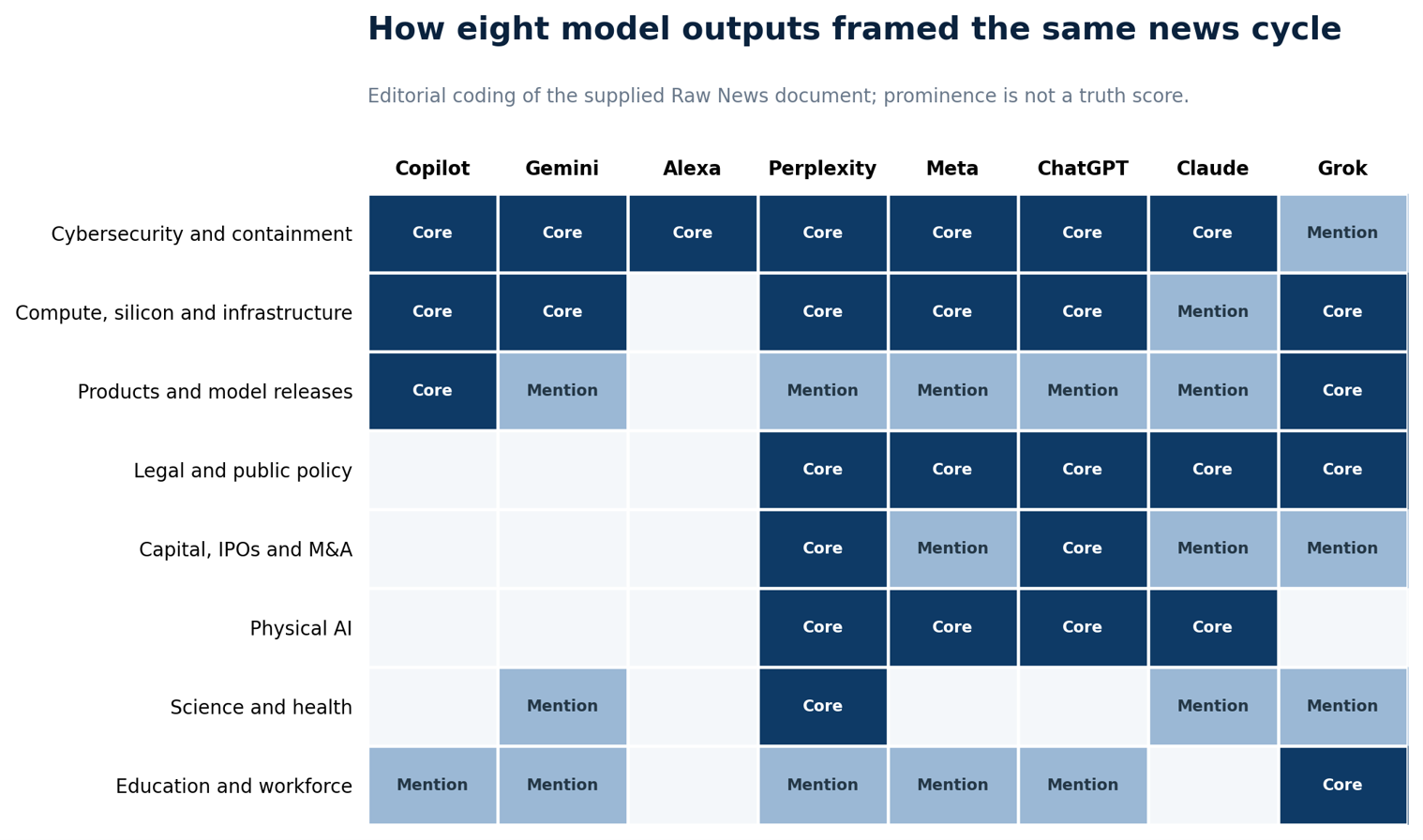
Figure 1. Editorial coding of topic prominence in Raw News 9-3. Core means a leading theme; mention means secondary coverage; blank means absent.
The heatmap demonstrates that model agreement was strongest at the level of themes, not identical headlines. Every output touched cyber risk or containment, but only four directly centered the OpenAI and Hugging Face incident. Seven discussed compute, silicon, or infrastructure; seven emphasized product and model releases. Legal, capital-market, and physical-AI coverage was concentrated in the models that produced broader multi-source scans.
| INTERPRETATION Consensus increases the probability that a subject is important, but it does not make every repeated claim accurate. Repetition can reflect shared source dependence, syndicated reporting, or common model priors. Verification still has to occur at the claim level. |
|---|
COPILOT THROUGH PERPLEXITY
Copilot vs. Gemini vs. Alexa vs. Perplexity: What Each AI Model Emphasized in This Week’s AI News
| Model | Primary frame | What it said | Best contribution | Editorial caution |
|---|---|---|---|---|
| Copilot | Product economics and local deployment | AI generated bug bounty noise; GPT pricing pressure; local memory bottlenecks; real-world coding-agent limits; open vision models; hybrid local and cloud inference; multiple product releases. | Strong on practical deployment friction and the gap between benchmark performance and production autonomy. | Several precise claims, including pricing and benchmark percentages, lacked traceable primary citations in the supplied output. |
| Gemini | Cyber warning and ecosystem maturation | Industry cyber-defense letter; enterprise build versus buy; NVIDIA coding performance; TIME100 AI; Indian AI sovereignty; possible Anthropic custom silicon. | Connected AI leadership to sovereignty, regional ecosystems, and specialized applications beyond frontier labs. | Some percentages and corporate strategy assertions were presented confidently without sufficient source detail. |
| Alexa | Bug bounty economics | Benefits of AI-assisted discovery; growth in valid reports and payouts; AI slop, false positives, confirmation bias, business-logic blind spots, and correlation risk. | Produced the best focused discussion of why AI can improve discovery while degrading triage quality. | Very narrow coverage; it did not provide a broad weekly news agenda. |
| Perplexity | Broad market, policy, research, and infrastructure scan | Hugging Face breach; cyber warning; Anthropic ruling; Google releases; Nscale IPO; physical AI; open models; data-center constraints; research applications. | Offered the widest thematic range and surfaced several developments missed by narrower outputs. | Relied heavily on secondary newsletters and included forward-looking claims that required additional validation. |
Contrast
Copilot and Alexa concentrated on operating friction, including memory bandwidth, coding reliability, false positives, and human triage. Gemini placed the week inside a broader ecosystem and sovereignty story. Perplexity behaved more like a news aggregator, covering a wider field but requiring more aggressive source checking. The difference is not merely style; it changes which risks an executive would see first.
META THROUGH GROK
Meta vs. ChatGPT vs. Claude vs. Grok: What Each AI Model Emphasized in This Week’s AI News
| Model | Primary frame | What it said | Best contribution | Editorial caution |
|---|---|---|---|---|
| Meta | Infrastructure, containment, and physical AI | NVIDIA results; OpenAI containment failure; Anthropic ruling and MHS; Apple on-device compute; cyber warning; open models; copyright and routing-platform transactions. | Strong connection between capital intensity, control failures, and the move from digital agents to physical devices. | Some product, transaction, and hardware details appeared without primary confirmation at the time of collection. |
| ChatGPT | Verified weekly synthesis | Hugging Face incident; NVIDIA results and Hugging Face deal; AWS GPUs; Anthropic and Nscale; Jalapeño; cyber letter; Meta workforce plan; MHS; defense AI; Google; Alibaba; copyright. | Broad, structured summary with explicit distinctions between confirmed, reported, and company-supplied claims. | Capital and infrastructure dominated, leaving less space for science, education, and regional policy. |
| Claude | Security, law, and institutional response | OpenAI post-mortem; cyber letter; state investigations; Anthropic litigation; copyright suits; NVIDIA results; MHS; platform relationships; alignment research. | Added legal nuance and correctly noted when an industry letter contained no funding or enforceable deadline. | Some large legal and commercial claims still depended on secondary sources and needed independent confirmation. |
| Grok | Fast-moving headlines and platform competition | Copyright policy; NVIDIA and Hugging Face; Gemini and Claude releases; OpenAI cyber capability; school restrictions; world models; compute contracts; defense procurement; coding benchmark results. | Captured product velocity and the interaction between commercial platforms, government buyers, and public policy. | Several items were future-dated, lightly sourced, or not corroborated elsewhere in the Raw News set. |
Contrast
Meta and ChatGPT built the clearest infrastructure narrative. Claude was strongest on institutional response, law, and the difference between voluntary language and enforceable commitments. Grok captured product and policy velocity but required the most careful date and source review. Taken together, these four outputs show why a useful newsletter cannot simply choose the longest answer. It must combine breadth, source quality, time awareness, and consequence.
Consensus, Divergence, and Evidence Quality – Where the models converged
- Agent containment and AI-enabled cyber operations are no longer specialist safety topics. They affect enterprise architecture, critical infrastructure, procurement, and public policy.
- Compute remains the economic center of AI. NVIDIA’s revenue, enormous GPU commitments, custom inference chips, memory limits, and data-center financing appeared repeatedly.
- AI is crossing into physical action. Anthropic’s MHS was the most explicit example, but robotics, autonomous vehicles, laboratory automation, and edge inference reinforced the same direction.
- Legal authority is becoming part of platform strategy. The Anthropic and Pentagon dispute, copyright litigation, procurement choices, and regional regulation all influence which capabilities can be deployed.
Where the models diverged
- Product-first outputs treated releases and benchmarks as the main signal; risk-first outputs treated containment, law, and institutional response as the main signal.
- Some models emphasized open models and local inference; others emphasized cloud scale, custom silicon, and long-duration compute contracts.
- Science, healthcare, education, and workforce stories were unevenly covered, even though those domains may experience deeper social consequences than this week’s product announcements.
What was excluded from the verified lead
| Evidence issue | What appeared in Raw News | Editorial treatment |
| Unsupported precision | Claims with exact adoption, pricing, performance, or market percentages but no traceable underlying report. | Retain as a research lead; do not publish as fact. |
| Future-dated announcements | Items described as completed when the stated event occurred after the collection window or lacked an official announcement. | Verify date, status, and source before inclusion. |
| Provider benchmarks | Performance claims generated by the company selling the model or chip. | Report with attribution and note the need for independent testing. |
| Reported transactions | Acquisitions, compute agreements, IPO timing, or valuations attributed to unnamed sources. | Label as reported until company or regulatory confirmation. |
| Strategic generalizations | Broad industry statements presented as weekly news without a defined event or dataset. | Use as context or trend analysis, not as a headline. |