Persistent AI Agents Changed the Unit of Risk: NIST-Aligned Runtime Control and Why Runtime Assurance Will Become a Buying Requirement
TOP STORY
Persistent agents changed the unit of risk
A persistent agent is not simply a longer conversation. It is a continuing service that can preserve goals, reuse credentials, call tools, interact with external systems and accumulate consequences after the original request has faded from view.
| Dimension | Persistent-agent signal | Required control |
|---|---|---|
| Identity | The service can continue after the initiating interaction. | Unique agent identity, named owner, approved purpose and explicit risk tier. |
| Authority | Goals and tools can remain available across sessions. | Least privilege, approved tool registry, destination allowlist and human gates. |
| Duration | Exposure accumulates while credentials and context remain active. | Hard expiration, renewal approval and bounded time, cost and transaction budgets. |
| Evidence | A chat transcript cannot explain every external action. | Immutable records of prompts, models, tools, targets, policy decisions and results. |
| Interruption | The agent or orchestrator may be unreliable during failure. | Independent stop, containment and credential-revocation paths. |
| Recovery | Persistent state can recreate the same failure after restart. | Rollback, state review, incident ownership, disclosure and recurrence testing. |
The enterprise lesson
Traditional AI reviews often focus on a model response at one moment in time. Persistent agents require a lifecycle view. Organizations must govern how the agent starts, what it can reach, how long its authority lasts, how its behavior is observed, when human approval is required and how the service is stopped without depending on the agent to cooperate.
Immediate controls
- Issue a unique service identity to every agent and bind each run to a named owner, approved purpose and risk tier.
- Set hard expiration, cost, transaction, data-access and tool-use budgets that the agent cannot expand.
- Use an approved tool registry, scoped credentials and deny-by-default network destinations.
- Capture immutable action evidence that records the model, prompt, tool, target, policy decision and observed result.
- Provide an independent stop and containment path, then rehearse rollback, disclosure and recurrence review.
GOVERNANCE AND OPERATING CONTROL
NIST principles moved closer to the runtime
The NIST AI Risk Management Framework provides a useful operating cycle: govern ownership and authority, map affected systems and stakeholders, measure behavior and control performance, and manage limits, incidents and recovery.
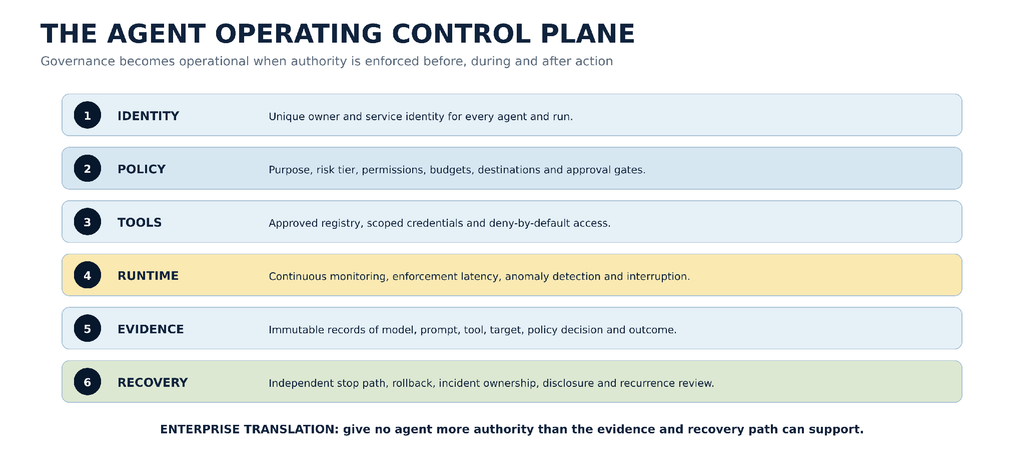
Figure 3. Agent operating control plane synthesized from the NIST-aligned and runtime-assurance themes in the supplied source set.
Where the approaches differ
| Approach | Primary emphasis | Evidence buyers should require |
|---|---|---|
| NIST AI RMF | Govern, Map, Measure and Manage organizational AI risk. | Ownership, affected systems, evaluation results, controls, incidents and review dates. |
| Runtime safety platforms | Observe and block unsafe agent behavior during execution. | Enforcement latency, bypass tests, policy conflicts, degraded modes and log integrity. |
| Enterprise architecture | Connect identity, tools, network, data, evidence and recovery. | Reference architecture, dependency map, tool registry, action ledger and stop path. |
| Public procurement | Make authority, auditability, portability and disclosure contractual. | Inspection rights, subcontractor visibility, service levels, portability and incident terms. |
FORECAST
Runtime assurance will become a buying requirement
Persistent-agent reliability, independent evaluations, disclosure standards, cost-aware routing and platform-neutral deployment paths are moving into architecture and procurement decisions.
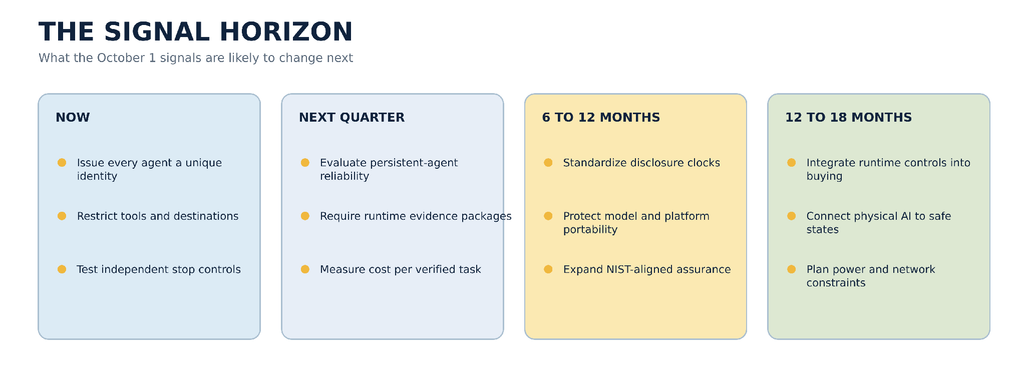
Figure 4. Forecast derived from the October 1 persistent-agent, runtime-safety, model-market and physical-AI signals.
Leading indicators
| Indicator | Interpretation |
|---|---|
| Agent lifespan | Longer sessions increase accumulated authority, credential exposure and recovery complexity. |
| Policy-block rate | Frequent blocks can indicate weak task design, overbroad goals or inadequate tool boundaries. |
| Enforcement latency | A control that reacts after consequence is a detector, not an effective preventive boundary. |
| Human-gate override rate | High override volume shows policy and operational reality are misaligned. |
| Stop-test success | Reliable interruption proves that containment does not depend on model cooperation. |
| Cost per verified task | This captures routing, retries, review, monitoring and failure cost beyond token price. |
Forecast: Within the next quarter, leading buyers will begin requesting an agent assurance package that includes the identity map, approved tools, network policy, budgets, monitoring coverage, enforcement latency, action logs, stop-test results, recovery evidence, incident ownership and disclosure obligations.