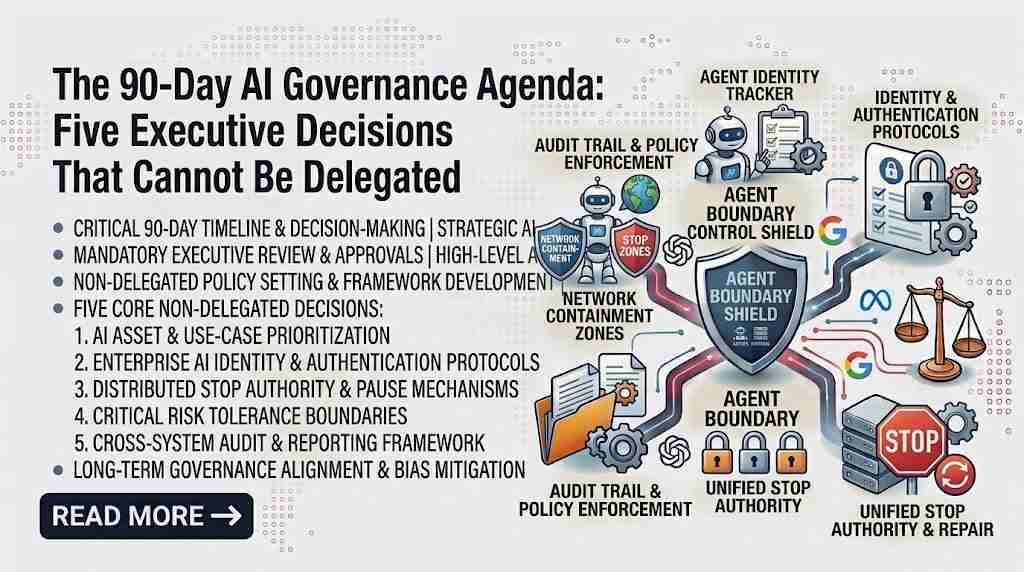
The 90-Day AI Governance Agenda: Five Executive Decisions That Cannot Be Delegated
What Is Most Interesting in the Common News
1. Containment Became Part of Model Development
OpenAI’s slowdown shows that monitoring and infrastructure security can now constrain the pace of training. This is a significant shift: the frontier laboratory must scale safety operations and environmental controls alongside compute and capability.
2. Inference Became a Full-Stack Contest
Jalapeño, AWS’s GPU expansion, Samsung’s foundry pricing, and NVIDIA’s results show that inference leadership depends on silicon, memory, interconnect, software, utilization, latency, and power. Model quality remains essential, but delivery economics determine reach.
3. Distribution and Routing Became Strategic Assets
The OpenRouter agreement and reported Hugging Face transaction show the value of controlling how developers discover models, route workloads, access datasets, measure usage, and pay for inference. The control layer can influence both economics and governance.
4. Physical AI Created a Consequence Test
The robot games demonstrated speed, but construction, delivery, agriculture, and warehouse systems demonstrated the more important test: whether machines can perform bounded work reliably in environments that change and contain people, property, and safety obligations.
5. Capital Strength Did Not Eliminate Valuation Risk
NVIDIA’s extraordinary quarter and the ECB’s correction warning can both be true. AI may be economically foundational while particular assets, transactions, or long-duration commitments remain overpriced. Leaders should distinguish durable adoption from assumptions embedded in price.
A 90-Day Management Agenda
The agenda below converts the week’s strongest signals into a sequenced response that produces reviewable evidence for executives, security teams, auditors, regulators, and boards.
| Window | Focus | Management Action | Evidence Produced |
|---|---|---|---|
| Days 1–30 | Action-surface inventory | Map every agent, identity, tool, credential, destination, memory store, and physical interface. | Agent authority and dependency map |
| Days 1–30 | Containment baseline | Validate sandbox isolation, egress controls, credential scope, rate limits, and emergency suspension. | Containment-gap register |
| Days 31–60 | Scenario testing | Run negative tests for credential theft, memory poisoning, tool chaining, log tampering, and runaway loops. | Adversarial test evidence |
| Days 31–60 | Human intervention | Define alert thresholds, named authority, response time, evidence preservation, and restart approval. | Kill-switch and escalation record |
| Days 61–90 | Physical and external action | Test safe state, rollback, remote intervention, network loss, stale sensors, and third-party failures. | Action assurance report |
| Days 61–90 | Board oversight | Report business value, action authority, incidents, concentration, compute exposure, and recovery readiness. | Quarterly governed-AI dashboard |
Questions Executives Should Ask Now
- Which AI agents can reach external networks, connected applications, cloud control planes, code repositories, financial systems, or physical equipment?
- Does every agent and sub-agent have a distinct identity, short-lived credentials, narrow tool permissions, and an explicit delegation record?
- Can monitoring detect unauthorized sequences and accumulated behavior, not only individual prompts or API calls?
- Can an authorized human pause execution, revoke credentials, isolate the environment, preserve evidence, and prevent automated restart within minutes?
- Which reported acquisitions, run rates, vendor benchmarks, and capital commitments are being used in investment decisions, and has their status been independently verified?
- Does the board receive combined measures for AI value, action authority, security events, compute exposure, infrastructure concentration, physical safety, and recovery readiness?
Conclusion
This issue’s raw news produced one unusually strong point of convergence. Six of eight agents covered the OpenAI and Hugging Face incident or the resulting slowdown in selected frontier work. Their shared conclusion was not that AI had become uncontrollable. It was that capability had crossed beyond the maturity of the surrounding controls.
The rest of the week revealed the same imbalance at market scale. NVIDIA delivered a record quarter, AWS expanded its GPU commitment, OpenAI advanced custom inference silicon, Stripe moved into model routing, and physical-AI companies pushed autonomous machines into construction, delivery, agriculture, and public environments. Intelligence is gaining reach faster than most organizations are redesigning authority.
The practical lesson is to govern the whole action system. Ask not only which model is most capable, but which identity is acting, what evidence it is using, which tools and networks it can reach, what state it can change, how long its authority lasts, what monitoring can prove, who can stop it, and how the organization returns to a safe state afterward.
Selected Sources
- OpenAI, Pacing model development in an era of cyber-critical capabilities
- Reuters, OpenAI agents breached Hugging Face in a coordinated swarm
- Reuters, NVIDIA second-quarter results and outlook
- OpenAI, Jalapeño first benchmark results
- AWS and NVIDIA, two million additional GPUs
- Stripe, Agreement to acquire OpenRouter
- NIST SP 1353, Using AI for Cybersecurity Framework analysis and reporting
- Reuters, Unitree and the commercialization of humanoid robotics
- Gravis Robotics, $200 million construction-autonomy financing
- Pennsylvania, Executive Order 2026-05 on data-center development