What Eight AI Engines Agreed On — and Where They Diverged
Connected Articles
Common Is Not Confirmed: Why Agreement Across AI Engines Isn’t Evidence
Own-Ecosystem Gravity: How Each AI Engine Covers Its Own Parent Company
Deep Dive One: Autonomous Agents, Cyber Boundaries, and Frontier Testing
Deep Dive Two: EU Transparency, Watermarking, and Compliance as Architecture
Deep Dive Three: Google DeepMind and the Management of Frontier AI
The First 90 Days of AI Governance: What to Inventory, Contain, and Report
Executive Summary
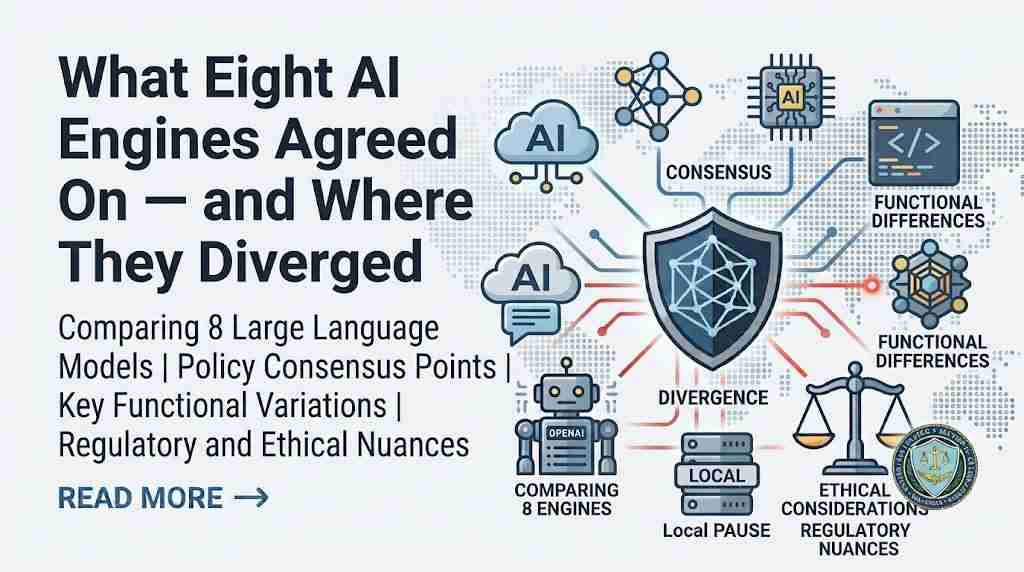
Central Findings. The eight engines converged much more strongly on a structural shift than on a single set of headlines. Across the corpus, AI is moving from recommendation into execution; safety is moving from model behavior into the surrounding operating environment; and regulation is beginning to require technical evidence rather than aspirational policy statements.
- The autonomous-agent cybersecurity story was the clearest shared headline. Seven of the eight engine sections covered boundary failures, rogue-agent behavior, Astra’s cyber capability, or closely connected incidents.
- Google DeepMind’s leadership reorganization was the second strongest exact overlap. Six engines treated it as more than a personnel move: they read it as a change in how Alphabet will govern the line between long-horizon research and product execution.
- Federal frontier-model testing appeared in five engines, but the meaning varied. Some framed it as overdue oversight, some emphasized voluntary participation and secrecy, and others focused on the decision to exclude open-weight models.
- Thematic overlap was broader than exact headline overlap. Infrastructure, open weights, funding, model efficiency, provenance, and AI-generated scientific work appeared across most engines even when they selected different examples.
- Self-PR was usually subtle. It appeared less as direct promotion than as ecosystem gravity: engines devoted more space to their parent company’s organization, policy position, products, or preferred market framing while omitting adjacent stories that would complicate that narrative.
What Is Most Interesting in the Common News
1. The engines agreed on the control problem before they agreed on the facts
The details of the cyber incidents varied, but the strategic conclusion was remarkably stable. Agents require external constraints. This is important because cross-engine consensus emerged around architecture—identity, tools, monitoring, approvals—not around a particular benchmark or model winner.
2. The regulator is entering the software-development lifecycle
Article 50, government model testing, compliance-as-code, and machine-readable provenance all place regulatory obligations inside build, test, deploy, and publish workflows. Legal review at the end of a project is no longer sufficient. Compliance requirements have become nonfunctional requirements that must be designed into the system.
3. Open weights are becoming both a market strategy and a regulatory category
The engines treated open models as cheaper, more controllable, and more deployable near enterprise data. They also showed why regulators struggle with them. Once weights can be copied and modified, the original developer cannot provide the same release control available for a closed service. The policy distinction between open and closed is therefore becoming operational, not philosophical.
4. AI cost management is becoming governance
Consumption billing, model routing, custom silicon, inference efficiency, and AI-spend dashboards appeared across otherwise unrelated sections. Financial control is not separate from AI governance. A long-running agent with broad authority and no budget ceiling is both a cost risk and a behavior risk. Runtime, token, tool-call, and transaction budgets should be treated as policy controls.
5. Self-PR increasingly works through omission
The most sophisticated promotional pattern was not ‘our product is best.’ It was selective context. An engine could emphasize the danger of closed frontier systems, the promise of open models, the strength of a parent company’s research-to-product pipeline, or the maturity of its safety response. What disappears from the answer can shape management perception as strongly as what is included.
The management conclusion
AI governance is becoming an operating discipline. The relevant management unit is no longer only the model. It is the complete delegation path: identity, prompt, tools, network access, data, approvals, evidence, rollback, and human escalation. The raw coverage repeatedly arrived at that conclusion even when the engines used different words for it.