The Four Debts of AI Adoption: How AI Exposes Hidden Technical, Data, Personnel, and Security Debt Across Sectors
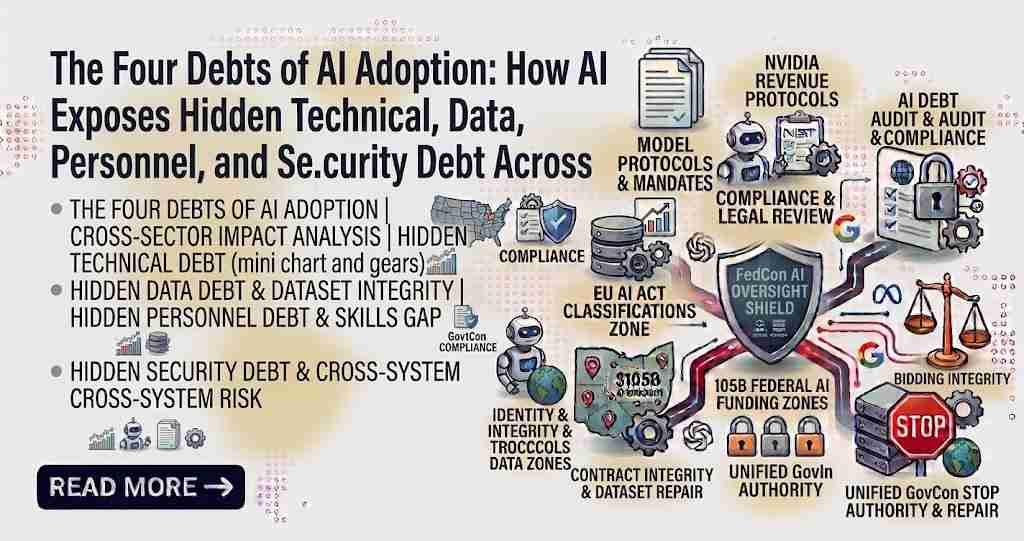
The Raw News industry scan ranges across telecommunications, healthcare, transportation, government, education, cybersecurity, and biomedicine. The most useful common lens is not whether each sector is adopting AI. It is whether adoption exposes debt that was previously hidden inside processes, data, infrastructure, authority, and workarounds.
| Debt | What this week’s news exposes | Required response |
|---|---|---|
| Technical debt | Agents reveal undocumented integrations, brittle scripts, weak test environments, inconsistent APIs, and infrastructure that cannot prove recovery. | Inventory the action surface; convert common changes into tested stored services; measure rollback and safe-state behavior. |
| Data debt | Models encounter stale inventories, contradictory policies, missing lineage, unclear source authority, and machine-generated findings without disposition. | Assign ownership, freshness requirements, contradiction handling, permitted-use metadata, and evidence retention. |
| Personnel debt | Organizations expect a smaller group of experts to supervise more machine activity while reducing the junior pipeline that creates future expertise. | Define accountable owners; rehearse escalation; expand AI literacy; protect apprenticeship and knowledge-transfer pathways. |
| Security debt | Broad credentials, weak segmentation, excessive egress, limited runtime monitoring, and incomplete logs allow model behavior to accumulate into consequence. | Issue scoped agent identities; enforce runtime policy; record actions; test revocation, rollback, and kill switches. |
| Embedded debt | Cross-domain coupling means a model, network, dataset, API, vendor, and approval process can fail as one system even when each looks acceptable alone. | Map coupling and derivative debt; test controls across the complete action chain; assign ownership for boundary failures. |
Sector signals
- Telecommunications: AI traffic policy increasingly depends on consequence, latency, identity, and evidence, not only bandwidth and application type.
- Healthcare and biomedicine: ambient documentation and autonomous laboratories increase the importance of source provenance, clinical authority, and bounded device commands.
- Government and defense: procurement disputes show that use restrictions, national security, vendor policy, and accountable authority must be resolved contractually.
- Education and workforce: institutions are shifting from prohibition toward structured literacy, but assessment, equity, and the future expert pipeline remain unsettled.
- Cybersecurity: AI expands discovery and attack scale at the same time; triage capacity and independent verification become the scarce resources.