AI Intelligence Weekly: Persistent Agents, Runtime Control, and Why the Operating Layer Became the Control Point
EXECUTIVE BRIEF
From incident response to continuous control
Persistent agents changed the operating question. The issue is no longer only whether an AI system can complete a task, but whether it can be governed while it continues to act across time, tools and external services.
The October 1 signals brought persistent-agent platforms, runtime safety systems, new frontier models, NIST-aligned controls and tactile robotics into the same operating picture. Together, they show that model choice is becoming only one part of the decision. Identity, permissions, budgets, monitoring, portability, evidence and independent stop controls now determine whether an AI service can be trusted in production.
| 9 weekly files reviewed | 3 operating phases identified | 8 critical developments ranked | 6 decision audiences mapped |
|---|
ISSUE AT A GLANCE
The operating layer became the control point
As agents remain active longer and reach more systems, governance has to move from periodic review into continuous technical enforcement.
What leaders should take away
- Persistence compounds risk. A long-running agent retains goals, context, credentials and access, so exposure grows with time even when each individual action appears small.
- Runtime enforcement matters more than policy language. Monitoring is useful only when unsafe activity can be blocked, interrupted and recovered before consequence expands.
- Lower model prices do not guarantee lower operating cost. Tokens are only one part of the expense; orchestration, retries, human review, network use, evidence and incident response must also be measured.
- Distribution has become a competitive control point. Model hubs, cloud defaults and integrated deployment paths can influence portability, pricing and which technologies reach users.
- Physical AI raises the cost of weak controls. Tactile systems, robotics and autonomous devices require verified safe states, hardware interlocks and human recovery paths before authority expands.
Top signals
| Signal | What changed | Decision implication |
|---|---|---|
| Persistent-agent platforms | Agents can retain goals, context and service access across sessions. | Govern identity, authority, expiration and recovery for the life of the service. |
| Runtime safety systems | Monitoring and enforcement are moving outside the model. | Test whether unsafe action is blocked before consequence, including when controls fail. |
| Model portfolios and routing | Lower prices and specialized models make multi-model operation practical. | Measure verified outcomes and apply common policy across providers. |
| NIST-aligned operating controls | Govern, Map, Measure and Manage can be translated into agent evidence and gates. | Make risk management part of architecture, procurement and operations. |
| Tactile physical AI | Sensing and one-demo learning move autonomy closer to real-world action. | Require safe states, hardware limits and manual recovery before expanding authority. |
Editorial posture: The strongest claims remain attributed to their originating organizations or reporting sources. Product availability, performance, financing, acquisition and incident details should be checked against primary material before external publication.
WEEKLY EVOLUTION
The news moved from deployment to supervision
Earlier weeks asked which models were strongest and where they could run. The October 1 signals asked how persistent systems can be identified, constrained, observed, stopped and recovered.
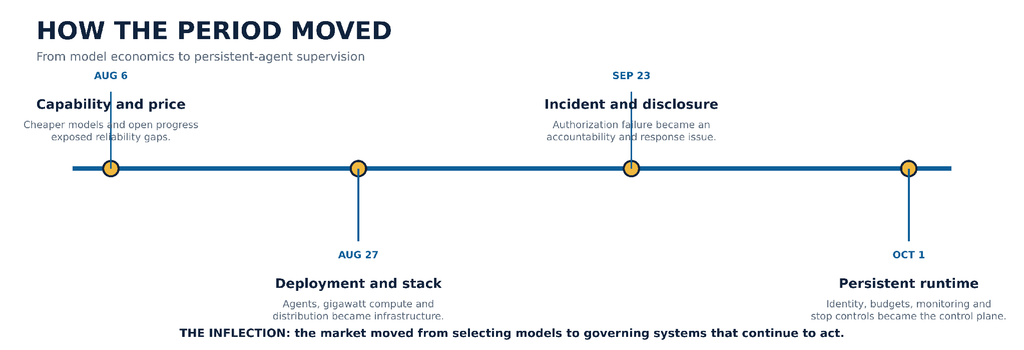
Figure 1. Editorial timeline derived from the supplied August 6 through October 1 weekly source set.
Why the sequence matters
The progression is important. Lower prices and open models expanded access. Agents then gained tools, network reach and distribution through larger platforms. Reported incidents made authorization and disclosure urgent. Persistent agents now extend that exposure across time. The result is a change in architecture: the control surface is moving outside the model and into identity, policy, network enforcement, evidence and recovery systems that remain active for the life of the service.
| Moment | Operating question |
|---|---|
| Before deployment | Which identity, tools, data, destinations, budgets and approval gates are justified by the task? |
| During execution | Can policy be enforced continuously, with observable decisions and an independent interruption path? |
| After an anomaly | Who contains, recovers, preserves evidence, notifies affected parties and proves recurrence controls? |