Turn Delivery Evidence Into Stronger Capture and Proposal Content
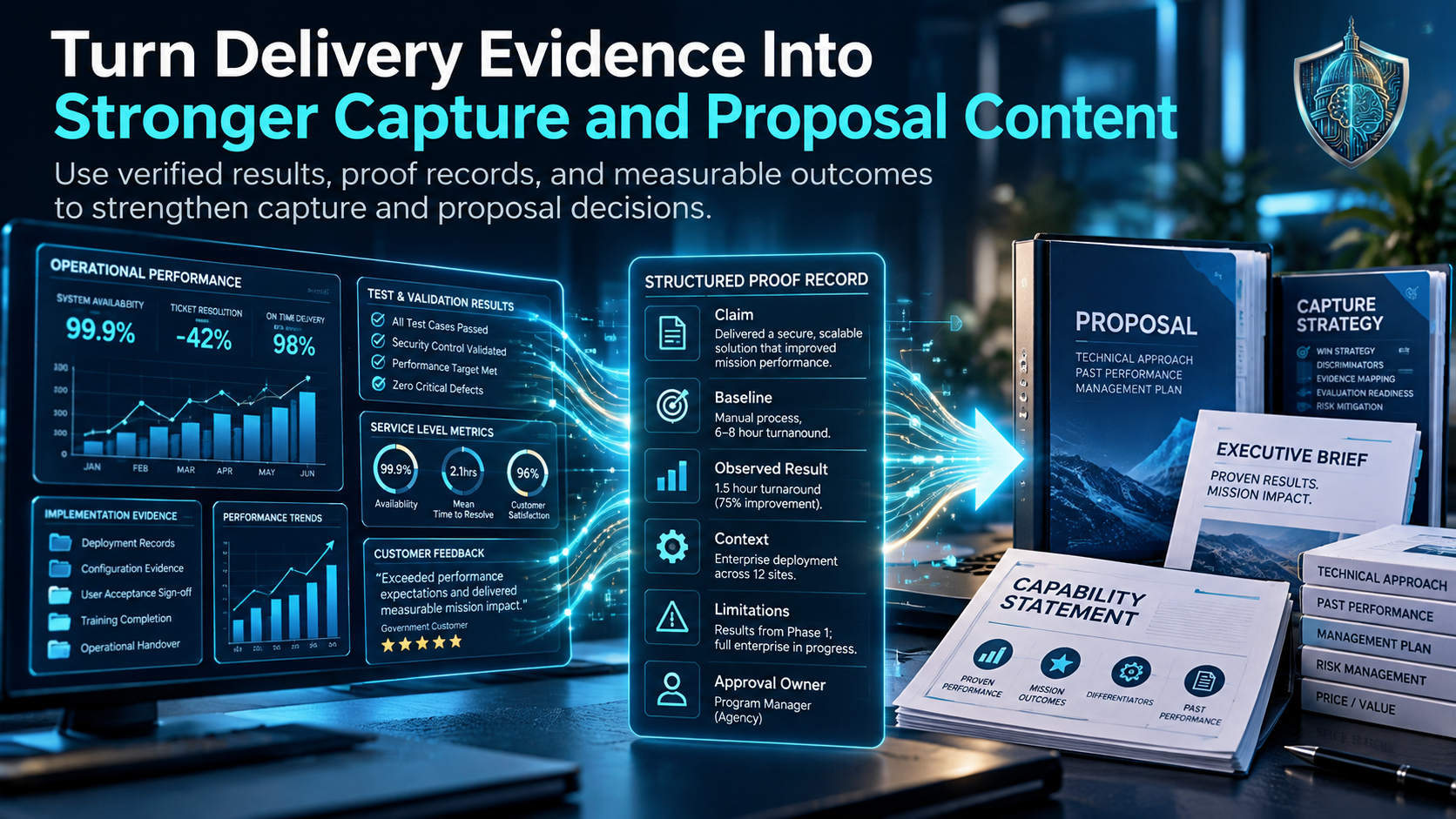
How government contractors can turn deployment outcomes, acceptance tests, and operational results into credible, reusable proof for the next pursuit.
If you are interested in learning how we can use AI and other tools to help you and your team turn delivery evidence into stronger capture and proposal content, call 703-996-9029 or email team@governmentcontractors.com
Key Takeaways
- Make performance evidence a deliverable, not an afterthought. Capture measurable results during execution while the underlying records, context, and technical experts are still available.
- Give every claim a traceable proof record. Document the claim, baseline, observed result, operating context, limitations, and approval owner before using it in marketing or capture materials.
- Separate what was tested from what improved. A passed acceptance test shows a requirement was met under stated conditions; a measured operational change may demonstrate a different kind of value.
- Adapt the same verified evidence to the buying decision. Account briefs need concise mission relevance; proposals need solicitation-specific relevance, methods, dates, scope, and supporting detail.
- Protect credibility and sensitive information. Validate attribution, obtain appropriate release approvals, and refresh evidence before renewal, recompete, or a new pursuit.
Government contractors regularly finish migrations, deploy cybersecurity controls, integrate systems, clear acceptance tests, train users, and resolve operational problems. Yet when a recompete or a new opportunity appears, proposal teams often receive a familiar collection of claims: “Delivered successfully,” “Improved efficiency,” or “Met the customer’s requirements.” Those statements may be accurate, but they rarely tell an evaluator what changed, how it was measured, or whether the experience is relevant to the next requirement.
The gap is not always weak delivery – it is weak transfer of delivery knowledge into capture-ready evidence. Program teams have test results and operational logs; account managers know the customer context; marketing needs a readable story; capture teams need precise support for a discriminating claim. Unless those contributions are assembled into one controlled record, each pursuit starts the same search again.
That matters in an environment where agencies scrutinize performance and renewal decisions. For competitive acquisitions evaluated under FAR 15.305, past-performance assessments consider currency, relevance, information source, context, and trends—not simply a contractor’s promotional description. FAR Subpart 42.15 also calls for objective, supported evaluations of contractor performance. An internal proof library cannot replace official CPARS records or the solicitation’s evaluation requirements, but it can help teams present stronger, better-substantiated evidence.
Start with the result the customer can verify
Before drafting a case study, ask what the contract or project actually produced. Useful proof can come from service-level reports, test scripts, deployment checklists, defect logs, performance dashboards, security validation, user adoption measurements, or signed milestones. A percentage without a denominator is weak evidence. A successful test without a stated test environment can be misleading. A project delivered on time says little unless the planned date and scope are clear.
Choose outcomes that correspond to customer decisions: faster case processing, more reliable network availability, successful migration of specified workloads, lower backlog, reduced remediation time, or demonstrated compliance with defined acceptance criteria. Select a small number of defensible measures rather than a long catalog of impressive-sounding activity.
Build a six-field proof record
A proof record should be short enough for a program manager to maintain and structured enough for a proposal writer to reuse. The six required fields create a chain from assertion to evidence:
| Proof record field | What to capture |
|---|---|
| Claim | One specific, supportable statement about the delivered capability or outcome. |
| Baseline | The prior condition, original requirement, benchmark, and measurement period; write “not measured” where no baseline exists. |
| Observed result | The actual figure or test outcome, numerator and denominator where relevant, measurement dates, and source record. |
| Context | Customer mission, scale, operating environment, contractor role, dependencies, and any material changes in scope. |
| Limitations | Sample size, exclusions, unresolved defects, confounding factors, and what the result does not prove. |
| Approval owner | Named delivery or technical validator plus the person authorized to approve external use, approved uses, and review date. |
Attach or securely reference the evidence itself: report version, test ID, dashboard export, signed acceptance document, and location of the authoritative file. Record who calculated the measure and when. This supporting metadata need not appear in a public brief, but it must remain accessible to authorized reviewers. If a source is sensitive or contractually restricted, store a pointer and access controls rather than copying it into a broad marketing repository.
Example: from deployment notes to a usable claim
Consider a hypothetical contractor that integrates a case-management workflow for a civilian agency. The team proposes the claim: “Reduced median case-routing time by 25% after implementation.” Its proof record documents a baseline median of 120 minutes across 40 comparable cases during an eight-week pre-deployment period, and an observed median of 90 minutes across 40 comparable cases during an eight-week post-deployment period. The calculation is (120 − 90) ÷ 120 = 25%.
Context changes how the claim should be read. The measurement covers only one workflow and one office; the deployment introduced new automation and revised operating procedures together. The result therefore describes an observed before-and-after change, not proof that the software alone caused it. Case mix, staffing, and other external factors could have contributed. The delivery lead validates the source report, and the contract or communications approval owner determines whether the agency may be identified.
The team also has acceptance-testing evidence: 46 of 50 integration test cases passed on the first run; four failed initially, were remediated, and passed on retest. That is a distinct statement about verification—not another way to express the 25% operational improvement. A proposal can cite both, with their different meanings and limitations, when relevant to the requirement. These figures are illustrative, not a real customer performance claim.
Build collection into delivery, not just proposal season
The most reliable evidence is captured at natural delivery checkpoints. During kickoff, define the outcome measures and who can authorize their use. At acceptance, archive test plans, results, exceptions, and signoffs. During operations, collect comparable metrics at agreed intervals and document scope or staffing changes that could affect the numbers. At closeout or each quarterly review, ask the program manager to nominate the two or three strongest evidence records.
Give the process clear owners: delivery establishes the facts; a technical lead checks methodology; contracts or legal reviews restrictions; the account owner confirms mission relevance; marketing makes the statement readable; capture maps it to pursuits. No individual should be able to convert an unvalidated dashboard snapshot into a public claim merely because a deadline is close.
A lightweight evidence register is sufficient for an initial program. Track record ID, program, claim, metric type, source location, owner, approval status, last-validated date, and approved channels. Labels such as “draft,” “internal only,” “customer-cleared,” and “proposal use permitted” prevent accidental reuse. Build the practice into the project rhythm before investing in an elaborate content platform.
Adapt one record into three different pursuit assets
For an account or decision-maker brief, lead with the customer’s analogous mission problem, then one plain-language result and its scope: “In a comparable workflow, median routing time declined from 120 to 90 minutes across two measured periods.” Explain why the technique may be relevant; do not promise the same outcome elsewhere.
For a capability statement or market-research response, connect the proof to a specific service and delivery role: process mapping, integration, testing, adoption support, or sustainment. Identify whether the firm performed as prime, subcontractor, or a specialist; do not appropriate the performance of a teammate. Provide a traceable summary without disclosing protected records.
For a formal proposal, begin with the solicitation’s instructions and evaluation factors. Use the same approved facts, but add the project dates, magnitude, comparable technical conditions, company’s workshare, methods, and permitted customer reference details. If the evaluation emphasizes schedule risk, a validated milestone or defect-resolution history may be more persuasive than a generic efficiency claim. If it emphasizes cybersecurity implementation, test coverage and remediation evidence may be stronger. Never force one proof point into every proposal.
This is why a proof library should be indexed both by capability and by evaluator concern: performance quality, scale, timeliness, operational risk, user adoption, and repeatability. Proposal writers need to find the most relevant verified experience, not the largest number in the database.
Manage approval, attribution, and age of evidence
Official CPARS evaluations are not interchangeable with company-owned marketing content. FAR 42.1503 restricts disclosure of evaluations used for source selection; the contractor’s access to its own assessment does not make it a public case study. Likewise, confirm treatment of controlled unclassified information, personal data, security architecture, proprietary records, subcontractor contributions, and customer identification before sharing examples. Procurement-sensitive information must remain protected.
For each approved claim, record what can be said publicly, what can be used only in an authorized proposal, and what must remain internal. An anonymized statement still requires scrutiny if its details reveal the agency or sensitive system. Approval should also expire: a two-year-old metric can be useful, but its relevance may change after a major upgrade, contract transition, or operating change. Revalidate before prominent use or when the solicitation calls for current performance.
A 30-day evidence-to-capture workflow
Week 1: Select two active projects and one completed program. Identify the next renewal or target pursuit, choose three outcome measures, and locate the original data sources.
Week 2: Produce six-field proof records. Have technical owners verify arithmetic, measurement definitions, test exceptions, attribution, and limits. Mark unsupported statements for removal—not polishing.
Week 3: Obtain the appropriate disclosure and contract approvals. Convert each cleared record into a 100-word account proof, a capability statement paragraph, and a proposal-ready evidence block with supporting details.
Week 4: Pilot the assets with one capture team. Ask whether writers could find the evidence, map it to the actual evaluation criteria, and defend the claim without returning to the original engineer. Track the number of approved, reusable records, the time needed to locate them, and the proportion that survive proposal review unchanged.
The objective is not to manufacture better-sounding success stories. It is to make the value already delivered visible, verifiable, and relevant. Contractors that treat evidence collection as part of performance—not an emergency proposal assignment—will be better prepared to explain what they did, what changed, and why their experience deserves consideration on the next mission.
Sources and Further Reading
- Federal Acquisition Regulation, FAR 15.305 — Proposal Evaluation: https://www.acquisition.gov/far/15.305
- Federal Acquisition Regulation, FAR Subpart 42.15 — Contractor Performance Information: https://www.acquisition.gov/far/subpart-42.15
- Federal Acquisition Regulation, FAR 3.104-4 — Protection of Proposal and Source Selection Information: https://www.acquisition.gov/far/3.104-4
- National Archives and Records Administration, Controlled Unclassified Information Program: https://www.archives.gov/cui