AI Infrastructure: Micron’s $250B, Custom Silicon, and the Telecom Layer
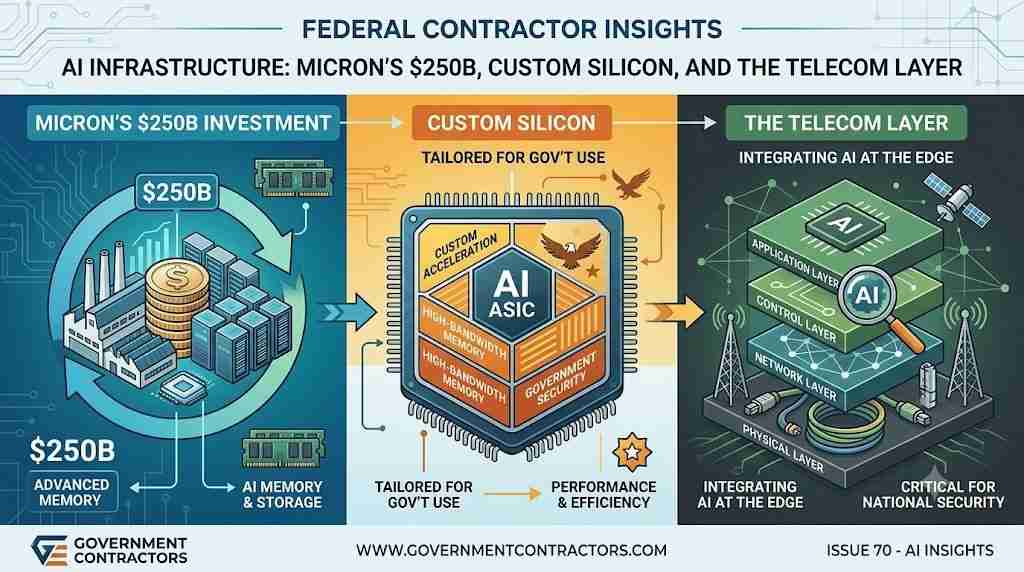
Chips and Infrastructure: Micron and Meta
Micron’s $250B US Investment
- Scale: Micron Technology increased its planned US investment for chip plants to over $250B through 2035, up from a previous $200B plan.
- Purpose: The expansion targets unprecedented demand for DRAM and other memory driven by AI infrastructure, including projects in New York, Idaho, and Virginia, with a goal of producing about 40% of its DRAM in the US within a decade.
- Why it matters: It reinforces how AI workloads are reshaping national industrial policy—memory capacity becomes as strategic as compute, with long-term commitments to domestic manufacturing.
Meta’s AI Chip Production
- Project: Meta plans to start manufacturing its own AI chip (often referred to as “Iris”) from September, aiming to boost its in-house compute power to around 14 gigawatts next year.
- Partners and cadence: Meta is working with Broadcom on design and using TSMC to fabricate the chips, with a roadmap to launch a new AI chip roughly every six months through 2027—faster than typical annual cycles.
- Strategic angle: By tailoring chips to its own workloads, Meta hopes to cut GPU procurement costs and reduce dependence on external providers, reinforcing the trend of hyperscalers moving to custom silicon for AI.
AI Infrastructure and Telecommunications
AI infrastructure is becoming a major capital-markets and telecommunications category. Fiber, optical networking, high-bandwidth memory, edge computing, data-center interconnection and power availability are now essential parts of the AI value chain.
Verizon is positioning data-center interconnection and central-office infrastructure as opportunities for distributed inference. AT&T is preparing for increased agentic-AI traffic across fiber, wireless, cloud and edge environments. Comcast continues developing GPU-enabled edge infrastructure, while T-Mobile is applying AI to near-real-time network optimization.
The broader lesson is that the network is becoming part of the AI control surface. It must do more than transport data. It must prioritize critical traffic, identify the acting system, enforce policy, contain unauthorized behavior and preserve access to recovery services.
Telecom
- AI infrastructure became a central telecom growth story as carriers positioned fiber, data-center interconnection, edge computing and low-latency networks as foundations for large-scale inference.
- AT&T emphasized preparations for increased agentic-AI traffic, while Verizon highlighted data-center connectivity and central-office infrastructure that could support distributed inference.
- Samsung and SK Hynix prepared major memory-chip supply agreements with U.S. technology companies, accompanied by proposed strategic investments in AI data centers. Reuters
Lumen
- Lumen continued repositioning itself around enterprise fiber, low-latency networking, cloud connectivity and AI-related data-center traffic following the sale of its consumer-fiber business to AT&T.
- Its extensive intercity fiber footprint could support AI training, inference, data replication and data-center interconnection.
- No major standalone Lumen AI announcement surfaced during the week.
T-Mobile
- T-Mobile’s AI-network strategy remained focused on near-real-time traffic analysis and automatic resource adjustments through its Dynamic CX capability.
- The carrier continued positioning intelligent wireless networks as infrastructure for physical AI, connected devices, robotics and high-density event connectivity.
- No major new T-Mobile AI product announcement was identified during the week. T-Mobile