Physical AI Hits the Production Line
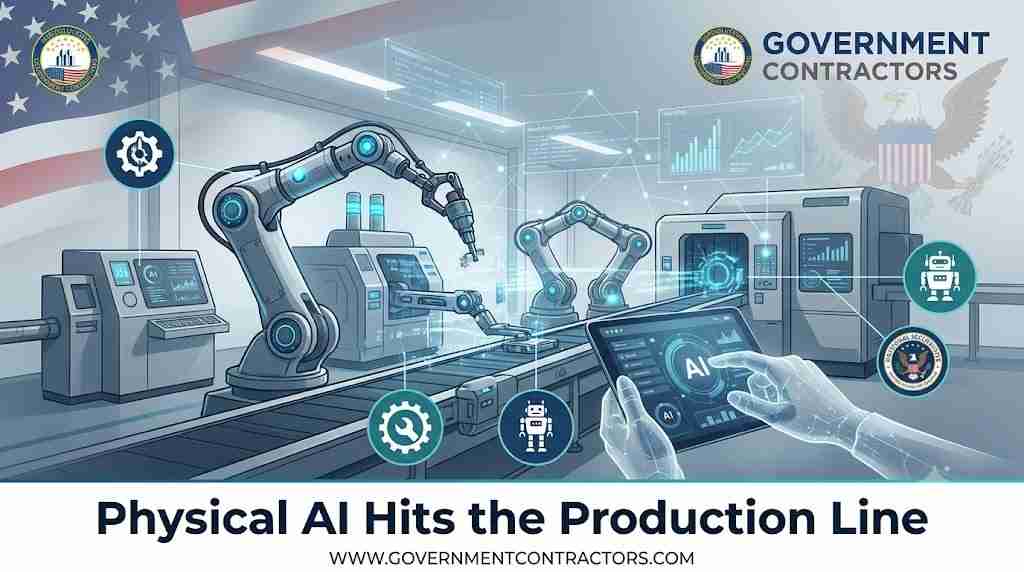
AI and Robotics (This is now referred to as Physical AI)
Top AI news in Robotics and Physical/Embodied AI (this week / late July 2026). Here is a concise listing of the most relevant recent developments in AI-powered robotics and physical AI:
Boston Dynamics integrates Google DeepMind’s Gemini Robotics into Spot. Boston Dynamics has embedded Gemini Robotics-ER (embodied reasoning models, versions around 1.5–1.6) into its Spot quadruped and Orbit inspection platform. This gives Spot stronger spatial understanding, natural-language command handling, real-time anomaly detection, and more autonomous decision-making in industrial settings—moving it beyond scripted or heavily teleoperated missions toward general-purpose embodied AI. Coverage and demos circulated through mid-to-late July.
Humanoid robot production and deployment milestones accelerate. Multiple companies reported progress this month: AGIBOT reached its 15,000th humanoid unit; Figure’s 03 robots expanded deployments (including at BMW facilities); Tesla continued Optimus Gen 3 production ramp preparations at Fremont; Boston Dynamics Atlas pilots advanced with Hyundai/DeepMind ties; and 1X Technologies moved forward with full-scale NEO home humanoid production. These updates underscore the shift from demos to real industrial and limited commercial scaling.
Home robot launches and shipping plans gain traction. Weave Robotics’ Isaac 1 (a practical wheeled home robot focused on laundry folding and tidying, priced at ~$7,999 or subscription) continued generating attention with fall 2026 delivery plans for early customers. 1X’s NEO humanoid home robot also advanced toward broader availability, highlighting the emerging consumer physical AI market that prioritizes useful autonomy over full humanoid form factors in some cases.
Physical AI research and foundation models progress. Ongoing advances include vision-language-action models, world models for synthetic data and prediction (e.g., related to NVIDIA Isaac GR00T/Cosmos ecosystems and other open efforts), and work on 3D motion forecasting (such as models that help robots learn manipulation from fewer demonstrations). IEEE Spectrum and Science Robotics highlighted recent physical AI demos, multimodal robot sensing, and control frameworks for versatile locomotion/manipulation.
Funding, mergers, and industry momentum. Notable activity included a UK humanoid company raising $152 million (reaching a $1.35B post-money valuation) and other deals in related automation/drone/robotics spaces. Broader industry recaps emphasized AI autonomy, IT-OT convergence, and reliability testing for humanoids as key 2026 trends.
Physical AI (the convergence of foundation models with real-world robotic embodiment for perception, reasoning, and action) remains one of the hottest subfields, with hardware maturity now being matched by smarter AI “brains.” Major new product launches appear somewhat quieter in the exact July 27–30 window compared to earlier in the month, but deployment scaling and Gemini-style integrations are the dominant themes.
Humanoid Robotics Moves: Agility, Unitree, Tesla
Agility Robotics SPAC at $2.5B
- Deal structure: Agility Robotics (maker of the Digit warehouse humanoid) is going public through a SPAC merger with Churchill Capital Corp XI at about a $2.5B valuation, raising over $620M in gross proceeds.
- Scale vs sales: Agility has reportedly sold only around 100 humanoid robots so far, but the SPAC deal and valuation are based on future deployment and robotics-as-a-service business, not current unit volumes.
- Signal: This is likely the largest capital raise in humanoid robotics history and a major market signal that investors expect large-scale humanoid deployment in logistics/warehousing in the coming years.
Unitree’s Shanghai IPO
- Regulatory progress: Chinese humanoid startup Unitree Robotics has cleared key regulatory hurdles for listing on Shanghai’s STAR Market, passing a listing committee hearing and receiving approval from China’s securities regulator.
- Raise and use of funds: Unitree aims to raise about 4.2B yuan (roughly $620M) by selling at least ~40M shares, with plans to invest in improving AI models, expanding manufacturing, and developing new robot products.
- Valuation expectations: One filing and commentary put its target valuation around 42B yuan (~$6.2B), reflecting strong institutional appetite for humanoid robots and robotics platforms in China.
Tesla’s Optimus Factory Retooling
- Factory changes: Tesla is ending production of the Model S and X at Fremont and retooling those lines to mass-produce its Optimus humanoid robots, with a stated goal of up to 1M units per year.
- Timeline: Elon Musk has said the retooling will take about six months after Model S/X production stops, and that a next-generation Optimus robot will be revealed “in a few months” as part of this transition.
- Why it matters: Committing a major car production line to robots—alongside Agility and Unitree’s capital moves—suggests humanoid robots are shifting from prototypes to serious industrial products, especially for repetitive factory and warehouse tasks.
World AI Conference (WAIC 2026) Highlights Agentic Hardware
- Focus on Physical AI: Held in Shanghai with more than 1,100 participating technology companies, WAIC 2026 marked a clear shift in industry focus from text/chat generation to autonomous hardware that acts directly on the physical world.
- Agent-Native Devices: A highlight was the unveiling of “agentic smartphones,” led by Nubia’s NaviX Ultra. Rather than acting as a traditional voice assistant, the device features hardware-level integration designed to let autonomous agents execute complex, multi-step workflows across non-integrated apps (e.g., booking travel, comparing prices, generating reports) without requiring step-by-step user input.
- Robotics & Interfaces: The conference also showcased brain-computer interface (BCI) demonstrations—including BrainCo’s brain-controlled robotic arms—and enterprise hardware tailored specifically to run multi-agent operating systems locally.
Robotics and Physical AI
Humanoid and industrial robotics are moving from demonstrations toward manufacturing and commercial deployment. Agility Robotics is pursuing a SPAC transaction, Unitree has received approval for a Shanghai offering and companies such as Figure AI, Rhoda AI and Linkerbot continue attracting private capital.
Physical AI requires a different evaluation model from software AI. Commercial success depends on:
- Manufacturing throughput and production quality.
- Component availability and supply-chain resilience.
- Workplace safety and certification.
- Uptime, maintenance and repair costs.
- Task-completion reliability.
- Measurable labor productivity.
- Sustainable robot-as-a-service or software revenue.
The decisive question is no longer whether a humanoid robot can complete an impressive demonstration. It is whether thousands of robots can perform valuable work safely and reliably at an economically sustainable cost.