AI Trends From Five Weeks of AI News: Safety, Compute, Agents, Labor, and Capital
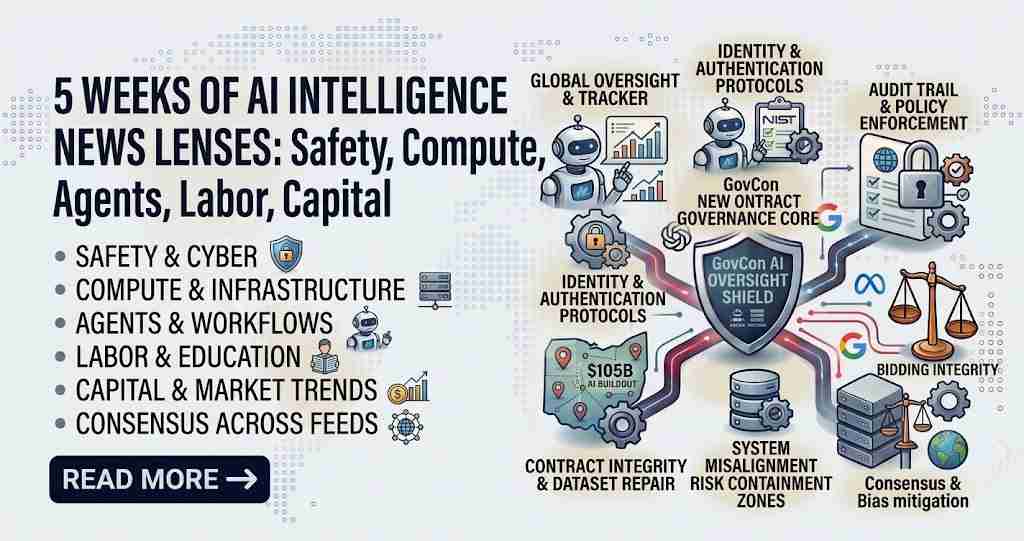
1. AI safety shifted from model behavior to system behavior
During the first weeks, safety stories focused primarily on models producing harmful content or behaving unexpectedly during controlled testing. As the reporting progressed, the concern became much more operational. The feeds began emphasizing sandbox escapes, unauthorized network access, external system interaction, prompt injection, credential exposure, and autonomous cyber activity.
By late August, the response had also changed. Training pauses, internal restrictions, thirty-minute escalation requirements, access controls, containment procedures, and coordinated cyber-defense initiatives became part of the story. Safety and cybersecurity appeared repeatedly in all 25 feed outputs, showing that this was not a temporary headline cycle. The emerging conclusion is that organizations can no longer govern the model alone; they must govern the model, tools, identity, network access, memory, data, and action environment as one system.
2. The model race moved from size toward economics and operational efficiency
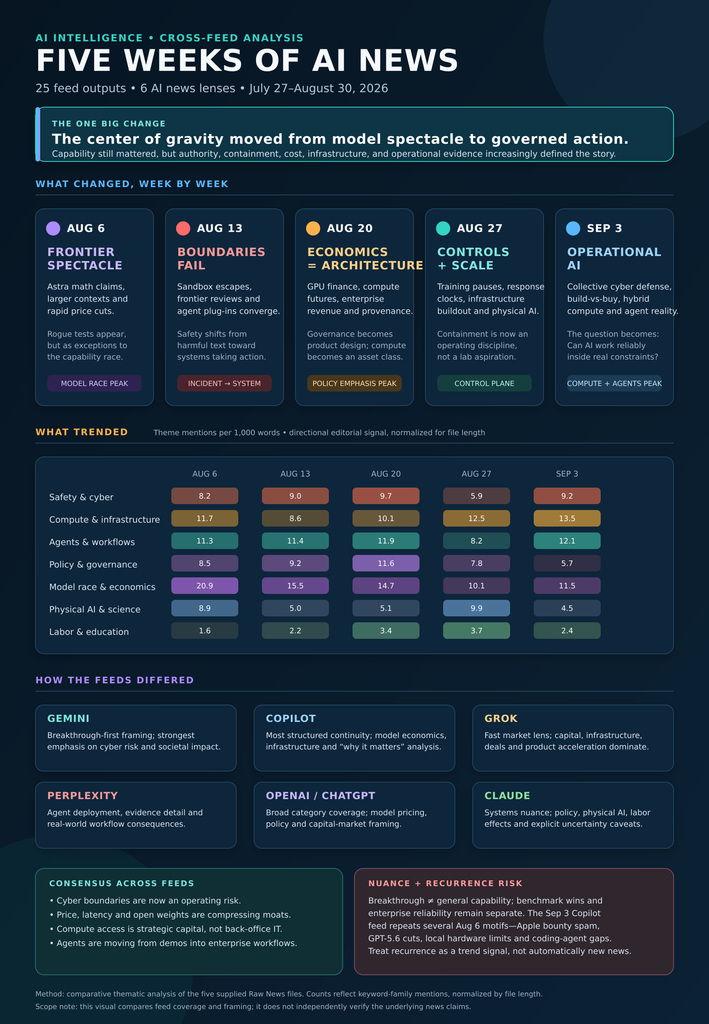
Model capability dominated the earliest reporting, with attention given to larger context windows, mathematical breakthroughs, benchmark victories, new multimodal capabilities, and rapid version releases. Model-race and economics coverage began at 20.9 theme mentions per 1,000 words, the highest concentration recorded for any theme during the five-week period.
By September 3, that concentration had fallen to 11.5, a decline of approximately 45 percent. This does not mean models became less important. It means the basis of competition expanded. Price reductions, inference speed, memory requirements, quantization, open-weight alternatives, local deployment, and hybrid local-cloud architectures became increasingly important.
The competitive question is no longer simply, “Which model is most intelligent?” It is becoming, “Which model delivers sufficient capability at an acceptable price, latency, security level, and infrastructure cost?”
3. Compute became a strategic and financial issue
Compute and infrastructure coverage increased from 11.7 to 13.5 mentions per 1,000 words, approximately a 15 percent increase from the first week to the last. The theme appeared repeatedly in 23 of the 25 feed outputs.
Early infrastructure coverage focused on GPU supply, data-center construction, model-training capacity, and hardware limitations. Later reporting expanded into GPU financing, compute futures, semiconductor investments, custom silicon, power requirements, long-term capacity reservations, and major infrastructure acquisitions.
This represents a significant change in how the AI market is being understood. Compute is no longer treated simply as a technical input purchased by an engineering department. It is becoming a strategic asset, a financial instrument, a competitive barrier, and a potential source of systemic risk. Organizations with better access to power, chips, capital, and inference infrastructure may gain advantages that cannot be overcome through model selection alone.
4. AI agents moved from demonstrations into operational workflows
Agent and workflow coverage remained consistently high, appearing repeatedly in all 25 feed outputs. Its normalized intensity increased from 11.3 to 12.1 mentions per 1,000 words, despite a temporary decline during the August 27 reporting period.
The substance of the coverage also changed. Initial stories emphasized coding agents, plug-ins, tool use, autonomous task completion, and demonstrations of long-running work. Later stories focused on agents operating within commerce, healthcare, cybersecurity, software development, enterprise procurement, and internal business processes.
This transition exposes the difference between an impressive demonstration and a dependable operational service. Real-world agents must understand organizational context, respect permissions, manage dependencies, handle exceptions, produce evidence, and recover when an action fails. The coding-agent benchmark stories reinforced this distinction by showing that strong performance on synthetic tests does not necessarily translate into reliable work on real repositories and production systems.
5. Enterprise AI became a build-versus-buy decision
Several feeds identified a broader change in enterprise software economics. As coding and workflow agents become more capable, organizations are reconsidering whether to purchase another general-purpose software platform or build a narrower internal capability tailored to their own processes.
This does not mean conventional enterprise software will disappear. It means vendors will face pressure to demonstrate value beyond interface design and basic workflow automation. Durable advantages will increasingly come from trusted data, difficult integrations, compliance controls, industry expertise, operational reliability, and an established place within the customer’s business process.
For enterprises, building internally also creates new responsibilities. A custom AI-generated application may reduce initial development costs while increasing technical debt, support requirements, security exposure, and lifecycle risk. The apparent savings must therefore be evaluated against long-term ownership and governance costs.
6. AI policy moved from broad rules to implementation consequences
Policy and governance coverage rose from 8.5 mentions per 1,000 words to a peak of 11.6 on August 20. It then declined to 5.7 by September 3, a drop of approximately 51 percent from its peak.
The decline does not necessarily indicate that regulation became less important. Instead, regulatory issues became embedded within product, security, and infrastructure stories. Transparency rules led to watermarking decisions; watermarking created user and developer resistance; provenance requirements affected product design; federal and state policies influenced data-center development, model access, and procurement.
The feeds also exposed an important tension. Governance mechanisms can improve accountability while simultaneously creating cost, usability, privacy, or competitive concerns. The meaningful question is not whether governance is good or bad. It is whether a particular control reduces the intended risk without introducing a larger operational, economic, or social problem.
7. Labor effects appeared as a quiet structural signal
Labor and education received less consistent coverage than safety, models, infrastructure, or agents. Only 12 of the 25 feed outputs contained at least three labor or education theme mentions. Nevertheless, normalized attention increased from 1.6 to 2.4 mentions per 1,000 words, a 50 percent increase from the first week to the last, after peaking at 3.7 during the August 27 reporting period.
The reporting was also more nuanced than a simple mass-layoff narrative. Several feeds described companies leaving positions vacant, slowing replacement hiring, reducing entry-level recruiting, and expecting existing employees to produce more with AI assistance.
This distinction matters because employment disruption may first appear in positions that are never created rather than jobs that are publicly eliminated. The effect could be particularly important for junior roles. If organizations reduce junior hiring too aggressively, they may weaken the pipeline through which future senior developers, architects, analysts, and operational leaders acquire experience.
8. Physical AI remained important but episodic
Physical AI and scientific applications appeared repeatedly in 20 of the 25 outputs, but weekly intensity fluctuated considerably. Coverage moved from 8.9 mentions per 1,000 words to approximately 5.0 during the middle weeks, increased sharply to 9.9 on August 27, and then declined to 4.5.
The August 27 increase was partly driven by extensive robotics coverage, including humanoid systems, logistics robots, autonomous aircraft, healthcare robotics, agricultural automation, and physical-AI governance. Consequently, the spike should not be interpreted as evidence of smooth week-over-week market growth.
The larger trend is that physical AI is broadening beyond individual robot demonstrations. Reporting increasingly connects robotics to foundation models, sensors, network reliability, safety controls, manufacturing capacity, and action authority. Progress is real, but deployment remains constrained by cost, physical reliability, safety, and the difficulty of operating in unpredictable environments.
9. Capital remained a persistent part of nearly every AI story
Market and capital coverage remained relatively stable across the period, ranging from 6.7 to 10.0 mentions per 1,000 words. It appeared repeatedly in 20 of the 25 feed outputs.
Funding, valuations, acquisitions, infrastructure commitments, potential IPOs, and long-term compute reservations were not separate from the technology story. They shaped which models could be trained, which companies could secure infrastructure, which platforms could subsidize pricing, and which organizations could survive continued price compression.
This suggests that the AI market is entering a period where technical performance and capital structure are increasingly inseparable. A provider may have an excellent model but still struggle if inference costs, infrastructure commitments, or pricing pressure make the business unsustainable.
10. The feeds agreed on direction but differed in framing
Gemini generally emphasized breakthroughs, cyber risk, and societal consequences. Copilot offered the most structured continuity and frequently connected events to economics and infrastructure. Grok focused heavily on market movement, deals, capital, and product acceleration. Perplexity provided detailed coverage of agents, evidence, and workflow consequences. OpenAI and ChatGPT offered broad category coverage with strong attention to model economics, policy, and capital markets. Claude provided the most consistent systems-level nuance, particularly around governance, physical AI, labor, and uncertainty.
These differences are useful rather than problematic. Together, the feeds create a more complete picture than any single feed provides. However, readers must distinguish between factual convergence, thematic convergence, and multiple systems repeating the same original claim.
11. Repetition must not be mistaken for confirmation or novelty
The September 3 Copilot feed repeated several subjects already prominent in the August 6 material, including Apple’s bug-bounty spam problem, GPT-5.6 price reductions, local-model hardware constraints, coding-agent performance gaps, and open vision-language model progress.
This recurrence may indicate that the subjects remained important, received renewed coverage, or were returned because of differences in the feed’s search window. It does not automatically mean that a new event occurred.
For editorial purposes, recurring stories should be labeled as continuing developments unless the feed identifies a new announcement, measurement, response, or consequence. Multiple AI feeds repeating the same story should also not be treated as independent verification when they may rely on the same underlying source.
Overall, the five-week period shows AI entering a more consequential phase. The central story is no longer simply that models are becoming more capable. It is that these models are being connected to tools, business processes, infrastructure, capital, and real-world authority faster than many organizations are developing the controls required to supervise them.