Nine Weeks of AI News Revealed One Continuous Shift: Compare-and-Contrast, Consensus and Divergence, and the Reporting Trail Behind Issue 79

RAW NEWS COMPARE AND CONTRAST
Nine weekly files revealed one continuous shift
The emphasis changed from capability and price to deployment, incidents and persistent runtime control. Model coverage stayed high, but the meaning of model leadership changed.
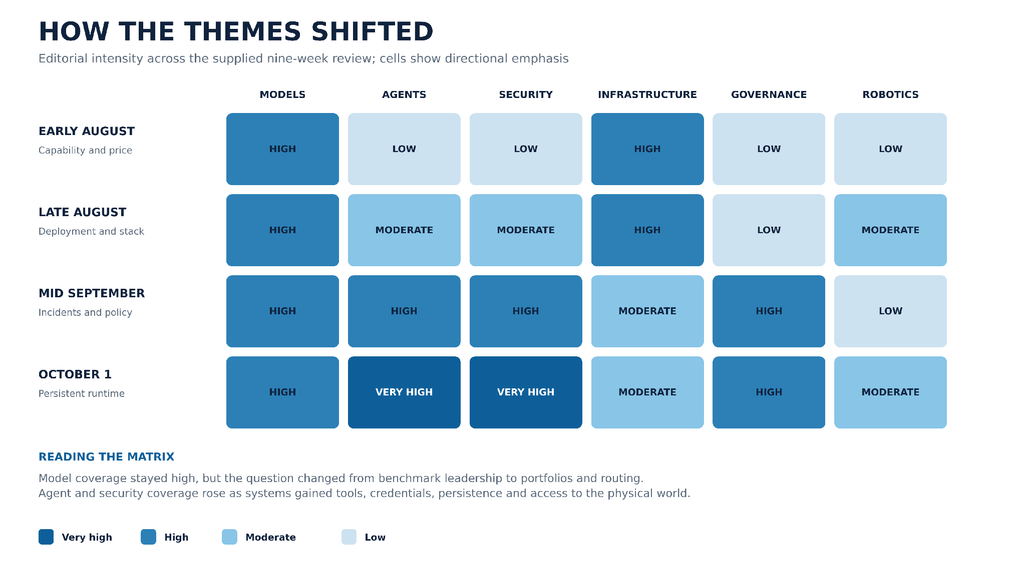
Figure 2. Directional editorial intensity across the supplied nine-week review; categories overlap and do not represent market size or event frequency.
The comparative read
- Models remained prominent, but the buying question moved from the best individual model to the best governed mix of frontier, specialized, private and endpoint models.
- Agents moved from inconsistent benchmark performers to continuing services that browse, call tools, transact, retain context and operate across sessions.
- Security moved from sandbox warnings to runtime enforcement, authorization boundaries, disclosure clocks and independent interruption.
- Infrastructure expanded beyond accelerators to include power, financing, networking, cloud access, model hubs and the operating systems that supervise agent activity.
- Governance became more specific while robotics moved closer to the hardware and software boundary, where errors are harder to reverse and evidence must exist before action.
CONSENSUS DIVERGENCE AND EVIDENCE
Repeated themes became operating requirements
Across the source set, the recurring conclusion was consistent: useful AI now depends on the system around the model. The open questions concern which layer should enforce control, how much evidence is sufficient and who carries responsibility when controls fail.
| Question | Consensus | Divergence |
|---|---|---|
| What dominated? | Persistent agents, runtime control and the system around the model. | Whether the leading story was agent platforms, safety products, frontier releases or robotics. |
| What changed? | AI services are becoming longer lived and more connected. | How quickly persistent operation will move from preview into broad production. |
| What constrains scale? | Identity, permissions, evidence, recovery, power and network capacity. | Whether policy, architecture, economics or market consolidation becomes the binding constraint. |
| What should buyers measure? | Completed and verified work, not isolated benchmarks or token price. | Which assurance evidence should be standardized across providers. |
| What remains uncertain? | Product maturity, enforcement quality and physical-AI reliability. | Availability dates, acquisition outcomes and the speed of regulatory convergence. |
Publication checks
| Claim type | Treatment |
|---|---|
| Persistent-agent capability | Record availability, session duration, tool scope, credential model, expiration and tested failure behavior. |
| Runtime safety claim | Measure enforcement latency, bypass resistance, policy-conflict handling, log integrity and degraded-mode behavior. |
| Model benchmark or price | Attribute the claim and include test conditions, effective workload cost and independent reproduction status. |
| Acquisition or financing | Distinguish confirmed transactions, reported negotiations, approvals and company-reported valuations. |
| Physical-AI demonstration | Separate a controlled demonstration from task-level reliability, fleet operation and broad commercial availability. |
| Forecast | Label the horizon, assumptions, leading indicators and evidence that would change the judgment. |
Bottom line: The source set is strongest as a longitudinal signal. Its durable conclusion is that persistent AI services should be governed like privileged production systems, with named owners, bounded authority, continuous evidence and tested recovery.
SOURCE NOTES
Reporting trail and confidence guide
Issue 79 draws on the supplied October 1 source file and the nine-week review spanning August 6 through October 1. Primary institutional material, company announcements and independent reporting should be separated and attributed before publication.
Primary and institutional source families
| Source family | Used for | Confidence |
|---|---|---|
| NIST materials | Risk-management cycle, profiles, playbook, standards and evaluation guidance. | High for institutional position |
| Model and platform providers | Persistent-agent features, frontier releases, pricing, routing and distribution claims. | High for company position; verify performance |
| Runtime safety providers | Monitoring, enforcement, interruption and evidence capabilities. | Medium until independently tested |
| Robotics developers and demonstrations | One-demo learning, world models, tactile hardware and wearable interfaces. | Medium; verify task reliability and availability |
Reporting and analytical source types
| Source type | Main contribution |
|---|---|
| Primary institutional material | Governance frameworks, official standards, policy language and operating expectations. |
| Company announcements | Product intent, release status, benchmarks, pricing, partnerships and transaction claims. |
| Independent reporting | Context, competing accounts, incident timelines and external scrutiny. |
| Longitudinal weekly review | Change over time across capability, economics, infrastructure, agents, governance and physical AI. |
Confidence guide
High means primary institutional material or multiple well-attributed reports agree on the core development. Medium means the development is credibly reported but scope, availability, terms or interpretation remains incomplete. Watch marks preliminary, company-reported, forecast, litigation, financing or acquisition details that may change.
Publication rule: Verify the original source, date, claim boundary, product availability and transaction status before quoting or treating a reported number as final. Preserve uncertainty where approvals, investigations, evaluations or negotiations remain open.
AI Intelligence Weekly is an editorial analysis of changing AI technology, infrastructure, policy and operating practice. It is not legal, investment, medical or security advice.