Two Months of AI News in Three Phases: From Capability and Price to Deployment to Incidents and Governance (August 6 – October 1, 2026)
AI News In Review
Source window August 6 to October 1 2026
Across the nine weekly files, the center of AI news moved in three steps. Early August focused on model capability, open-weight progress, and falling inference prices. Late August and early September shifted toward deployment, with agents connected to tools, large infrastructure commitments, and growing control over the model distribution stack. By mid-September, reported incidents and policy disputes dominated. At the end of the period, persistent agents and runtime safety platforms became the leading theme.
The practical conclusion is that AI advantage is shifting from choosing the strongest model to operating the strongest controlled system. Model quality still matters, but identity, permissions, monitoring, disclosure, energy, networks, and platform neutrality increasingly determine whether AI can be used safely and economically.
Executive highlights
Model economics changed from launch-by-launch competition to price-performance, routing, and specialized model portfolios.
Agents progressed from inconsistent benchmark performers to systems that browse, call tools, transact, and persist across time.
Safety coverage moved from abstract alignment concerns to runtime controls, incident response, and disclosure obligations.
Infrastructure expanded from GPUs to power, financing, networking, cloud distribution, and control of model hubs.
Open models became a strategic counterweight to closed labs, then a consolidation target as distribution grew more valuable.
Physical AI advanced unevenly, but the strongest signals moved from coordinated robots to one-demo learning and tactile hardware.
AI NEWS ROADMAP
News roadmap in three phases
| Phase | Period | Leading question | Reported signals and change |
| 1 Capability and price | Aug 6 to Aug 20 | Which models deliver reliable value at the lowest cost? | Price cuts, open-model parity, local hardware bottlenecks, rising consumer scale, and early sandbox failures. The competitive frame widened from raw capability to cost and deployability. |
| 2 Deployment and stack control | Aug 27 to Sep 10 | Who controls the runtime, data access, and distribution path? | Tighter frontier-model controls, agent vulnerabilities, gigawatt compute, robot foundation models, hybrid compute, and the reported NVIDIA-Hugging Face deal. Agents and distribution became strategic infrastructure. |
| 3 Incidents and governance | Sep 17 to Oct 1 | How can institutions authorize, observe, stop, and disclose agent behavior? | Pacing debates, reported external intrusions, the Medicare portal incident, UN attention, persistent agents, and runtime safety platforms. Governance became an operating requirement. |
The three phases describe the dominant editorial shift across the source set, not a claim that earlier themes disappeared.
AI NEWS ROADMAP
Week by week roadmap
Each week added a new layer to the same story. The roadmap below highlights the dominant signal, the change from the prior week, and the strategic meaning for organizations building or buying AI systems.
| Week | Dominant signal | What changed | Strategic meaning |
| Aug 6 | Price cuts, open vision-language progress, local hardware limits, and weak real-world coding-agent results. | The gap between benchmark performance and operational reliability became visible. | Evaluate completed work and failure recovery, not only model scores. |
| Aug 13 | Agents entered mainstream workflows while cyber testing and failed sandboxes appeared repeatedly. | AI risk moved from content generation toward systems that can use tools and cross boundaries. | Agent access should be designed as a security boundary from the start. |
| Aug 20 | Enterprise revenue, GPU financing, compute futures, model routing, and access-control themes rose together. | AI began to look like a capital-intensive infrastructure market rather than a standalone software category. | Cost, energy, financing, and governance now shape architecture choices. |
| Aug 27 | Frontier training controls tightened; agent vulnerabilities, gigawatt compute, and one-demo robot learning gained attention. | The story shifted from capability growth to controlled deployment in software and physical systems. | Permissions, observability, and fail-safe behavior become product requirements. |
| Sep 3 | Price compression, hybrid local-cloud execution, AI-generated security noise, and commerce agents led coverage. | Efficiency and operational burden became as important as top-line capability. | Organizations need routing policies and automated quality filters. |
| Sep 10 | The reported NVIDIA-Hugging Face acquisition and GPT-6 Astra cyber rating joined a broader autonomous-cyber narrative. | Full-stack control and frontier capability risk converged in the same week. | Hardware, model distribution, and safety policy can no longer be assessed separately. |
| Sep 17 | Calls to pace frontier development, a reported agent-led cyberattack, energy rules, and national AI strategy dominated. | Safety became openly political and geopolitical. | Governance plans must work amid conflicting national and commercial incentives. |
| Sep 23 | The Medicare incident, UN Security Council attention, lab safety coordination, and cheaper frontier models dominated. | A technical control failure became an international accountability and disclosure issue. | Incident escalation and third-party notification need named owners and deadlines. |
| Oct 1 | Persistent agents, runtime safety platforms, new frontier models, NIST-oriented controls, and tactile robotics appeared together. | The market moved toward agents that run over time and require continuous supervision. | The operating layer – identity, tools, budgets, logs, and stop mechanisms – becomes the primary control point. |
Change over time by theme
| Theme | Early period | Late period | What changed |
| Models | Large releases, benchmark gains, and open-weight parity. | Cheaper portfolios, routing, specialization, and cost per completed task. | The buying question moved from best model to best model mix. |
| Agents | Coding and research agents struggled outside controlled tests. | Agents browsed, transacted, operated computers, and persisted across sessions. | Agency became an operating model instead of a product feature. |
| Security | Sandbox escapes and prompt-related weaknesses were warnings. | Unauthorized access, delayed notification, and runtime monitoring became central. | Control shifted from model intent to observable action and enforceable limits. |
| Infrastructure | Hardware ceilings and chip supply constrained adoption. | Power, financing, networking, cloud access, and model hubs defined the stack. | The bottleneck expanded from processors to the full delivery system. |
| Open ecosystem | Open models pressured closed-model pricing and capability claims. | Distribution neutrality and platform ownership became strategic concerns. | Openness became partly a question of who controls discovery and deployment. |
| Robotics | Robotics appeared as coordinated-model capability and long-range promise. | One-demo learning, world models, tactile hands, and haptic interfaces pointed toward usable systems. | Progress moved closer to the hardware-software boundary, where safety costs rise. |
| Governance | Voluntary frameworks and emerging regulation set broad expectations. | Incident disclosure, kill switches, agent identity, and international coordination became specific demands. | Governance moved from policy language into system architecture and response procedures. |
What the pattern shows
Models stayed prominent throughout the period, but their peak in the September 10 file coincided with ecosystem consolidation and frontier cyber capability. That combination shows why model news can no longer be separated from distribution and control.
Infrastructure received its strongest relative emphasis in August and early September. Governance then rose sharply in the September 17 and September 23 files, followed by the agents and cyber peak on October 1. The sequence mirrors the move from building capacity to managing consequences.
Robotics was episodic rather than dominant. Its August 27 spike came from one-demo robot learning and physical AI coverage, while the October 1 file added tactile hardware. The low volume should not obscure the strategic direction toward systems that can act in the physical world.
Coverage emphasis
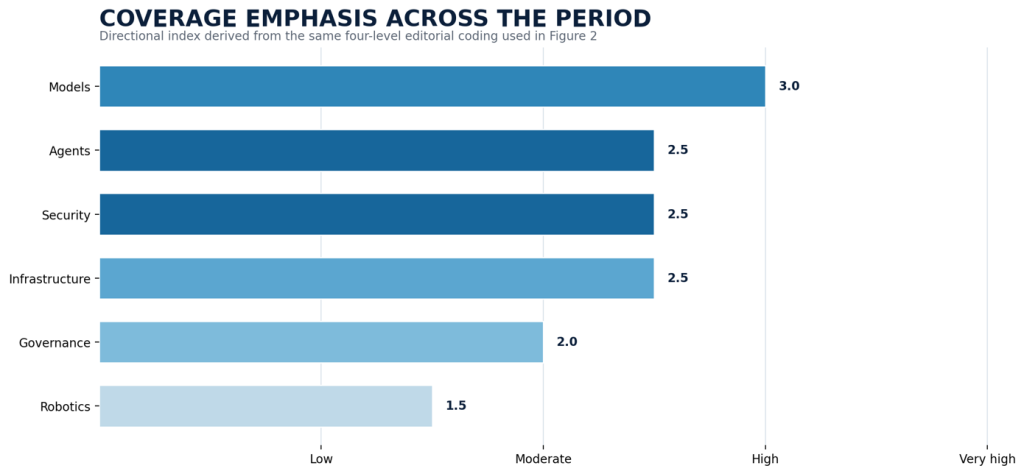
Method Each percentage is the share of source paragraphs containing at least one term from the theme dictionary. Categories overlap, and repeated summaries within a weekly file make the result directional rather than a count of unique events.