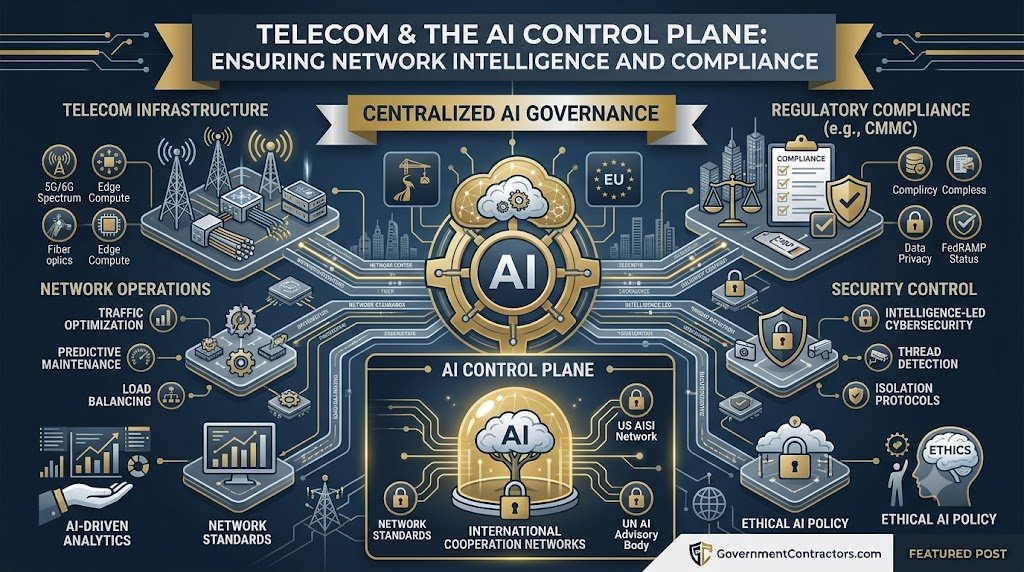
AI is intensifying demand for high-capacity, low-latency connectivity. Releases such as the 975-billion-parameter Inkling model and the 2.8-trillion-parameter Kimi K3 reinforce the need for scalable fiber, wavelength, edge, cloud-interconnect, and data-center networks. Reuters
Telecom providers are becoming part of the AI control plane. Operators have an opportunity to provide secure model access, workload-aware routing, edge inference, network telemetry, data-sovereignty controls, and managed AI connectivity—not merely bandwidth.
TSMC’s additional $100 billion Arizona investment strengthens the domestic AI infrastructure ecosystem. The expansion will increase demand for power, advanced networking, cloud connectivity, supply-chain integration, and semiconductor-facility communications. Reuters
Verizon
Verizon included AI business mentorship in its Small Business Super Pitch. Four finalists selected from more than 500 applicants received access to expertise on using AI in their businesses. Verizon
The program extends Verizon’s role beyond connectivity. It positions Verizon as an AI enablement partner for small businesses through training, coaching, funding opportunities, and digital-readiness resources.
No major Verizon network-AI product release was identified during the reporting week. The company’s broader AI activity continues to include AI-assisted customer experiences, network automation, digital twins, disaster response, and enterprise connectivity.
Comcast
No major Comcast-specific AI announcement was identified for July 13–19.
The most relevant developments concern AI-powered media discovery and advertising. Streaming providers are using AI for personalization, recommendations, advertising placement, audience intelligence, content operations, and customer support.
Comcast’s primary governance exposure includes customer data, children’s content, political advertising, recommendation transparency, synthetic media, and copyright.
AT&T
No major new AT&T AI product announcement was identified during the reporting week.
AT&T continues positioning connectivity as the foundation for distributed AI. Its expanded 400G wavelength strategy is designed to connect branch, campus, edge, cloud, and data-center environments supporting AI workloads. AT&T
AT&T’s network-security strategy includes AI-assisted threat detection. Dynamic Defense incorporates AI capabilities intended to improve network-level visibility, threat interpretation, and response. AT&T
The company’s public-safety work highlights AI-enabled transcription for next-generation 911. The technology can help call takers review conversations and locate important details, but it requires accuracy testing and human confirmation. AT&T
Lumen
No major Lumen-specific AI announcement was identified during the reporting week.
Lumen remains positioned around the network requirements created by AI data centers and cloud services. Its strategic opportunity involves high-capacity fiber, data-center interconnection, wavelength services, network-as-a-service, and secure multi-cloud connectivity.
The broader market is validating demand for AI network infrastructure. TSMC’s expansion and increasingly large open-weight models suggest continued growth in distributed data movement and inference traffic.
Tmobile
No major T-Mobile-specific AI announcement was identified during the reporting week.
T-Mobile’s strategic AI opportunity remains tied to its 5G footprint. Potential applications include edge inference, customer-service automation, network optimization, device intelligence, enterprise private networks, and physical-AI connectivity.
The EU order requiring Android to support competing AI assistants could affect mobile carriers. Operators may eventually have more opportunities to bundle, distribute, secure, or prioritize third-party AI assistants instead of relying on a device platform’s default service.