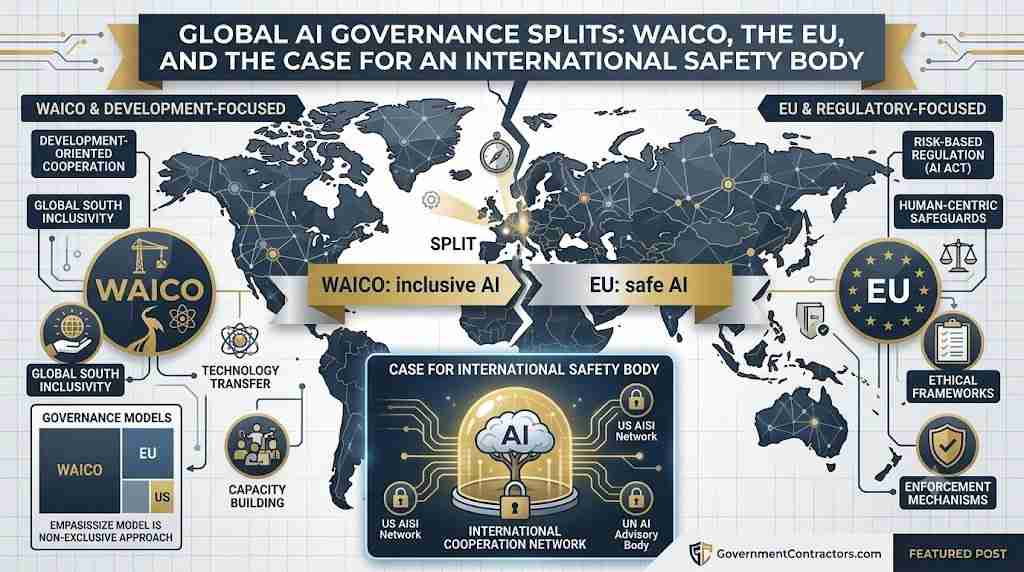
Global AI Governance Splits: WAICO, the EU, and the Case for an International Safety Body
EU AI Policy
- The European Commission ordered Google to open Android capabilities to competing AI assistants. Eleven Android functions must become accessible to qualified rivals, allowing users to invoke alternative assistants through voice commands and device actions. European Commission
- Google must share certain anonymized search-optimization data with AI-search competitors. The measure could help OpenAI and other providers compete with Google Search and Gemini.
- Privacy and security remain central to the dispute. Google argued that opening platform functions and search data could weaken safeguards; the Commission said access will be limited to providers meeting security and privacy requirements.
- EU members are preparing national AI regulatory sandboxes. Under the AI Act, member states must establish at least one national sandbox by August 2, 2026.
Chinese AI policy
- China led the creation of the World AI Cooperation Organization. Twenty-nine countries signed the agreement establishing a new international body for AI development and governance. Reuters
- President Xi Jinping promoted AI access as a global-development issue. China announced training programs and cooperation centers involving ASEAN, BRICS, the African Union, the Arab League, and other Global South partners. Reuters
- China emphasized open-source and domestically controlled AI infrastructure. Chinese companies displayed models and computing systems designed to reduce reliance on U.S. chips and technology.
- Apple Intelligence received regulatory registration in China. Apple’s localized service is expected to incorporate Alibaba’s Qwen and capabilities developed with Baidu. Reuters
Calls for an Independent International AI Safety Body
- Proposal Details: Google DeepMind CEO Demis Hassabis publicly urged international governments to establish a neutral, global safety framework to audit frontier AI models prior to commercial deployment.
- Governance Model: Modeled after international scientific and regulatory bodies (like the IAEA), the proposed agency would evaluate frontier models against standardized safety, alignment, and cybersecurity benchmarks.
- Strategic Takeaway: Leading AI labs are seeking synchronized global standards to establish clear compliance metrics and prevent regulatory fragmentation across international markets.
Global Regulation and Global Government
- Twenty-nine countries formed the World AI Cooperation Organization. The China-led initiative could become a counterweight to Western-led AI governance and technology alliances.
- China proposed AI training and cooperation programs for developing countries. The policy connects access to models and infrastructure with diplomatic and economic relationships.
- The EU used competition law to open Android and search data to AI rivals. This demonstrates that global AI governance extends beyond the AI Act into antitrust, platform access, data portability, and interoperability.
- Portugal joined an international health-AI regulatory network. Cross-border incident sharing may become increasingly important as the same AI tools are deployed in multiple healthcare systems.
- Governments are increasingly regulating AI infrastructure as well as algorithms. Data-center energy, water, chips, networks, and local community effects are becoming part of the global AI policy agenda.
Deep Dive
An international, independent AI safety body would serve as a global governance anchor—a hybrid institution drawing elements from the IAEA (inspection and verification), the IPCC (scientific evidence synthesis), CERN (pooled compute and frontier research), and INPO/FINRA (public-private industry standards enforcement).
What It Would Look Like (Structure & Mechanics)
To function effectively across jurisdictions, an international AI safety body would operate as a three-pillar architecture:
- The Scientific & Evaluation Body (The Engine): An independent, world-class technical cadre with direct access to pre-release frontier model checkpoints, weights, and high-performance compute clusters. Rather than relying on static benchmarks, it would conduct dynamic evaluations probing for dangerous capabilities—such as autonomous cyber-exploit generation, biological/radiological synthesis assistance, self-replication, and deceptive alignment.
- The Public-Private Standards Panel: A mechanism (similar to Wall Street’s FINRA or the nuclear sector’s INPO) where commercial labs, open-source communities, and national labs collaborate to define dynamic testing protocols. Capability thresholds would update continuously as compute and architecture evolve.
- The Intergovernmental Council (The Enforcement Arm): Representatives from participating member states tasked with codifying the body’s scientific evaluations into binding national laws, market access requirements, and mutual recognition agreements.
Why It Matters
- Resolving the Information Asymmetry: Currently, frontier AI labs hold a monopoly on visibility into raw model capabilities and tail-risk failure modes. Governments and enterprise buyers lack the technical talent and compute necessary to independently verify lab safety claims.
- Extraterritorial Risk Mitigation: AI-driven threats ignore borders. A catastrophic cyber attack or automated pathogen design generated in one country poses an immediate global threat (“an accident anywhere is an accident everywhere”).
- Preventing Regulatory Fragmentation: Without a unified global baseline, companies face an unworkable patchwork of conflicting national rules, while rogue jurisdictions offer “safety havens” for unvetted, high-risk deployments.
Why It Would Succeed
- Shared Universal Risk Alignment: Unlike ideological or territorial disputes, key global powers and leading lab developers share a fundamental interest in preventing loss of control over autonomous systems, critical infrastructure collapse, and bioweapon proliferation.
- Market-Driven Enablers: A trusted international stamp of approval would serve as a prerequisite for enterprise insurance, sovereign procurement, and global commercial deployment, giving frontier labs a direct financial incentive to comply.
- Aggregated Talent & Compute: Top-tier alignment and red-teaming researchers rarely want to work inside traditional government bureaucracies. An independent, high-status global institution with dedicated state-of-the-art compute would attract elite technical talent away from purely commercial incentives.
Why It Would Fail
- Geopolitical Rivalry & Fragmentation: Great Power competition presents a massive hurdle. Western framework efforts often clash with alternative blocs promoting open-source architectures and localized training networks (such as China’s WAICO initiatives). Nations suspicious of technological containment will resist sharing weights or granting oversight to foreign-dominated bodies.
- Regulatory Capture & Innovation Moats: Incumbent tech giants could weaponize complex testing regimes to lock out open-weight developers, startups, and academic institutions, transforming safety evaluations into an insurmountable barrier to entry.
- Velocity Mismatch (Bureaucracy vs. Technology): Multilateral treaties and consensus-driven scientific reviews typically operate on multi-year cycles. Frontier AI capability jumps occur in months, threatening to render static governance frameworks obsolete before they are ratified.
- Enforcement & the “Paper Tiger” Trap: Without sovereign statutory power to enforce pre-deployment blocks, hold back model weights, or sanction non-compliant actors, the body risks devolving into an advisory forum that produces ignored papers while a high-risk capability race continues unabated.